Home · Sights · Santa Anastasia
The great Dominican church near the Adige, with Pisanello's Saint George above a chapel arch and two stone hunchbacks holding the holy water.
The parts to look at
The Dominicans' great church
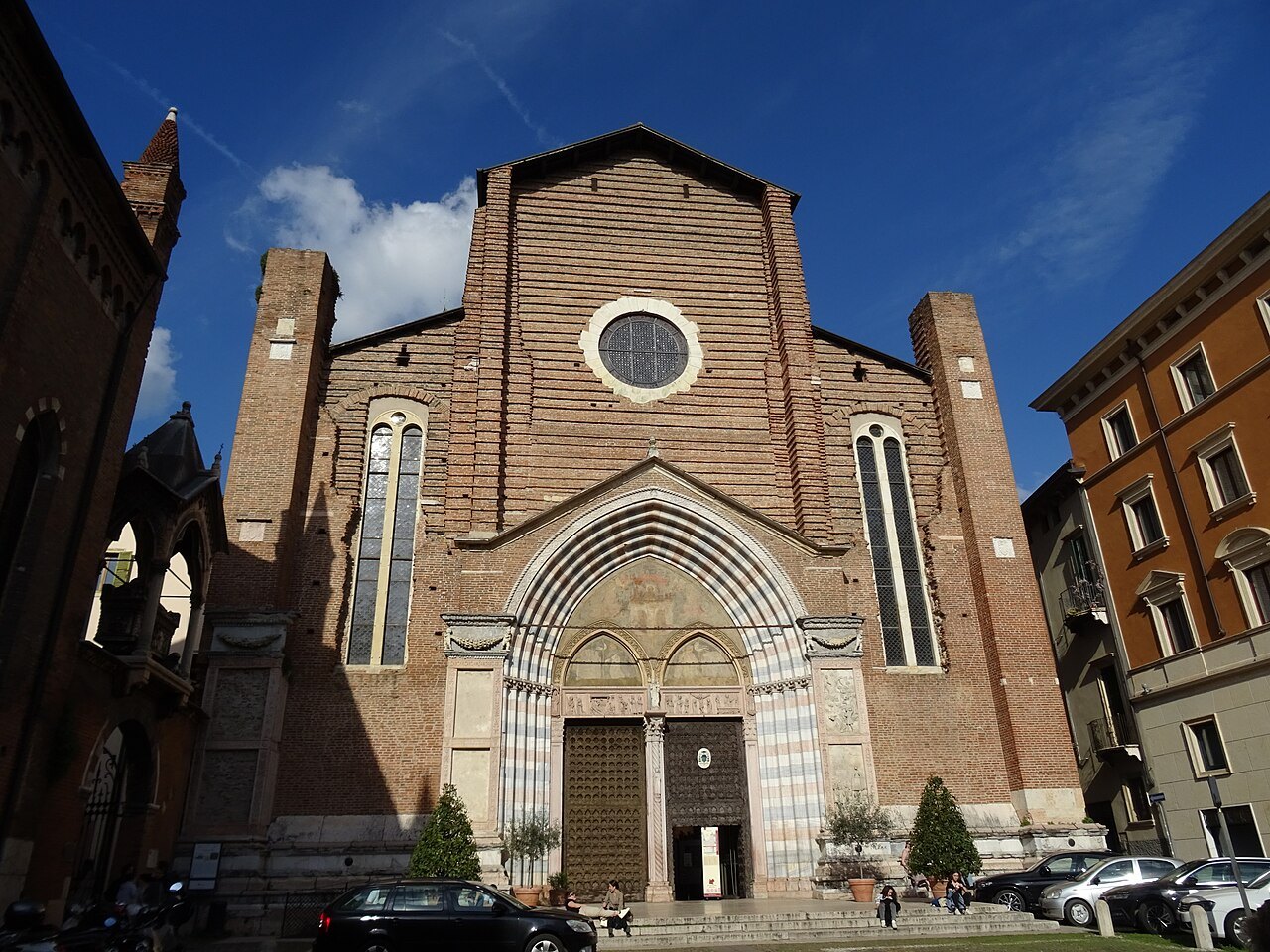
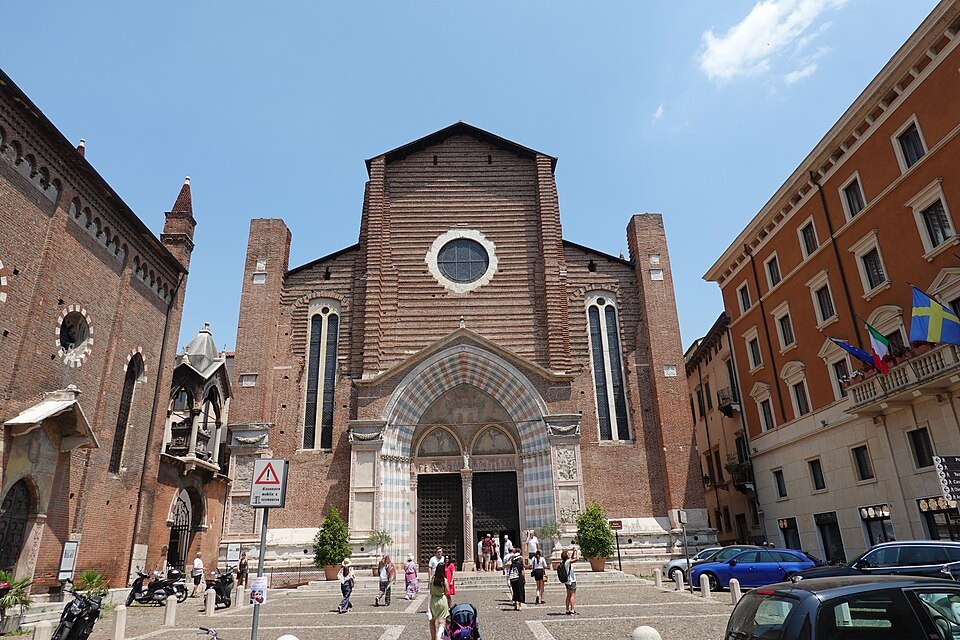
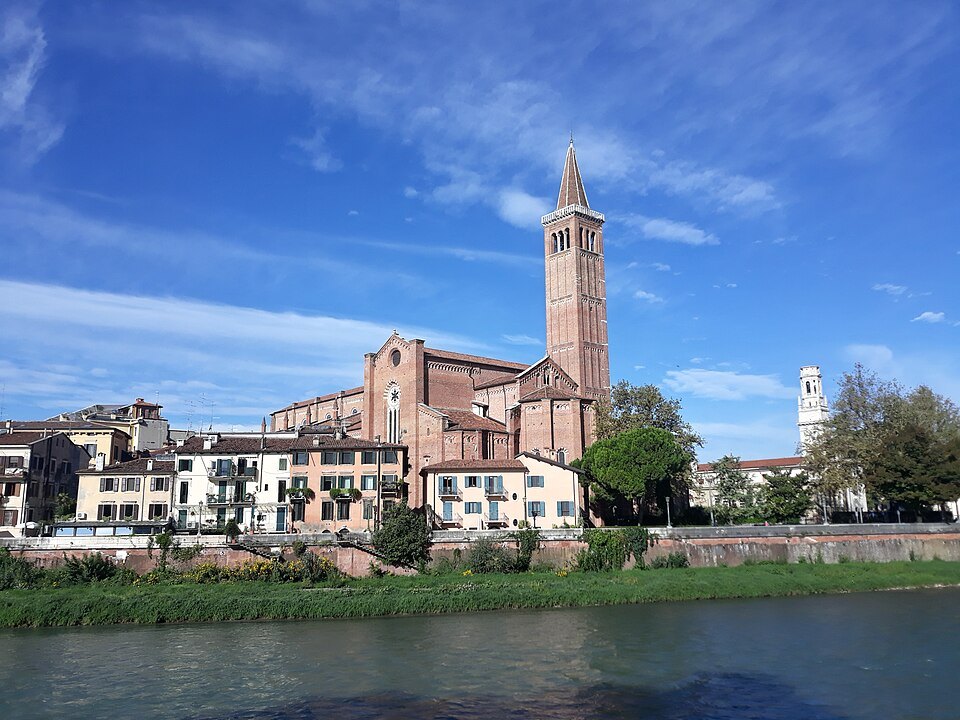
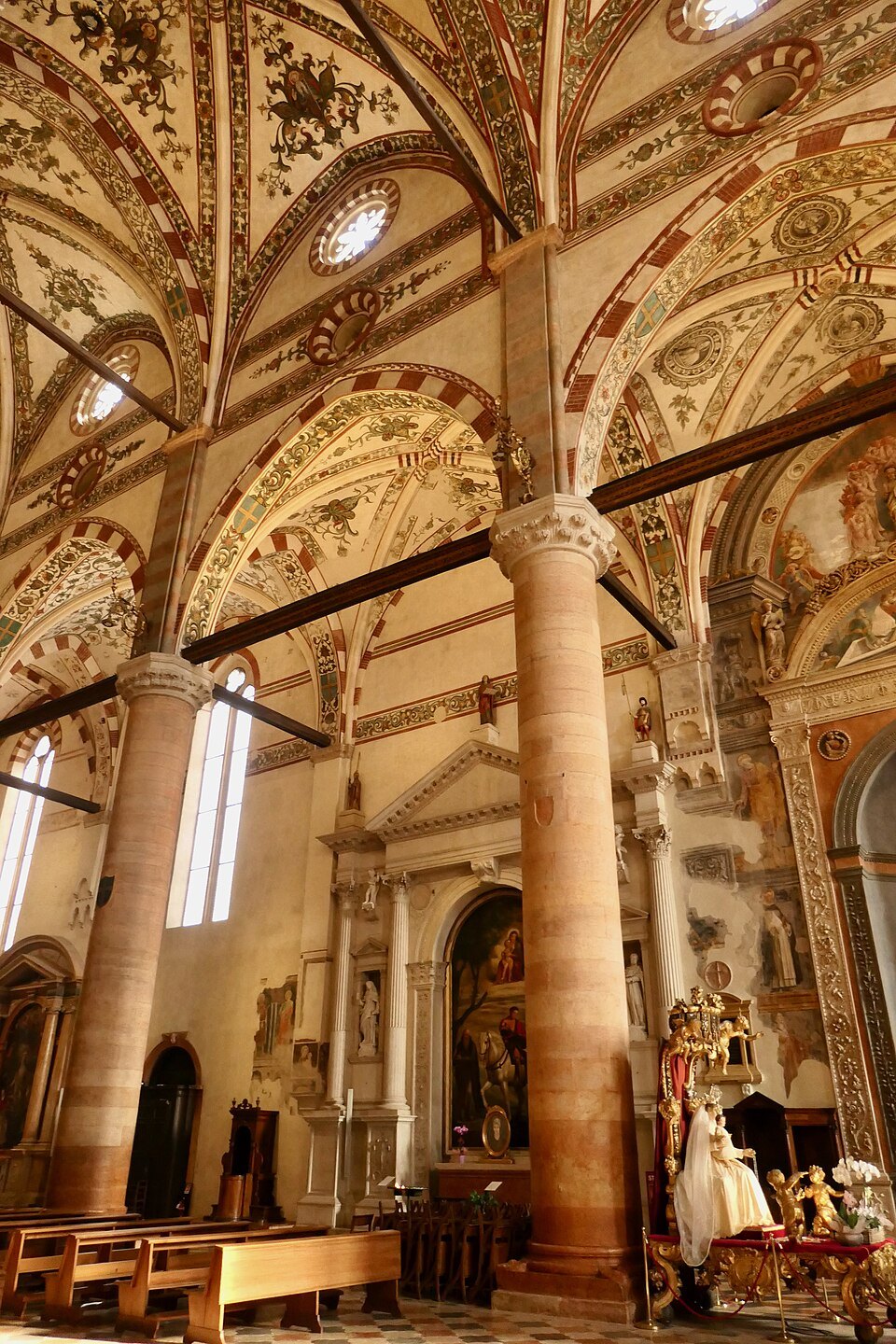
Santa Anastasia is the largest Gothic church in Verona, built by the Dominican friars near the Adige a few steps from the Scaliger tombs. Its bare brick front gives little warning of the interior: tall columns of red and white marble, painted vaults, a floor laid like a carpet, and one of the most admired paintings of the late Gothic age.
It is also a church with a sense of humor. Two small marble hunchbacks crouch under the holy-water basins by the entrance, and they are often the first thing visitors photograph. Between those figures and Pisanello's fresco near the altar, an hour passes easily.
From friary to basilica
The Dominicans arrived in Verona around 1220 and first settled outside the walls. In 1260 Bishop Manfredo Roberti gave them land in the city, where an older church dedicated to Saint Anastasia already stood. Work on the present building began in 1290 and ran on for more than a century, with generous support from the della Scala family who ruled the city.
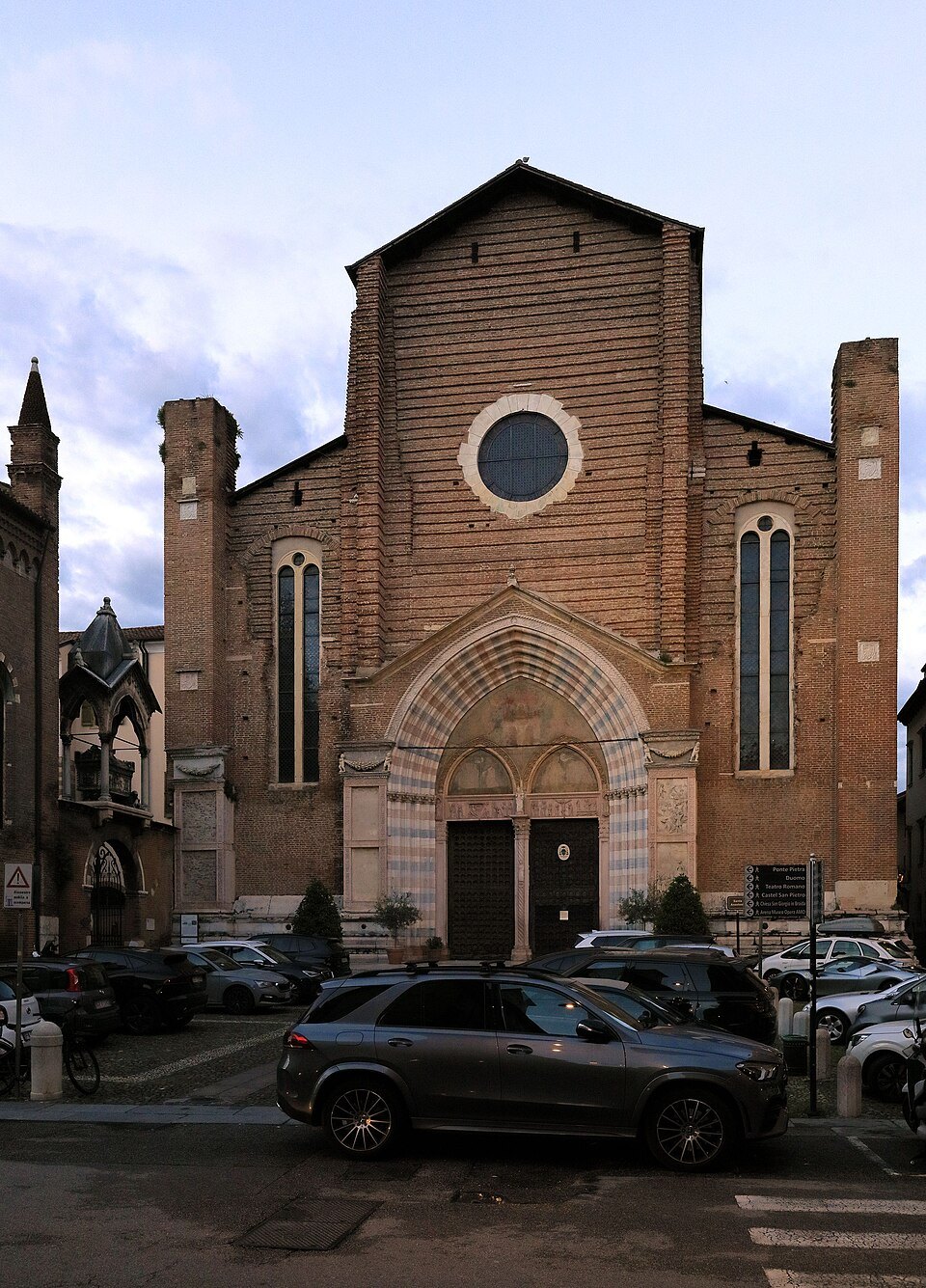
The new church was dedicated to the Dominican martyr Saint Peter of Verona, but the old name never let go, and everyone still calls it Santa Anastasia. It was consecrated on 22 October 1471. The facade was never finished, which is why most of it is plain brick.
The facade and the tower
The one finished part of the front is the portal, a wide pointed marble arch over twin doors with columns in red, white and black stone. Its carved panels are read by some sources as scenes from the life of Saint Peter Martyr and by others as stories of Christ with Dominican saints; the frescoed lunette shows the Trinity. Look at the contrast between this carved and polished frame and the rough brick around it: the rest of the facade was simply never clad.
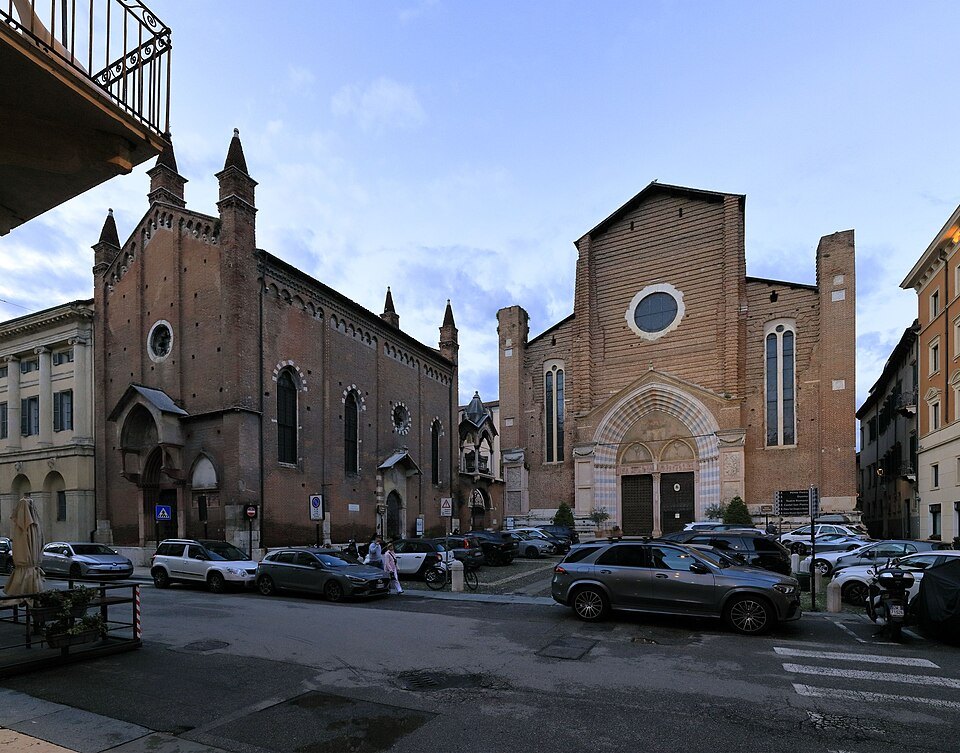
Beside the left transept rises the brick bell tower, about 72 meters high, divided into levels by bands of white stone and finished with a conical terracotta spire. Outside, the tomb of Guglielmo da Castelbarco, a patron who died in 1320 and left money for the building, stands under its canopy near the church.
Gobbi, floor and vaults
Just inside, at the first pair of columns, two crouching figures carry the holy-water basins on their backs. The one on the left is attributed to Gabriele Caliari, father of the painter Paolo Veronese, and was placed in 1491. The one on the right, attributed to Paolo Orefice, was added at Easter 1591, and its local nickname comes from that feast. Folk tradition says touching a hump brings luck.
Then look down. The floor is still the original paving of white, black and red stone; most sources date it to 1462 under Pietro da Porlezza, while the city's tourism site gives an earlier date in the same century. The colors are often read as the white and black of the Dominican habit.
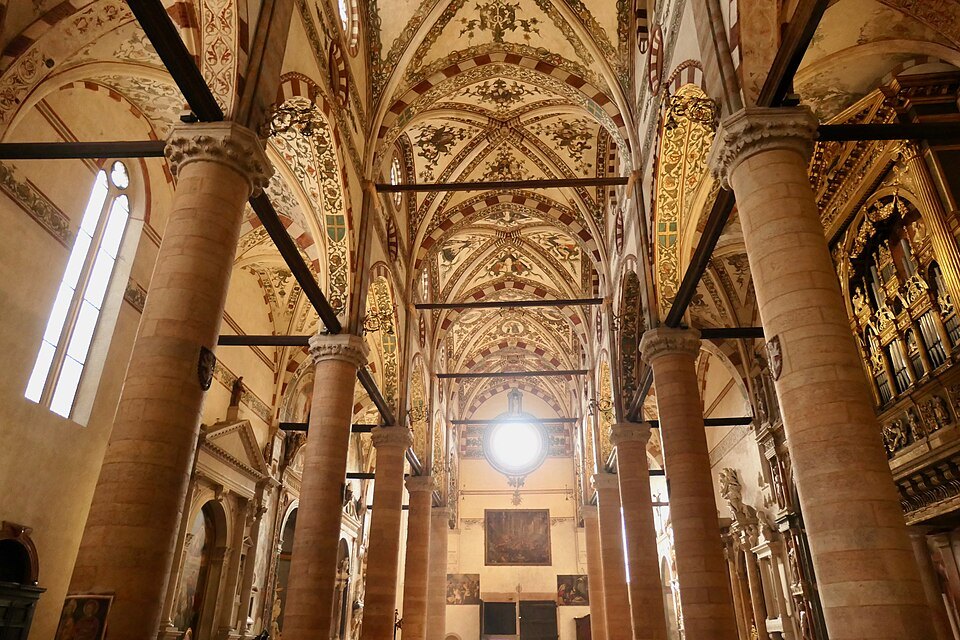
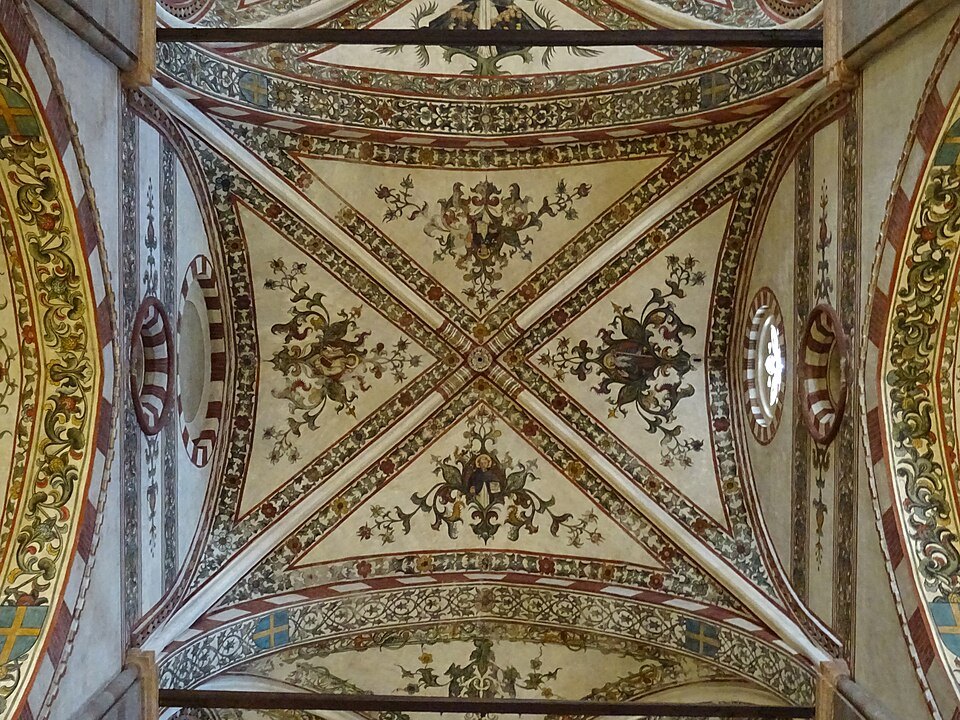
Finally look up. The three naves are covered by ribbed cross vaults, and on the vaults and walls of the transept and chapels survives a painted decoration of vine scrolls and ornamental motifs, pinwheels and shaded discs on the light plaster, with the della Scala arms on the main arch.
Pisanello's Saint George
The Pellegrini chapel sits to the right of the main chapel. Inside, terracotta reliefs by Michele da Firenze show episodes from the life of Christ, paid for through a bequest of Andrea Pellegrini, who died in 1429. Above the entrance arch, on the outside wall, is Pisanello's fresco of Saint George and the Princess, painted between about 1433 and 1438.
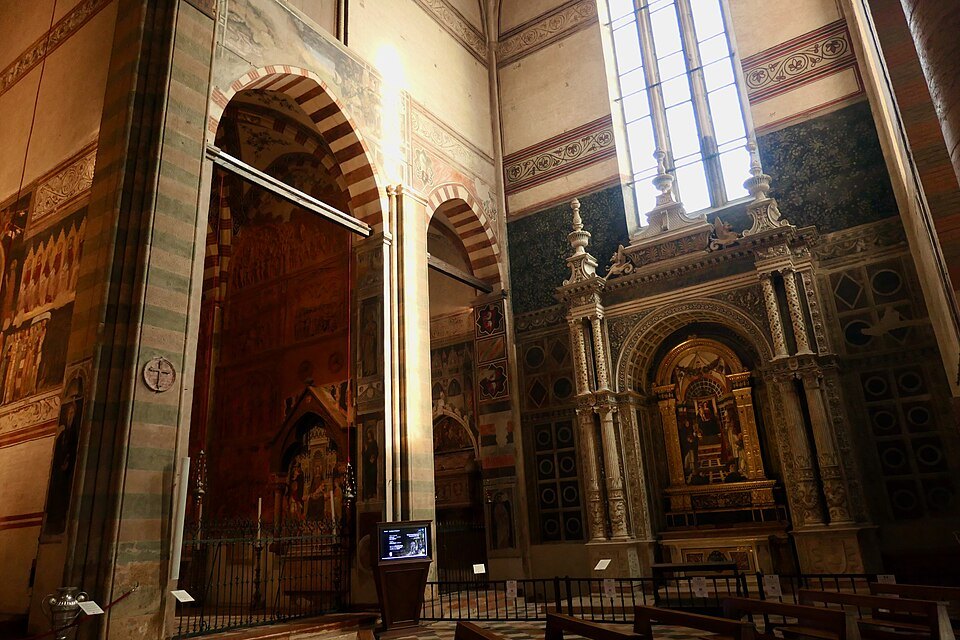
Water from the roof destroyed the left side, where the dragon was. What survives shows the saint about to mount his white horse, seen from behind, the princess in profile with a fashionable high hairline, knights, dogs and a ram, and a towered city with two hanged men near its gate. The fresco was detached in the nineteenth century and returned to its original place in 1996.
Other chapels
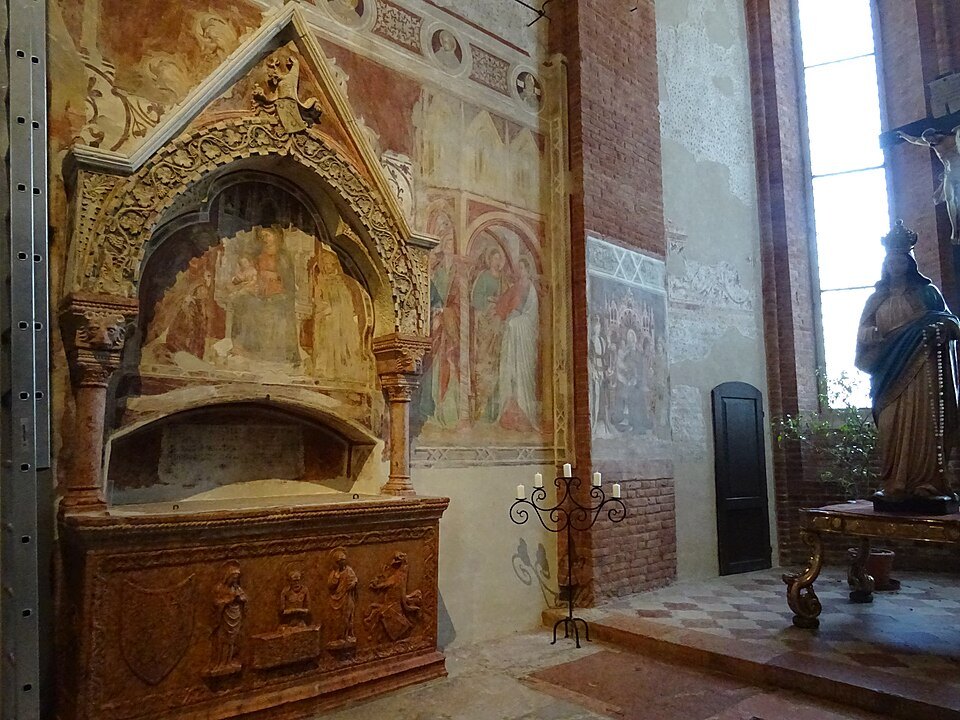
In the Cavalli chapel, Altichiero painted knights of the Cavalli family presented to the Virgin, his only documented work in Verona, dated around the later fourteenth century. The Cortesia Serego monument shows a knight on horseback in marble by the Florentine sculptor Pietro di Niccolò Lamberti.
Farther along, the Fregoso altar of 1565 by Danese Cattaneo, praised by Giorgio Vasari, commemorates the Genoese commander Giano Fregoso. The side chapels also hold work by Liberale da Verona and Falconetto.
How to visit
Santa Anastasia is one of four historic churches in the city managed for visitors by the Chiese Vive association, alongside the Duomo, San Zeno and San Fermo. Visitors buy either a ticket for a single church or a combined card covering all four; the association's website, chieseverona.it, lists the arrangements and visiting times, which change with the season.
Note Tourist visits pause during services, so check the schedule before crossing town. Allow about an hour to see the gobbi, the floor, the chapels and the fresco properly; bring binoculars or a zoom lens for Pisanello, which is high on the wall.
The church pairs well with the Scaliger tombs and Piazza dei Signori a few minutes away, and with a walk down to Ponte Pietra on the river.
Nearby
- Inside the loopThe Scaliger TombsThe Gothic tombs of the della Scala family, raised on canopies beside the little church of Santa Maria Antica…Read the page
- Inside the loopPiazza dei SignoriThe enclosed square where Verona was governed for centuries, ringed by linked palaces, a Renaissance council…Read the page
- Over Ponte PietraPonte PietraVerona's oldest bridge, begun by the Romans and patched by every age since, then blown apart in 1945 and…Read the page
- Inside the loopThe DuomoVerona's cathedral complex layers a Romanesque church, a Titian altarpiece, a cloister, a baptistery and…Read the page