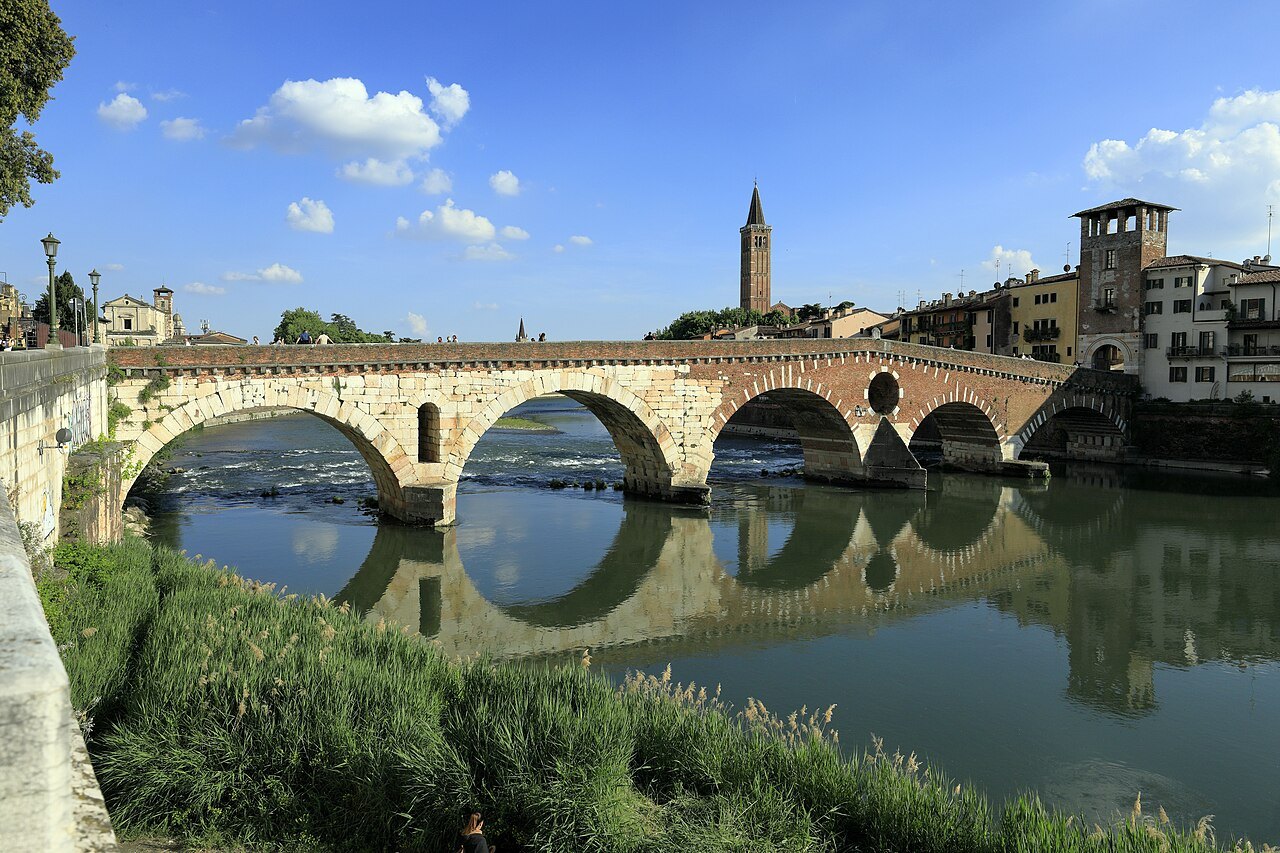
Verona's oldest bridge, begun by the Romans and patched by every age since, then blown apart in 1945 and rebuilt from stones lifted out of the river.
The parts to look at
- 1City-side towerThe brick tower at the end nearest the cathedral quarter, standing over the right-bank abutment
- 2Brick central archesThe middle spans, rebuilt in brick in medieval and Venetian times after floods
- 3Roman archesThe two arches towards the theater bank, faced in large pale blocks of Roman stonework
- 4Mid-span parapetThe best standing point for the view upstream, downstream and up the hill
- 5Left-bank landingWhere the bridge meets the Roman theater, the stairs and the funicular up the hill
- 6Riverside embankmentsThe stone quays on both banks, with the full profile of the arches from below
Along the Adige, in the order you meet them.
The bridge that has always been here
Ponte Pietra, the Stone Bridge, crosses the Adige at the top of the loop that holds the old city. It is the oldest bridge in Verona, and for a visitor it is also the hinge of the city: on one side the lanes around the cathedral, on the other the Roman theater climbing the hill towards Castel San Pietro.
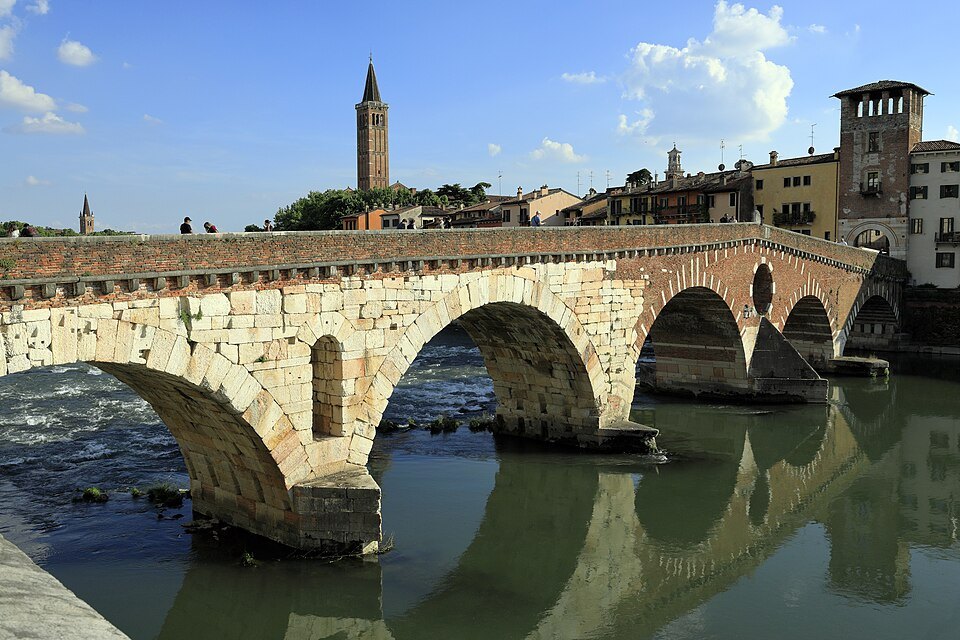
Its appeal is that it wears its history openly. Roman stone blocks, medieval brick and a postwar reconstruction sit side by side in five arches, and the patchwork is easy to read once you know what to look for. Few places in Verona show so plainly how the city has been damaged and repaired.
Roman beginnings
The English Wikipedia dates the bridge's completion to about 100 BC and gives its Latin name as Pons Lapideus; the Italian account links it to the Via Postumia, the Roman road laid out in 148 BC between Genoa and Aquileia, which crossed the river here. Sources agree it was the road bridge of Roman Verona.
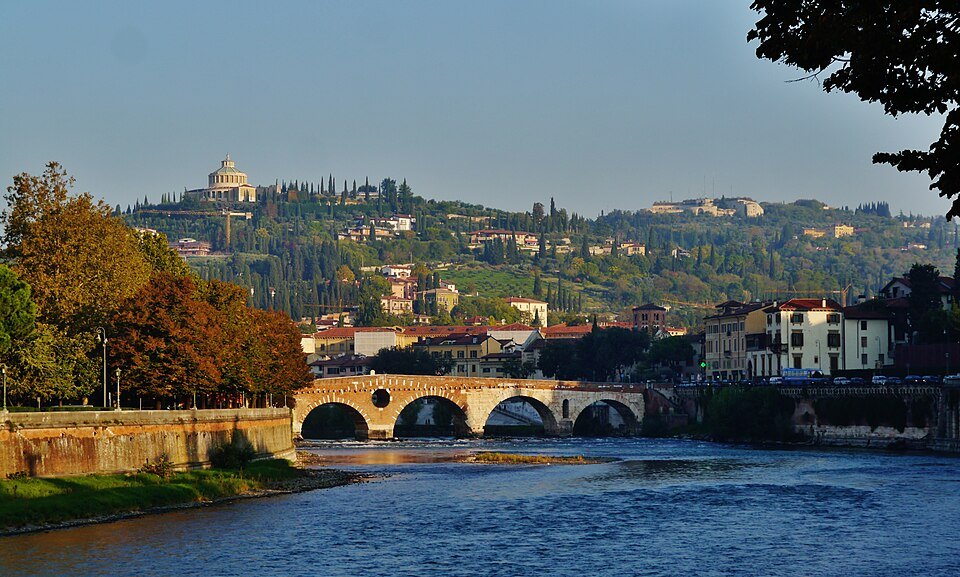
A second Roman bridge, the Pons Postumius, stood a little downstream. Before the theater was built on the hillside opposite, walls were raised along the Adige between the two bridges to protect the slope from floods, which tells you how close the river came to this part of the city.
According to the Italian account, the Roman bridge stood on four piers carrying five arches, each spanning fifteen or sixteen meters. Later builders kept that rhythm, so even where the fabric is medieval or modern, the proportions a visitor walks across are essentially Roman ones.
Floods, Scaligers and Venice
The Adige repeatedly damaged the bridge. The Italian record lists serious floods in 1007, 1153, 1232 and 1239. In 1298 Alberto I della Scala had work done on it; some sources say he rebuilt an arch, others describe a restoration of the tower. In 1368 Cansignorio della Scala ran an aqueduct across it.
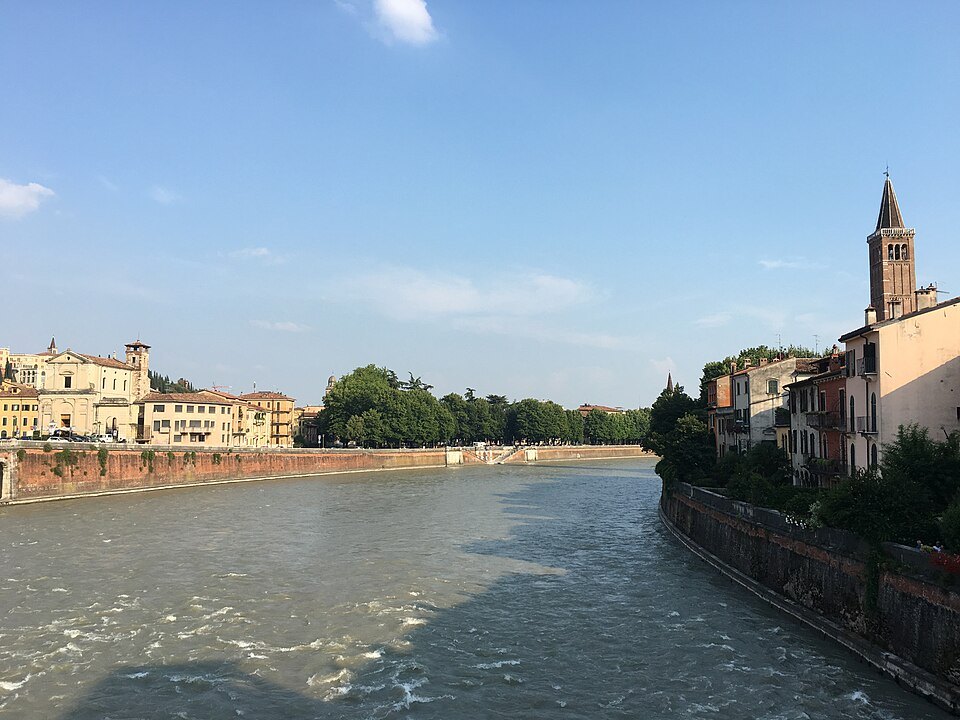
A rebuilding begun in 1503 partly collapsed. In 1508 the city council asked the friar and architect Fra Giocondo to oversee the works, and reconstruction went ahead from 1520. The result tied the medieval spans to the surviving Roman arches, and the bridge kept that form for more than four centuries.
Blown up in 1945, rebuilt from the river
On 24 April 1945 retreating German soldiers mined the bridge and set off the charges, on the same day that the castle bridge at Castelvecchio was destroyed. Only one arch came through intact; accounts differ on which one, the English Wikipedia naming the far left arch and the Italian the arch towards the city.
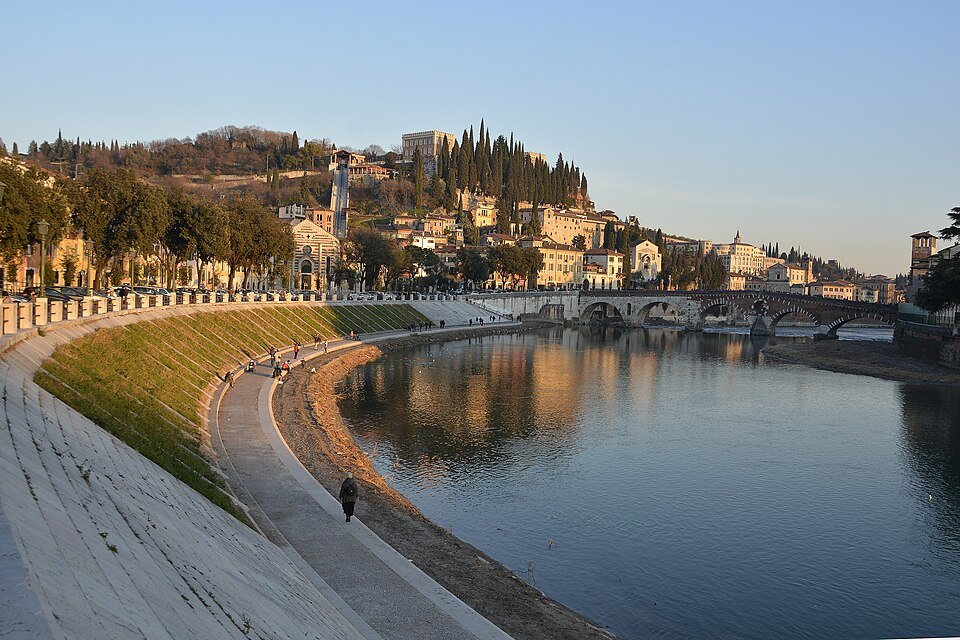
Reconstruction started on 4 February 1957 and ended on 3 March 1959. Rather than build a new bridge, the engineers pulled the fallen masonry out of the Adige: according to the Italian account, 529 stone blocks were recovered, and a further 379 stones were worked back into the structure. The method is anastylosis, putting original pieces back in their places.
That is why the bridge looks old rather than restored. The pale Roman blocks are, in large part, the same stones that stood here before the war, lifted from the riverbed and set back in their original positions, with the gaps made up so the crossing could be used again. Roughly fourteen years passed between the explosion and the reopening.
What you actually see
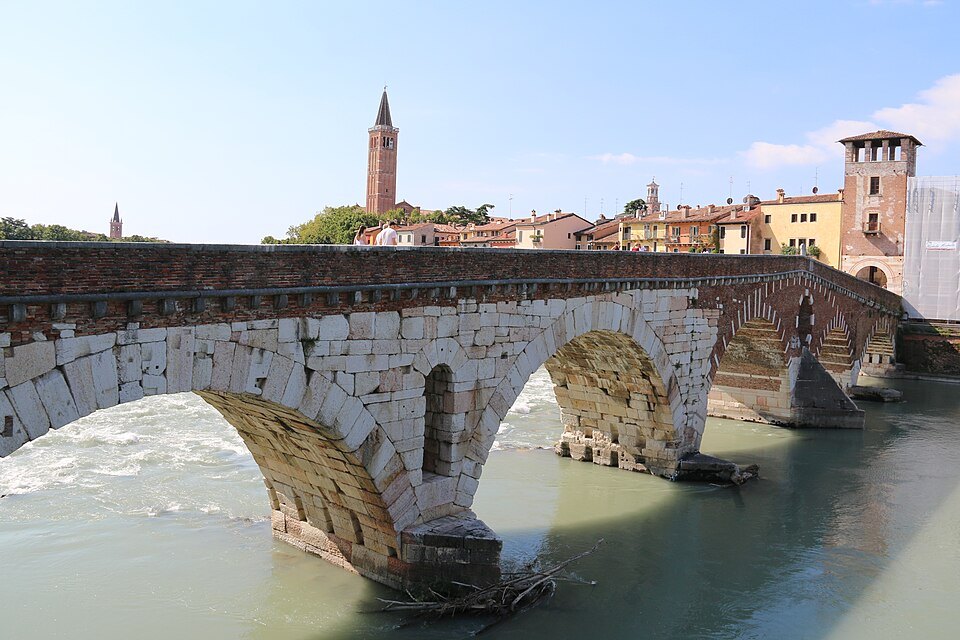
Start on the city side. The tower over the right-bank abutment is medieval in origin, and the arches next to it, like the central ones, are brick. Walk towards the theater and the masonry changes: the Italian account places the Roman abutment and the two arches on the countryside side, built of large squared stone blocks in the Roman technique known as opus quadratum.
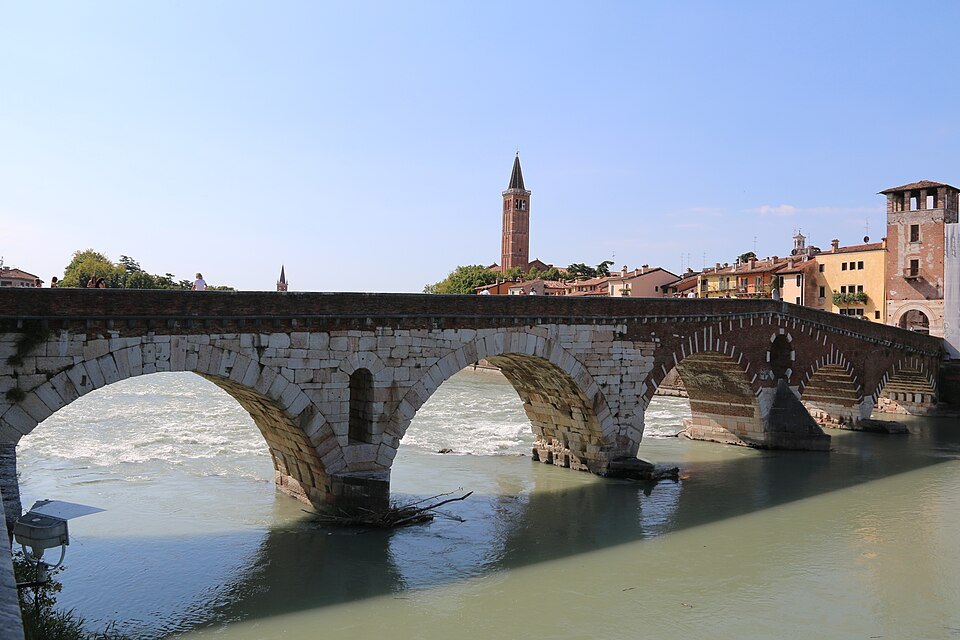
Stop in the middle and look around. Across the water the seating of the Roman theater rises in terraces, with the barracks of Castel San Pietro on the summit. Behind, the quarter of the cathedral begins a few streets from the bridge.
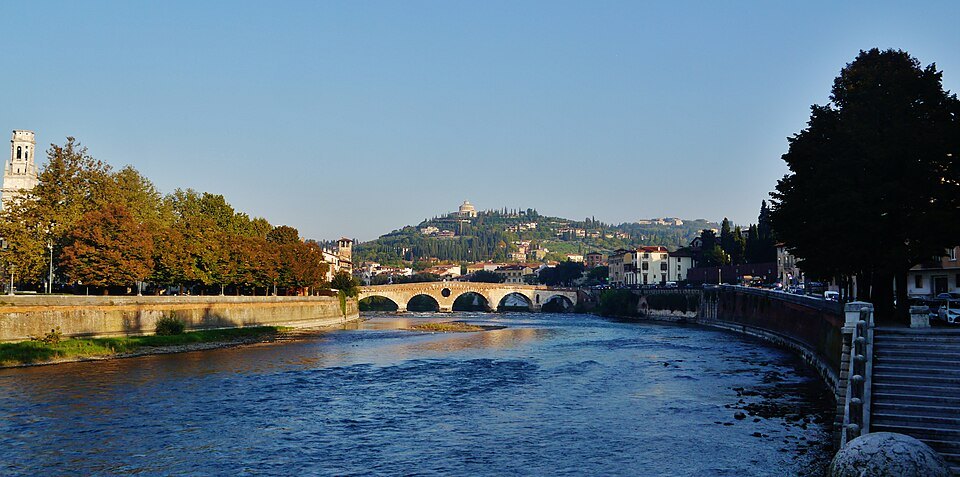
For the full profile, go down to the riverside embankment on either bank. From below, the difference between the brick and stone arches is clearest, and so is the width of the Adige here.
How to visit
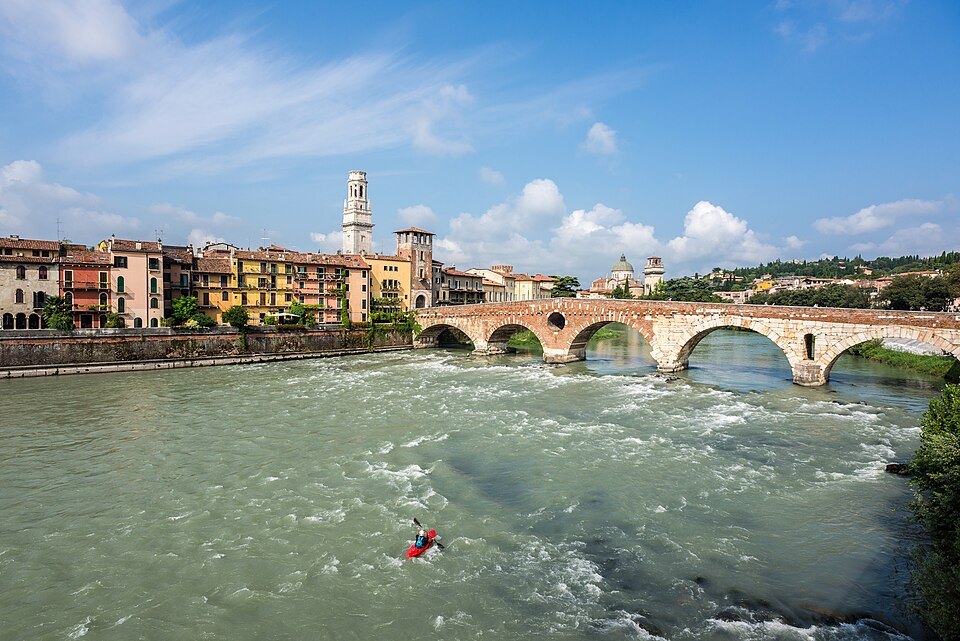
The bridge itself takes ten minutes, but it works best as the start of a half day on the left bank: the Roman theater and its museum, then the stairs or the funicular up to Castel San Pietro for the view. The walk from Piazza Erbe takes about ten minutes through the lanes past Sant'Anastasia.
Note The bridge is narrow, and around sunset it fills with people photographing the river and the hill. Light is softest early in the morning, when the embankments are quiet. For the story of the city's other Roman remains, see Roman Verona.
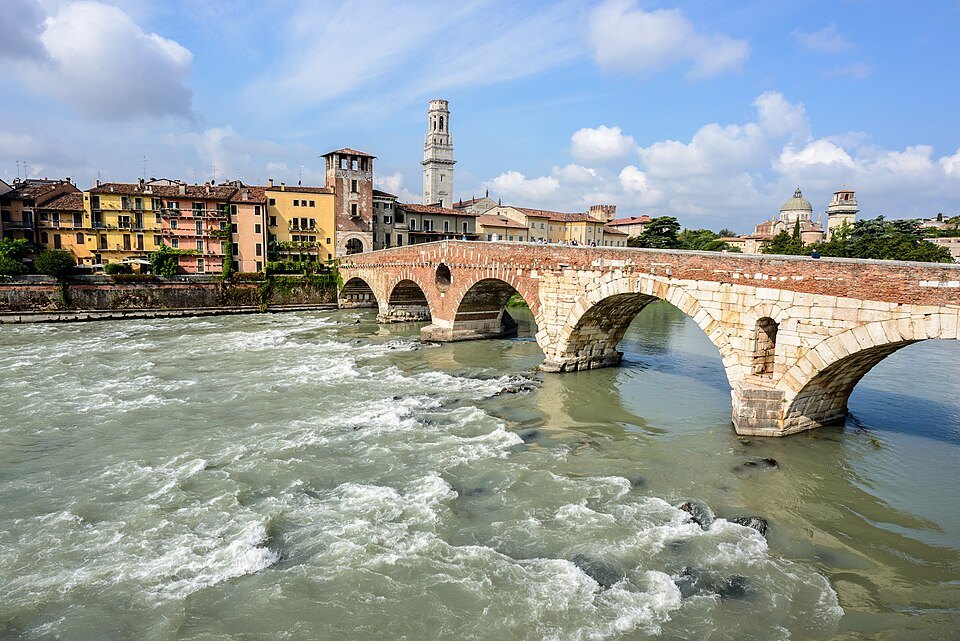
The two rebuilt bridges make a good pair. The Ponte Scaligero at Castelvecchio, blown up the same April day, was also put back together with stone recovered from the riverbed, but in brick-and-battlement form. Crossing both in one walk along the Adige shows two very different answers to the same wartime loss.
Nearby
- Over Ponte PietraThe Roman TheatreA Roman theater cut into the slope across the Adige, with a medieval church sitting in its seating and an…Read the page
- Over Ponte PietraCastel San PietroThe hill above the Roman theater, crowned by Austrian barracks, where a terrace looks straight down on the…Read the page
- Inside the loopThe DuomoVerona's cathedral complex layers a Romanesque church, a Titian altarpiece, a cloister, a baptistery and…Read the page
- Inside the loopSant'AnastasiaThe great Dominican church near the Adige, with Pisanello's Saint George above a chapel arch and two stone…Read the page