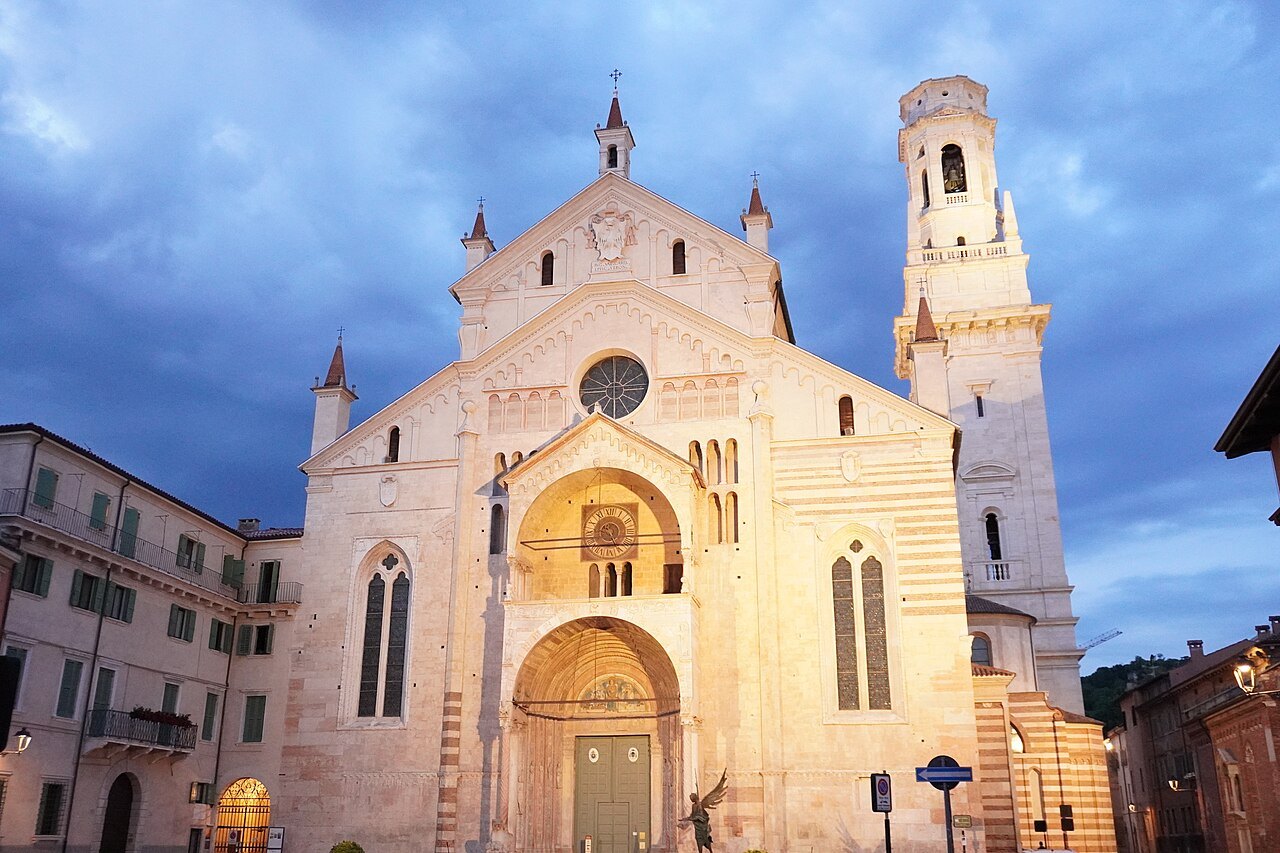
Verona's cathedral complex layers a Romanesque church, a Titian altarpiece, a cloister, a baptistery and early Christian mosaics into one quiet corner of the old town.
The parts to look at
More than a cathedral
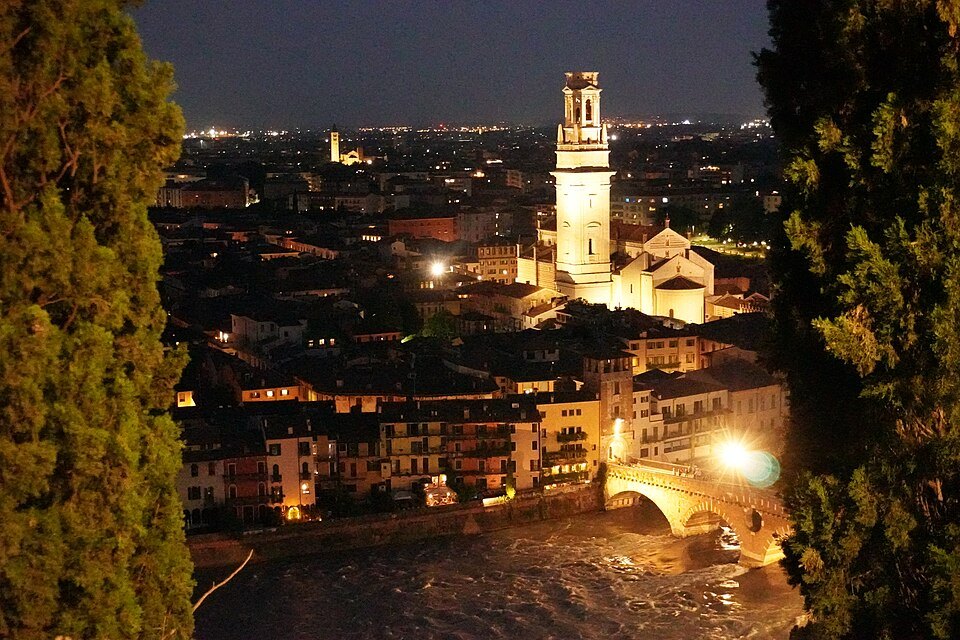
The Duomo, dedicated to Santa Maria Matricolare, is not one building but a cluster. Around the cathedral stand a Romanesque cloister, the baptistery of San Giovanni in Fonte, the little church of Sant'Elena, the Biblioteca Capitolare and the bishop's palace, all in a quiet corner of the old town close to the Adige.
A visitor gets several eras in a single stop: the mosaic floors of the first Christian churches, twelfth-century sculpture, a Gothic interior and one of Titian's great altarpieces. It is also one of the calmer major sights in the center, which makes it a good place to slow down.
Churches on churches
In Roman times the site held houses with private baths. In the fourth century a first Christian basilica with three naves was built where Sant'Elena now stands, later given raised floors covered in fine mosaics. A second, larger basilica followed at the end of the fifth century. In the eighth and ninth centuries the archdeacon Pacifico directed a rebuilding, and the church became known as Santa Maria Matricolare.
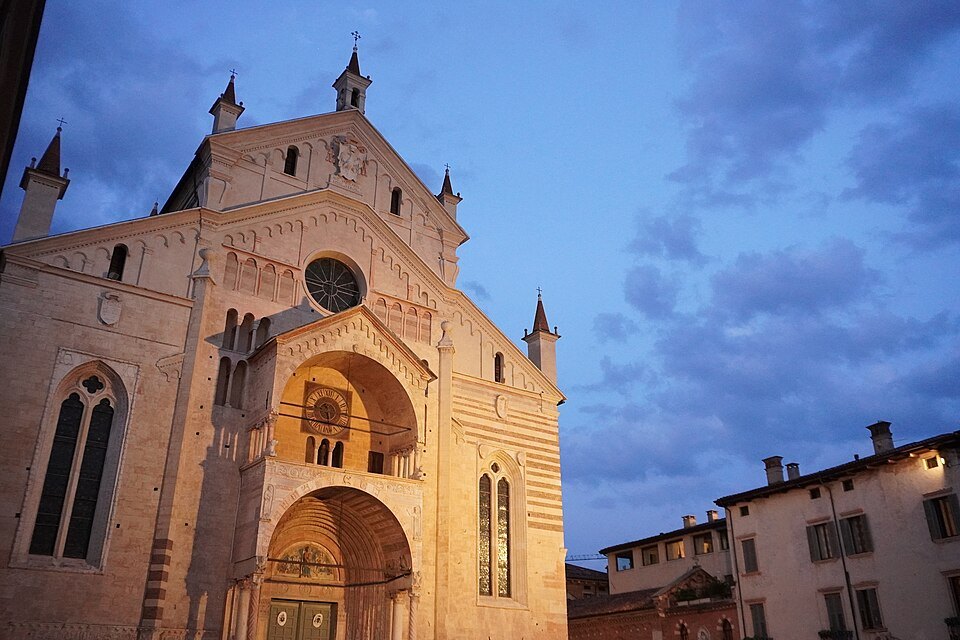
The earthquake of 1117 badly damaged the complex. Reconstruction began soon after in Romanesque style, and Pope Urban III consecrated the new cathedral on 13 September 1187. In the fifteenth century the interior was remade in Gothic form, the naves were raised, and side chapels were added through the following century.
The front door
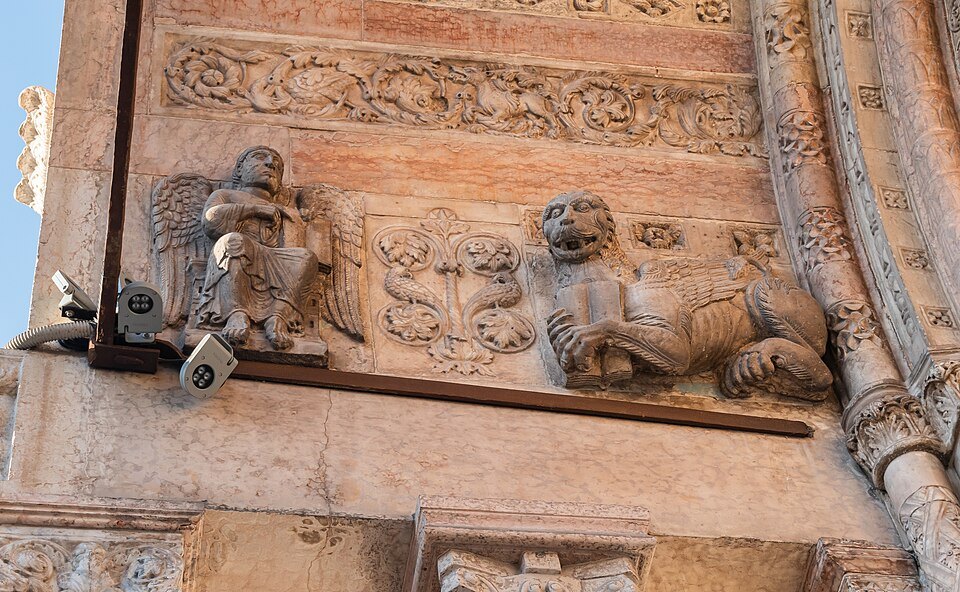
Before going in, spend time at the main portal. The sculptor Nicholaus, who also worked at San Zeno, built a two-storey porch whose twisted columns rest on the backs of griffins. In the lunette sit the Virgin and Child, flanked by the Annunciation to the Shepherds and the Adoration of the Magi.
Ten prophets stand along the doorposts, and beside the doorway are the paladins Roland and Oliver, the heroes of medieval epic, as if placed there to guard the church. The bell tower has a Romanesque base and a Renaissance shaft, finished with an octagonal bell chamber only in 1925.
Inside: Titian and the choir
The nave and aisles are divided by pillars of red Verona marble carrying Gothic arches, and the first three chapels on each side are framed with Renaissance painting and architecture by Veronese artists. In the first chapel on the left hangs Titian's Assumption of the Virgin, commissioned by the Nichesola family; sources date it variously between about 1530 and 1535.
It is the reason many visitors come, so give it a few quiet minutes. At the end of the nave stands the semicircular marble choir screen credited to Michele Sanmicheli, and behind it the apse, painted in 1534 by Francesco Torbido with biblical scenes from cartoons by Giulio Romano.
Cloister, baptistery and Sant'Elena
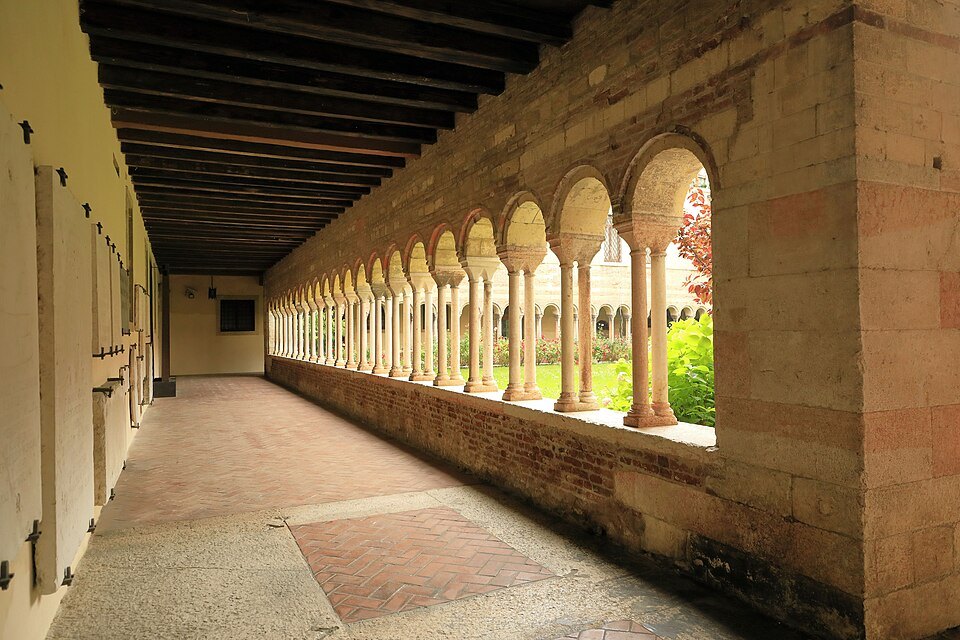
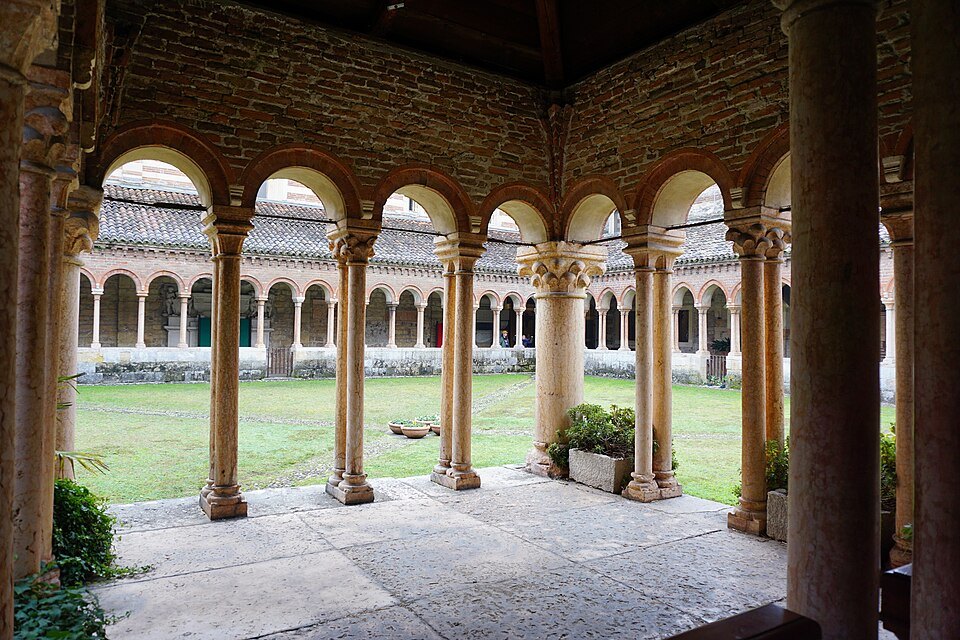
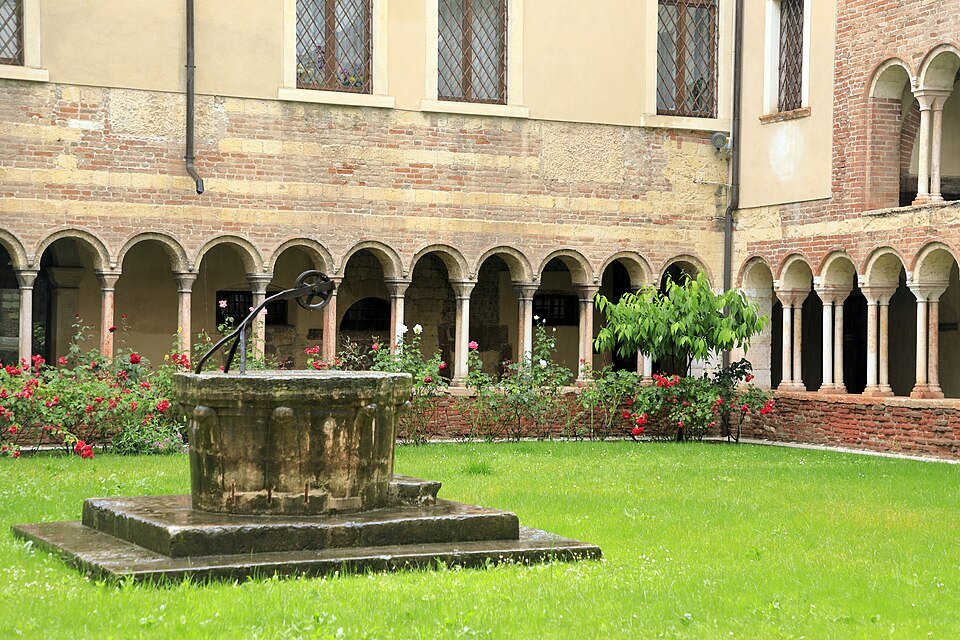
The Chiostro dei Canonici, the canons' cloister, was built in the first half of the twelfth century on the ruins of the early basilicas. Its round arches rest on pairs of slender red marble columns, and along one side the arcades are doubled, one above the other. Look down as well: stretches of the early Christian mosaic floors are visible in the cloister.
San Giovanni in Fonte, the baptistery, goes back to the Lombard era and was rebuilt from 1123 under Bishop Bernardo. Its centerpiece is the octagonal font of the late twelfth century, carved from a single block of marble so large that the building may have been finished around it. Eight faces show scenes from the Annunciation to the Baptism of Christ; the carving is attributed to Brioloto and his workshop, though scholars disagree on how much is his.
Sant'Elena preserves under its presbytery the foundations of the first basilica's apse and fragments of its mosaic floor, uncovered in excavations in the 1960s and 1970s. On 20 January 1320 Dante gave his Latin lecture, the Quaestio de aqua et terra, in this church, as an inscription on its front records.
The canons' library
Beside the cloister is the Biblioteca Capitolare, the chapter library of the cathedral canons. It is often described as the oldest library in the world still in continuous use. That is a claim made for it rather than a settled ranking, but it gives a sense of how long the canons have kept books and learning on this site.
The library is its own institution rather than part of a church visit, so anyone hoping to see inside should look up its arrangements in advance. For most visitors, knowing it is there adds depth to a walk around the cloister next door.
How to visit
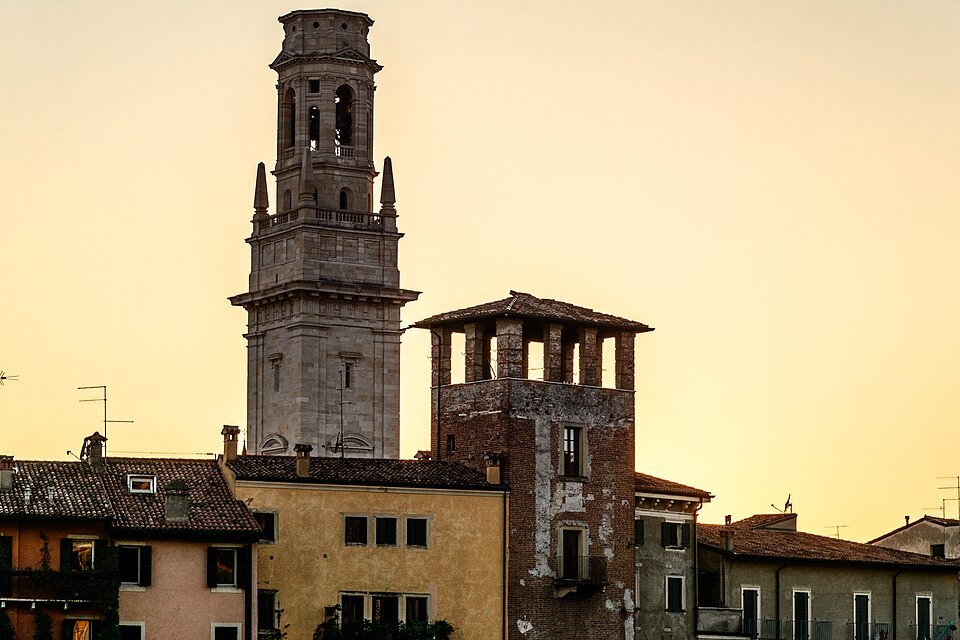
The cathedral complex is one of four historic churches handled for visitors by the Chiese Vive association, with Santa Anastasia, San Zeno and San Fermo. There is a ticket for a single church and a combined card for all four; chieseverona.it lists the details and the visiting times, which vary by day of the week and pause for services.
Note The cloister, baptistery and Sant'Elena are visited as part of the complex, so confirm which parts can be entered on the day. Allow an hour to an hour and a half to see the portal, Titian, the cloister mosaics and the font without hurrying.
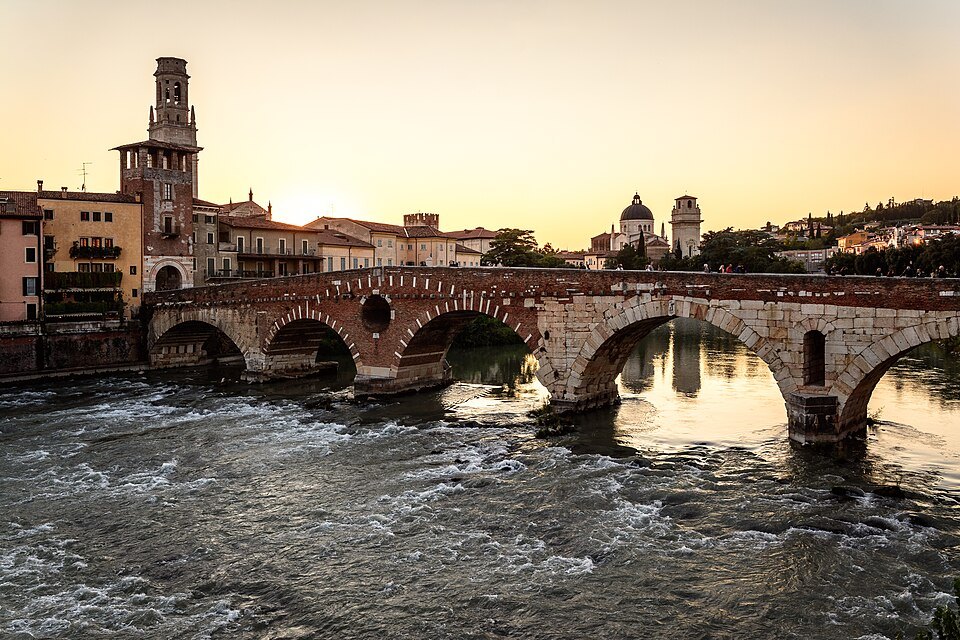
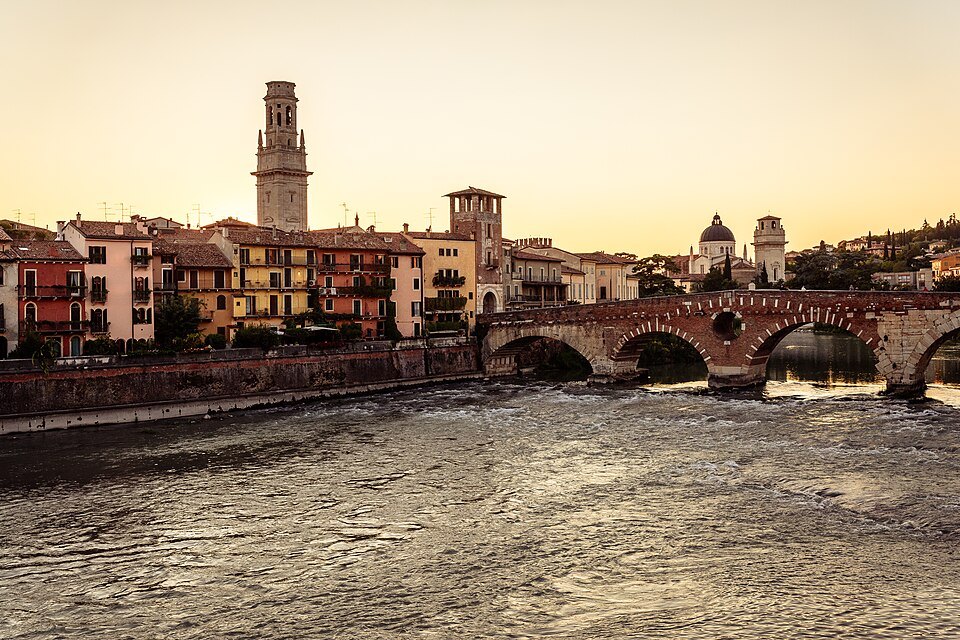
The Duomo sits a few minutes' walk from Ponte Pietra; cross the bridge to reach the Roman theater, or head back toward Santa Anastasia and the squares of the center.
Nearby
- Over Ponte PietraPonte PietraVerona's oldest bridge, begun by the Romans and patched by every age since, then blown apart in 1945 and…Read the page
- Inside the loopSant'AnastasiaThe great Dominican church near the Adige, with Pisanello's Saint George above a chapel arch and two stone…Read the page
- Over Ponte PietraThe Roman TheatreA Roman theater cut into the slope across the Adige, with a medieval church sitting in its seating and an…Read the page
- Inside the loopPiazza delle ErbeThe long market square laid over Verona's Roman forum, crowded with stalls, painted houses, a Roman statue on…Read the page