Home · Sights · Piazza dei Signori
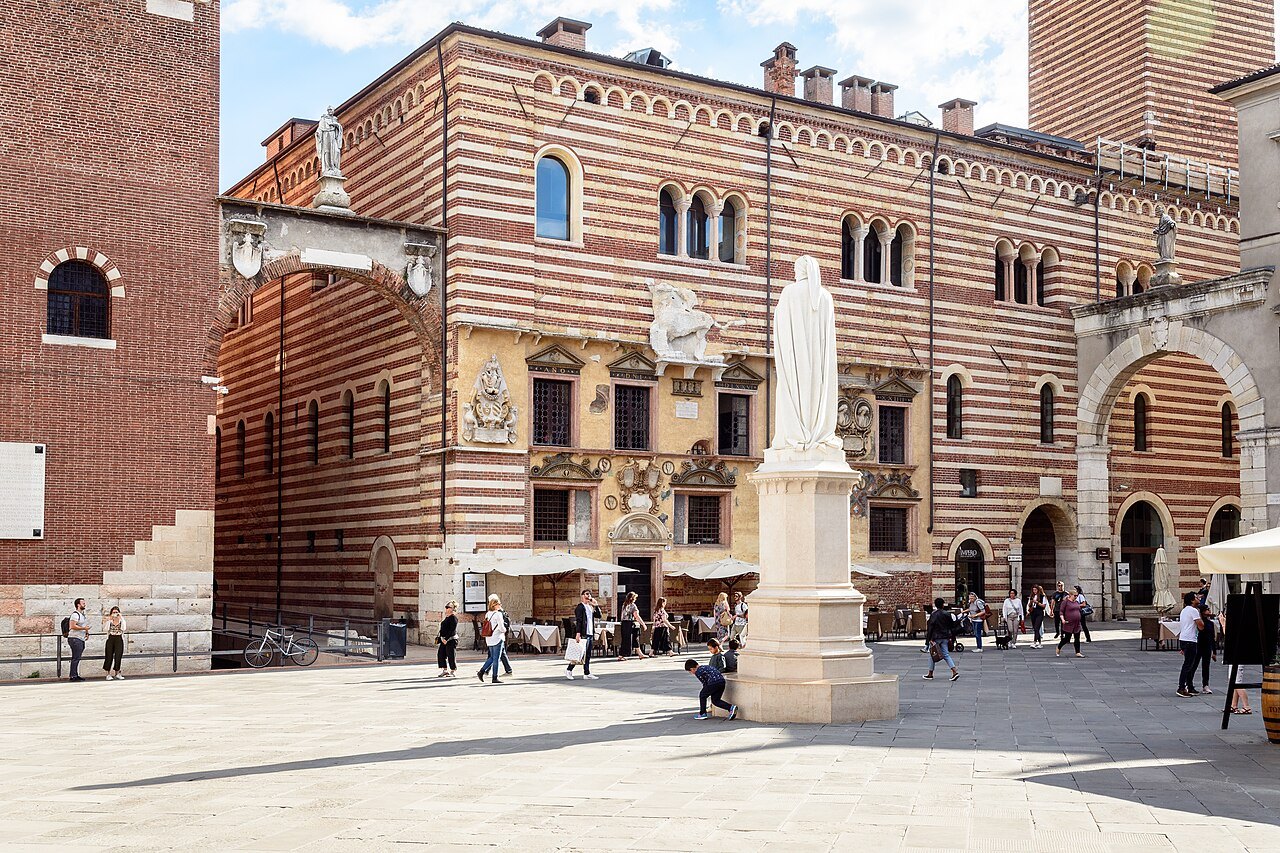
The enclosed square where Verona was governed for centuries, ringed by linked palaces, a Renaissance council loggia and Dante in white marble at its center.
Around the square
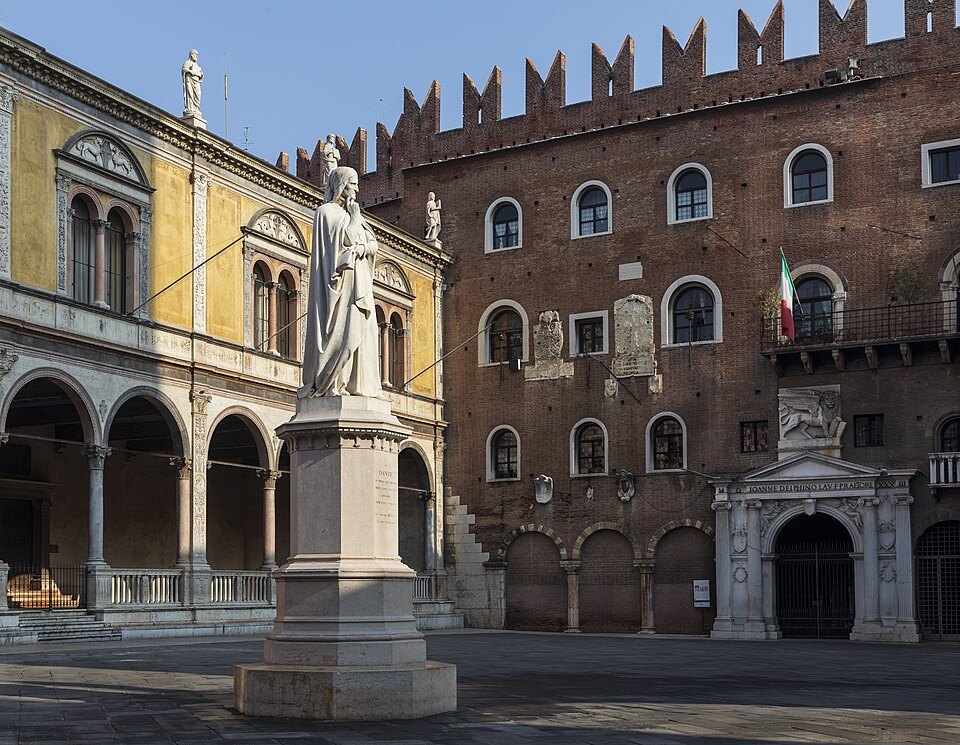
- 1Dante monumentUgo Zannoni's three-meter marble statue of the poet, raised in 1865 at the center
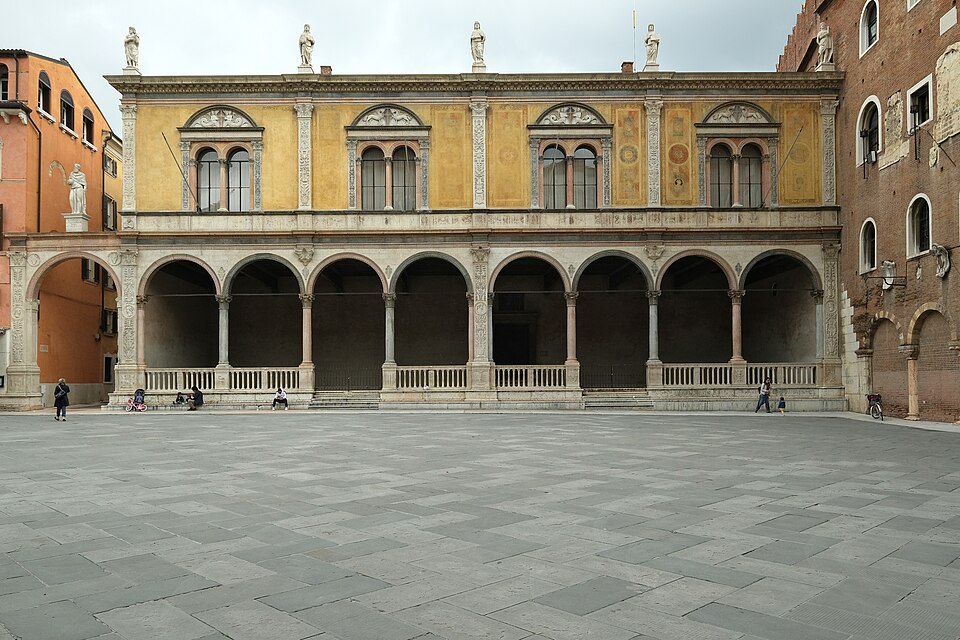
- 2Loggia del ConsiglioThe Renaissance council hall of 1476 to 1493, with five ancient Veronese on its roofline
- 3Palazzo della RagioneThe striped medieval town hall, with the Torre dei Lamberti rising from one corner
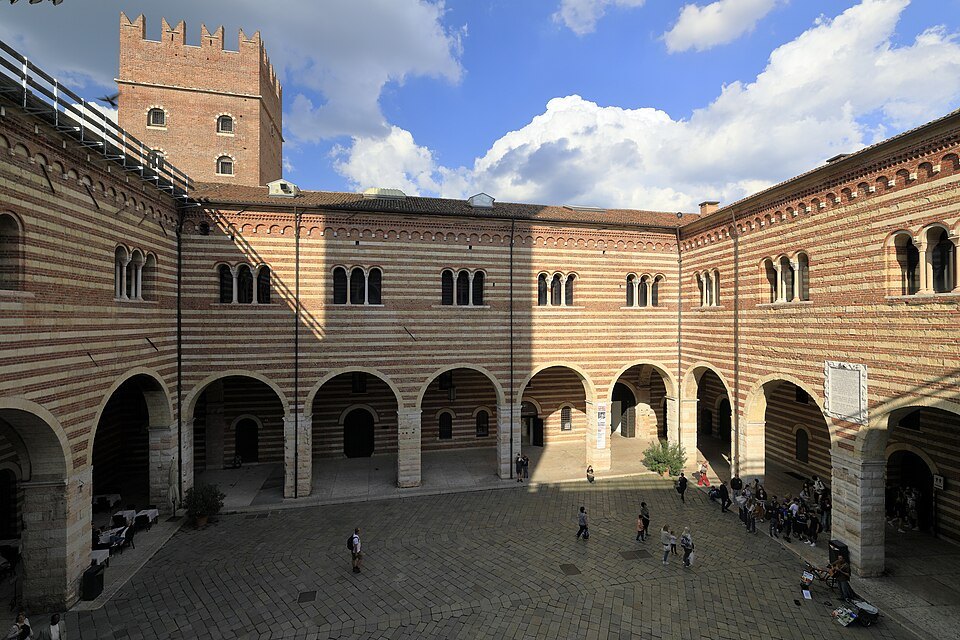
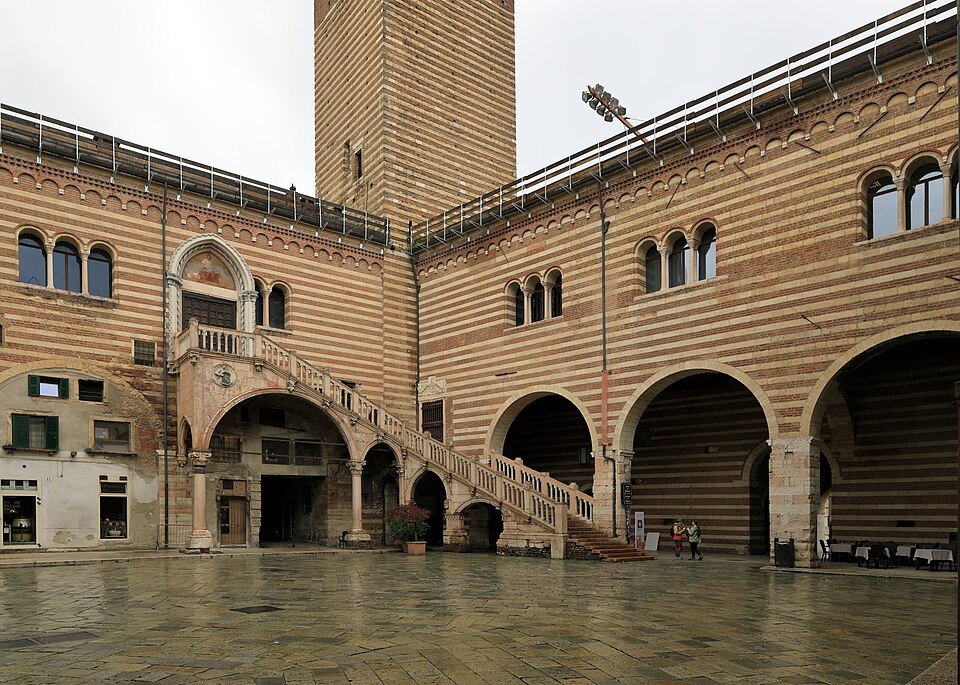
- 4Cortile Mercato VecchioThe old market courtyard inside Palazzo della Ragione, with the red marble Scala della Ragione
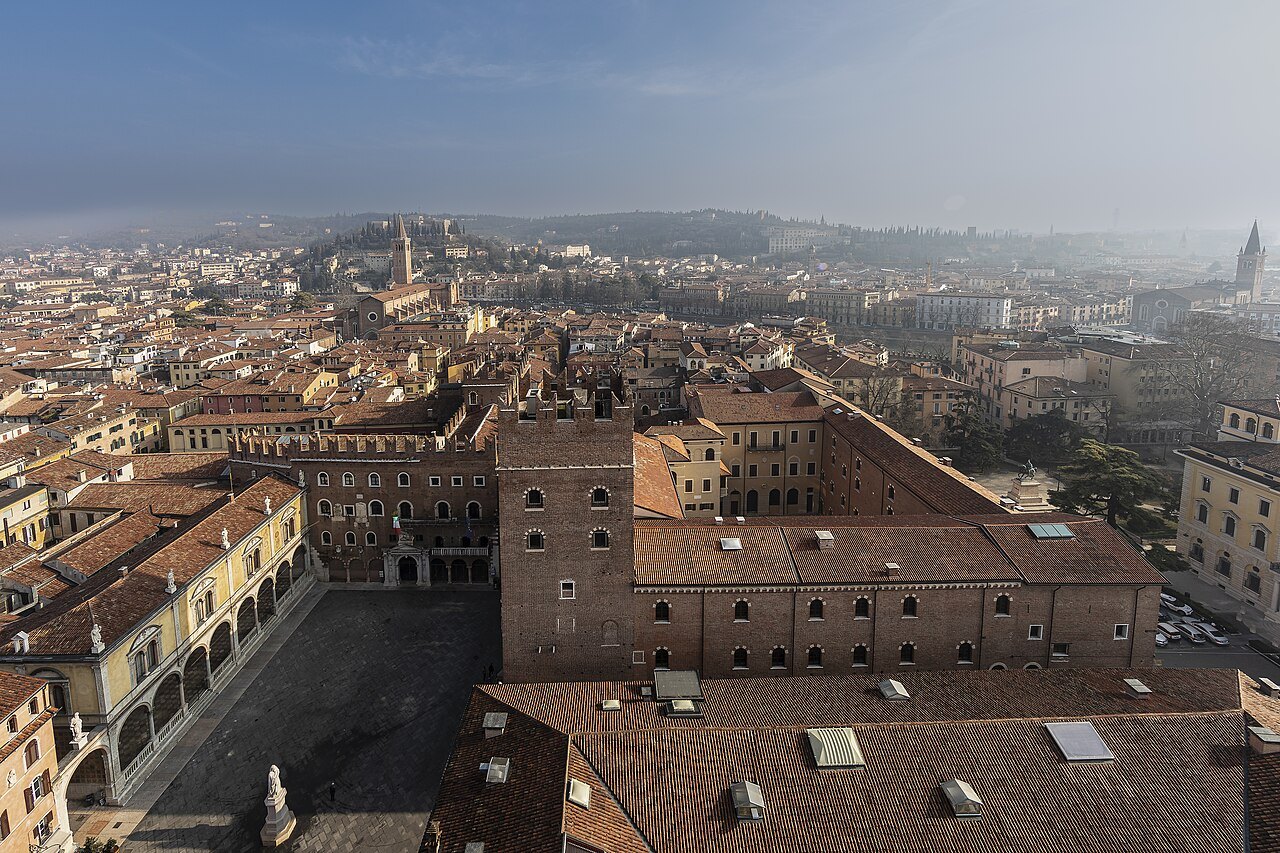
- 5Palazzo del CapitanioCansignorio's fortified palace, with a brick corner tower and a portal by Sanmicheli
- 6Palazzo del PodestàCangrande's palace, where Dante stayed in exile, now the Prefecture
- 7The linking archesArches joining the buildings, one carrying Girolamo Fracastoro holding his globe
A room for governing
Piazza dei Signori sits one short passage away from the market bustle of Piazza delle Erbe, yet it feels like another city. Instead of stalls there is paving, a single statue and a closed ring of palaces joined to each other by porticoes and arches, so the square reads almost as an outdoor room.
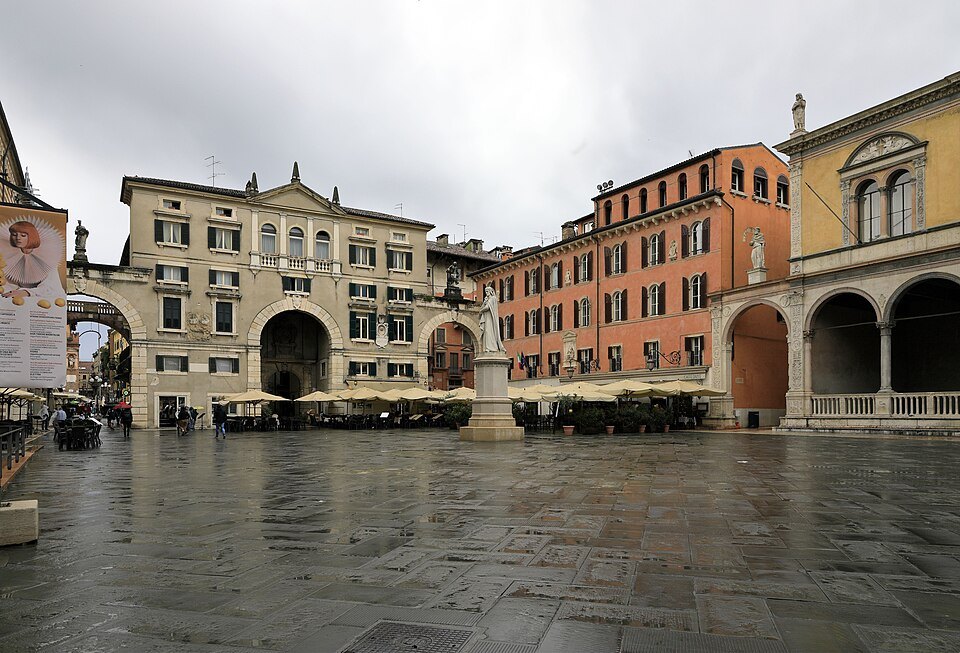
This was the political and administrative heart of medieval Verona. The della Scala family, the Scaligers who ruled the city from 1260 to 1387, built their residences here, and under Venice the same buildings housed the captain, the podestà, the judges and the city council. Locals often call it Piazza Dante, after the statue in the middle.
Palaces of the Scaligers
The oldest building is Palazzo della Ragione, the medieval town hall raised after the earthquake of 1117. Work on its corner tower, the future Torre dei Lamberti, began in 1172, and the main building was finished in 1194. In 1226 representatives of northern Italian cities met inside to renew the Lombard League. Fires struck it in 1218, 1541 and 1723.
The Scaligers built their own palaces beside it. Cangrande I della Scala began the Palazzo del Podestà around 1311, and Dante Alighieri, exiled from Florence, was a long-term guest at his court. Around 1364 Cansignorio della Scala rebuilt the Palazzo del Capitanio as a fortified complex around a courtyard, keeping the older brick tower that still stands on the square.
Venice remakes the square
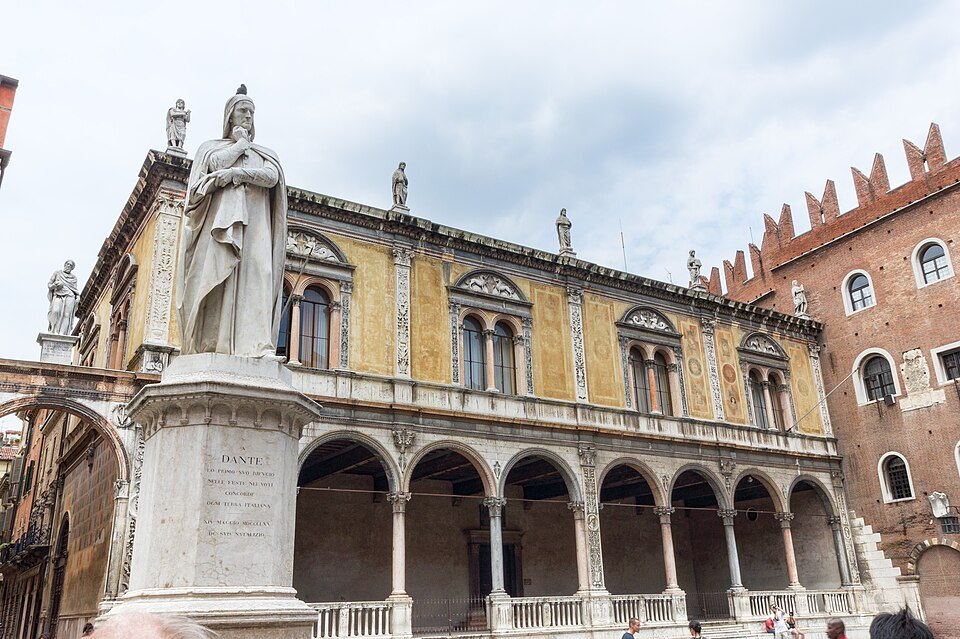
Verona submitted to Venice in 1405, and the new rulers made the Scaliger palaces the homes of their governors. Their great addition was the Loggia del Consiglio, built between 1476 and 1493 for the city council. It was long credited to the friar and architect Fra Giocondo; modern scholarship sees it as the work of a group of Veronese humanists and builders, with Daniele Banda prominent among them.
Michele Sanmicheli then gave the two Scaliger palaces Renaissance entrances: a portal for the Palazzo del Capitanio between 1531 and 1533, and in 1533 a portal for the Palazzo del Podestà modeled on a Roman triumphal arch. In the nineteenth century Giuseppe Barbieri gave Palazzo della Ragione a smooth neoclassical front toward Piazza delle Erbe, and Camillo Boito's restoration of 1874 to 1897 reopened its medieval windows and striped masonry.
What you actually see
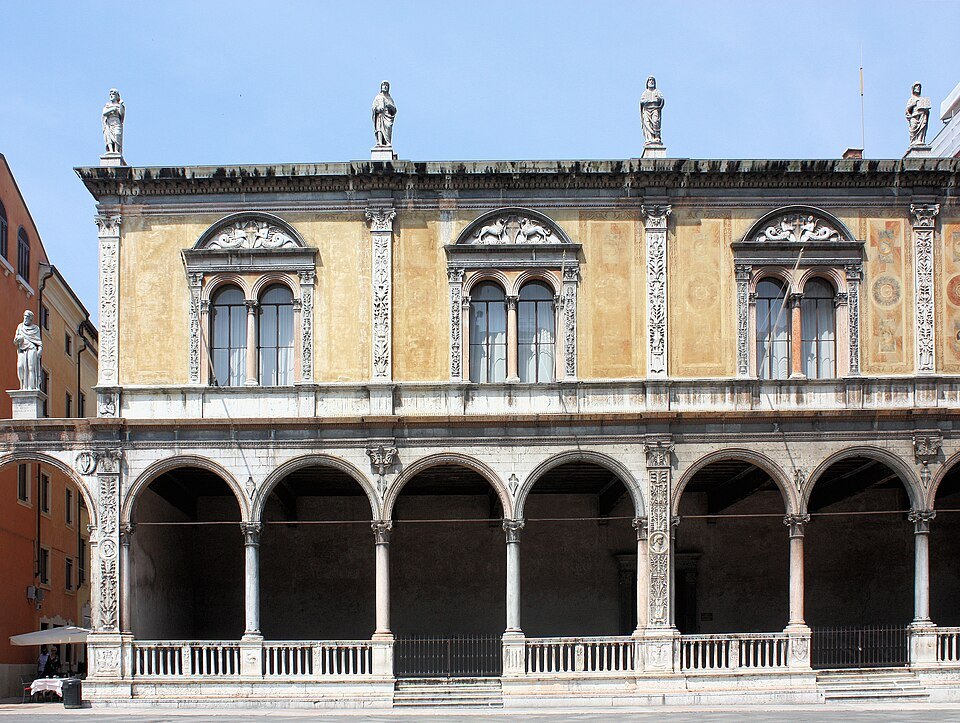
Start with the Loggia del Consiglio, counted as a masterpiece of the Venetian Renaissance and unlike anything else in Verona. Along its roofline stand five statues of ancient men claimed by the city: the poet Catullus, Vitruvius Cerdo, Aemilius Macer, Pliny the Elder and Cornelius Nepos, carved by Alberto da Milano and other Comacine craftsmen. The building is used by the Province of Verona.
Dante stands in the middle, a statue by Ugo Zannoni in Carrara marble about three meters high, inaugurated on 14 May 1865 for the six hundredth anniversary of the poet's birth. Behind him, look at the palace fronts for their different centuries: the bands of tufa and brick on Palazzo della Ragione, the plain brick tower of the Capitanio, and Sanmicheli's classical portal on the Palazzo del Podestà, which serves as the Prefecture.
Arches and the legend of the ball
Four of the arches around the square carry statues of learned Veronese: Onofrio Panvinio, Girolamo Fracastoro, Scipione Maffei and Enrico Noris. The best known is Fracastoro, the Renaissance physician and scholar, carved by Danese Cattaneo in 1559 and standing on the arch between the Loggia and the Casa della Pietà, over Via delle Fogge.
He holds a sphere, the bala in local dialect. Tradition says it will fall on the first true gentleman to pass underneath; it has never fallen. The Arco della Costa leads back to Piazza delle Erbe, with its hanging bone, while the small Romanesque church of Santa Maria Antica, once the private chapel of the Scaliger palace, stands beside the Scaliger tombs.
The courtyard and the staircase
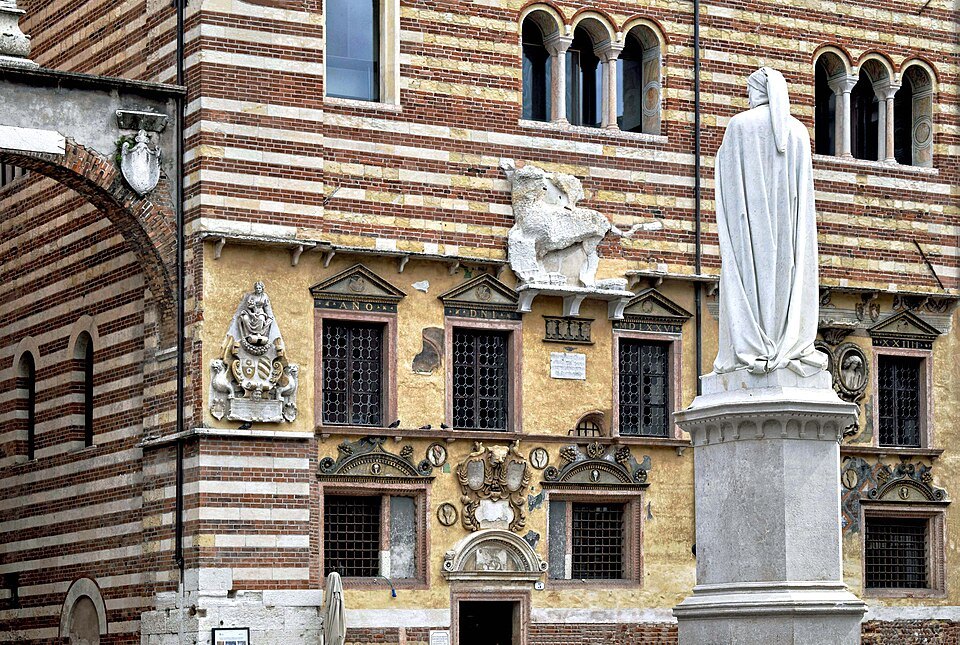
The Cortile Mercato Vecchio is the old market courtyard inside Palazzo della Ragione. Its showpiece is the Scala della Ragione, an open two-flight staircase in red Veronese marble built in the mid-fifteenth century, usually dated 1447. It once had a roof, removed during nineteenth-century restoration, which is why the steps now climb in open air.
After the courts moved out, the palace was restored in 2007 and became home to the Galleria d'Arte Moderna Achille Forti. Its visit route takes in the columned hall, the frescoed Cappella dei Notai and the climb up the Torre dei Lamberti, so one visit covers the interior and the view.
How to visit
The square and courtyard are public space, and a careful look at the facades, the arches and the staircase takes about half an hour. Add an hour or more for the tower climb, the modern art gallery or the Scaliger tombs, which make a natural group.
Plan the square as part of a short loop through the Scaliger quarter. From here, Casa di Giulietta and the church of Santa Anastasia are both short walks, and the itineraries show how to fit the square into a day.
Nearby
- Inside the loopPiazza delle ErbeThe long market square laid over Verona's Roman forum, crowded with stalls, painted houses, a Roman statue on…Read the page
- Inside the loopTorre dei LambertiThe medieval civic tower between Piazza delle Erbe and Piazza dei Signori, with two old bells at the top and…Read the page
- Inside the loopThe Scaliger TombsThe Gothic tombs of the della Scala family, raised on canopies beside the little church of Santa Maria Antica…Read the page
- Inside the loopSant'AnastasiaThe great Dominican church near the Adige, with Pisanello's Saint George above a chapel arch and two stone…Read the page