A door worth stopping for
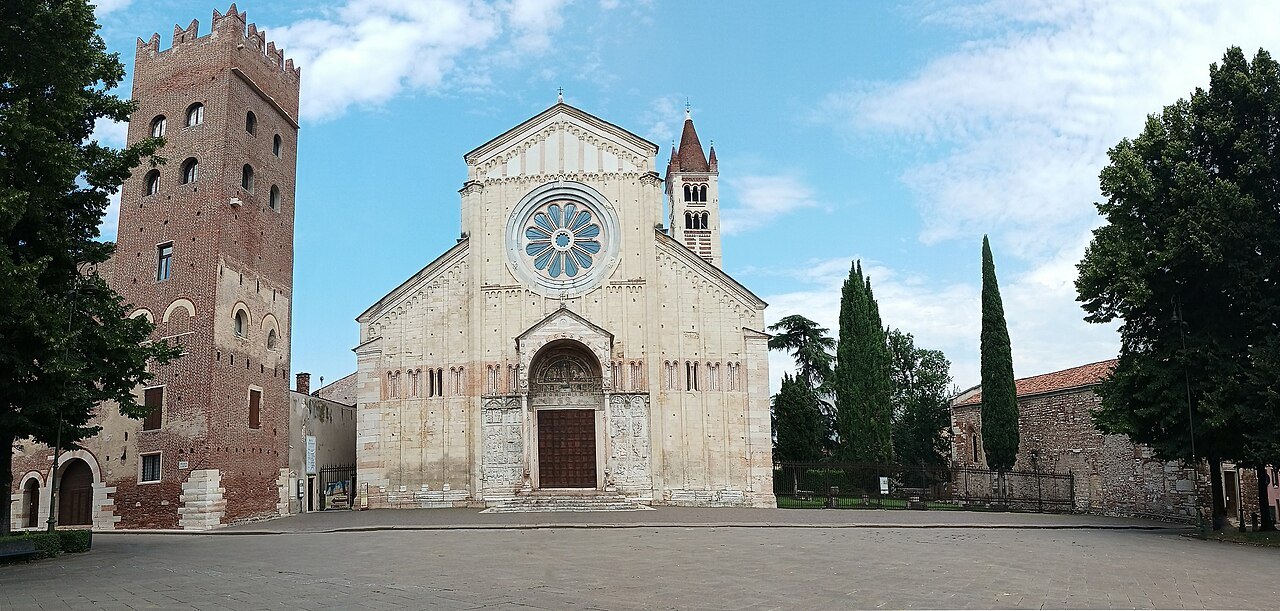
San Zeno Maggiore stands a little west of the old center, on its own broad square, and the bronze doors set into its facade are one of the reasons a visitor makes the walk. Before going inside, it is worth spending real time at the threshold, because the doors carry seventy-three bronze panels made by several masters across different generations, and reading them properly takes patience rather than a glance in passing.
The doors sit below the great rose window known as the Wheel of Fortune, carved with six figures riding its rim as fortune lifts a man up and crushes him down again. That window and the porch beneath it, finished by the master Niccolò in 1138 and resting on two carved lions, frame the doors and set the visitor's eye moving before the bronze panels are even reached. Taking a few minutes with the facade first makes the doors easier to place in context.
What the panels show
The doors are not a single, uniform work. The earliest bronze work is dated to around the first half of the eleventh century, and later masters added and replaced panels over time, so the surface in front of a visitor today is a patchwork built up across centuries rather than one artist's single composition. The forty-eight largest panels, each roughly half a meter square, carry most of the narrative weight, with Old and New Testament scenes dominating and four panels set aside for the miracles of Zeno himself. Two of the large panels double as door handles.
Smaller panels fill the remaining space between the large scenes: single standing figures, horned heads, personifications of the Virtues, and little frames shaped like miniature towers. These smaller pieces are easy to miss at a quick look because they do not tell continuous stories the way the large panels do, but they reward close inspection, since many are inventive in a way the larger, more formal scenes are not.
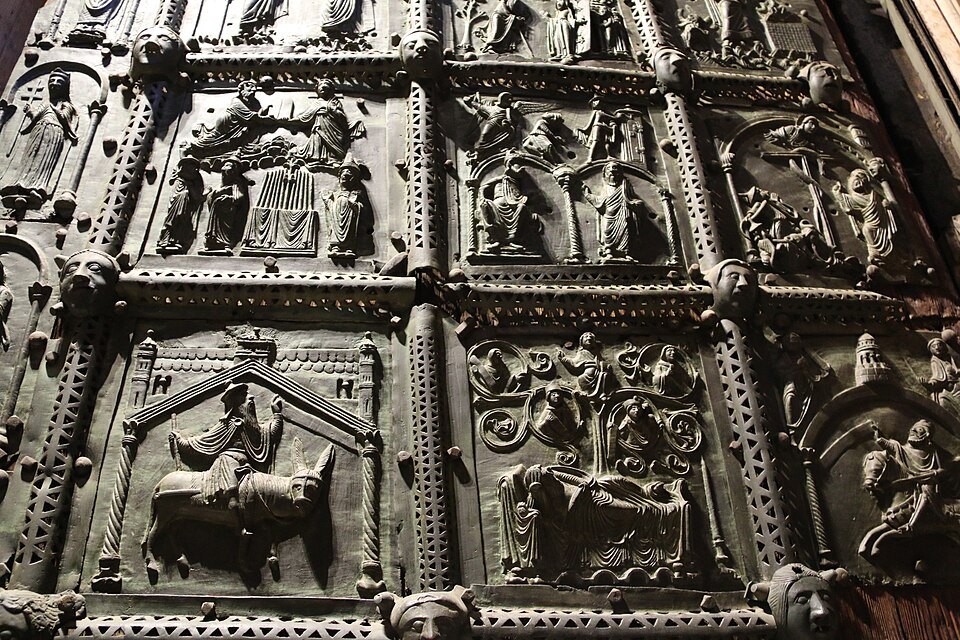
The scenes are not arranged as a strict chronological sequence running left to right or top to bottom in the way a modern comic strip would be. Panels from different workshops and different periods sit side by side, so the practical approach is to look at each one on its own terms rather than hunting for a single unbroken story running across the whole door.
Reading the panels up close
The most rewarding way to look at the doors is to stand close and compare neighboring panels directly against each other. Differences in style become obvious once a visitor starts looking for them: some figures are stiff and frontal, with simplified drapery and large heads, while others show more fluid movement and a greater interest in depth and gesture. These contrasts are the visible trace of different hands working in different decades, sometimes different centuries, on the same door.
It helps to treat the visit as two separate searches rather than one continuous reading. First, look for the four panels devoted to the miracles of Zeno, Verona's patron saint, who came from Mauretania in North Africa and served as the city's eighth bishop in the later fourth century. He is traditionally shown with a small fish hanging from his crozier, a reference to the story that he fished the Adige for his own meals, and spotting that detail among the bronze scenes is a useful way to anchor the search.
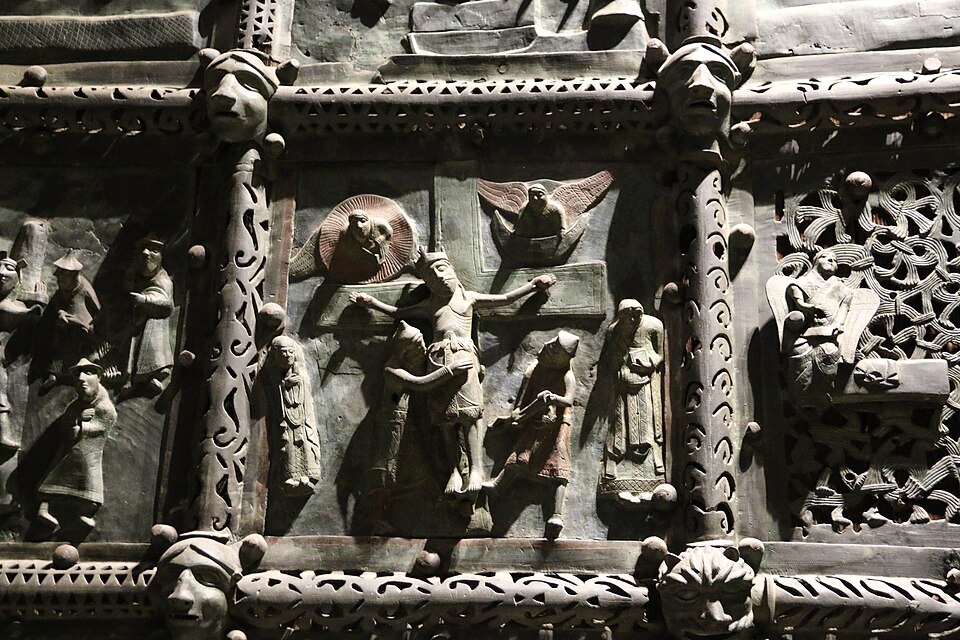
Second, look across the surface for the smaller filler panels: the horned heads, the single Virtues, the tower-shaped frames. These are easy to walk past without noticing, since they do not announce themselves the way a large narrative scene does, but they are part of what makes this door different from a single-period monument, and noticing them rewards the patience of standing in front of the doors rather than walking straight past into the nave.
Context from the facade around the doors
The doors do not stand alone on the facade. On either side run eighteen marble relief panels, separate from the bronze doors themselves: ten by the master Guglielmo showing New Testament scenes on the left, and eight by Niccolò showing Genesis and episodes from the story of the Ostrogothic king Theodoric on the right. Comparing these carved marble reliefs with the bronze panels on the doors gives a visitor a sense of how differently stone and metal handle similar subjects in the same period.
Above it all, the porch carries carved scenes of the months of the year and further episodes from the life of the saint, and its lunette shows Zeno consecrating the medieval commune of Verona. None of this needs to be absorbed in a single pass. A visitor who spends time at the doors, then steps back to take in the porch and reliefs, and only then goes inside, gets a more complete sense of the facade as a whole than someone who moves straight through.
Inside, after the doors

Once through the doors, the church unfolds across three levels. The lower church opens under a wooden ceiling shaped like an upturned ship's keel, built around 1386, and a small apse holds the thirteenth-century statue known as San Zeno che ride, the laughing San Zeno, seated and smiling in painted red Verona marble. Stairs lead up to a raised presbytery behind a marble gallery of small arches, where Andrea Mantegna's altarpiece, painted in the later 1450s, holds the high altar inside a gilded frame.
Below the presbytery, the crypt holds the tomb of Zeno among a low hall of columns, his remains identified in 1838 and visible today. A local tradition with no historical basis names this crypt as the place where Shakespeare's Romeo and Juliet married, the same kind of literary tradition that grew up around the Casa di Giulietta elsewhere in the city. None of it needs to be believed to make the crypt worth the visit; the columns and the tomb carry their own weight.
Planning the visit
San Zeno belongs to the group of four historic churches run for visitors by the Chiese Vive association, together with the Duomo, Santa Anastasia and San Fermo. A single-church ticket or a combined card covering all four is available, and the association's own site gives current arrangements and seasonal visiting times; checking it before setting out is worth doing, since tourist visits stop during services and times differ between weekdays and holidays.

Allow at least an hour for the church, and longer if the doors and facade reliefs are to be studied properly rather than skimmed. San Zeno lies further west of the old center than the other major churches, so it pairs well with a visit to Castelvecchio and a walk along the Adige on the way there or back. The square in front of the church is a reasonable place to pause before making the return walk into the center, and checking getting-around arrangements in advance makes the outing simpler.
Read next
- The Scaliger TombsReading the Scaliger Tombs, from Cangrande's rider to the iron ladders in the railingsA guide to the della Scala family tombs beside Santa Maria Antica, from Cangrande's rider to the ironwork in the railings.Read
- CastelvecchioHow Carlo Scarpa turned a medieval castle into a museum you walk through like a storyHow architect Carlo Scarpa turned Castelvecchio's old barracks into a sequence of rooms built around the art inside them.Read