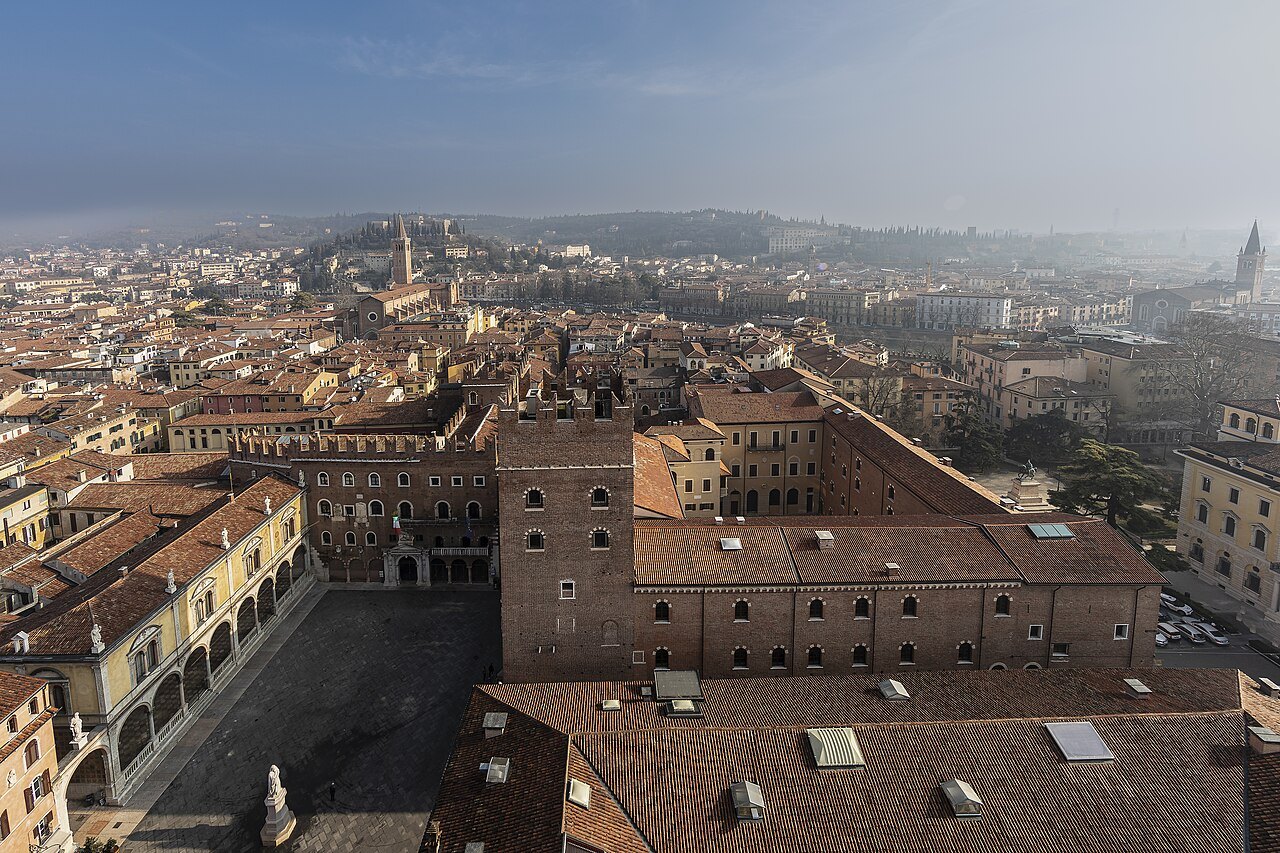
A family's pride on the street corner
A few steps beyond Piazza dei Signori, in a small enclosure beside the church of Santa Maria Antica, stand the tombs of the della Scala, the family who ruled Verona in the late Middle Ages. The Veronese call them the Arche Scaligere, and the city tourist board ranks them among the most significant monuments of Gothic art in the region.
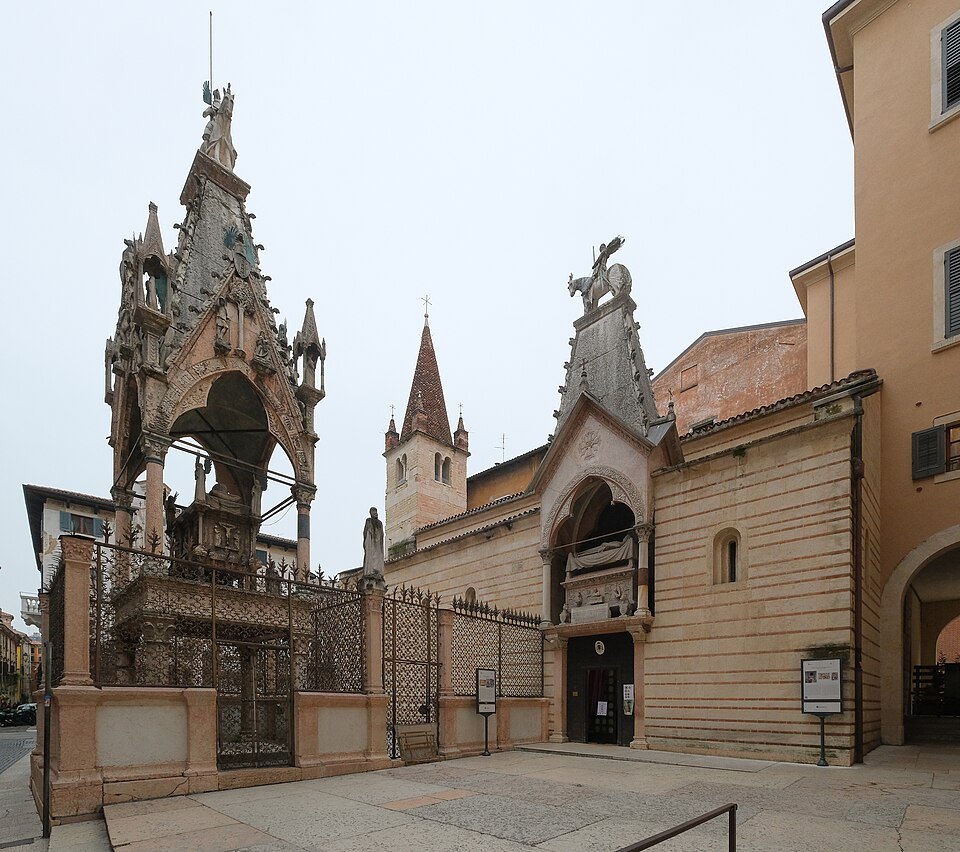
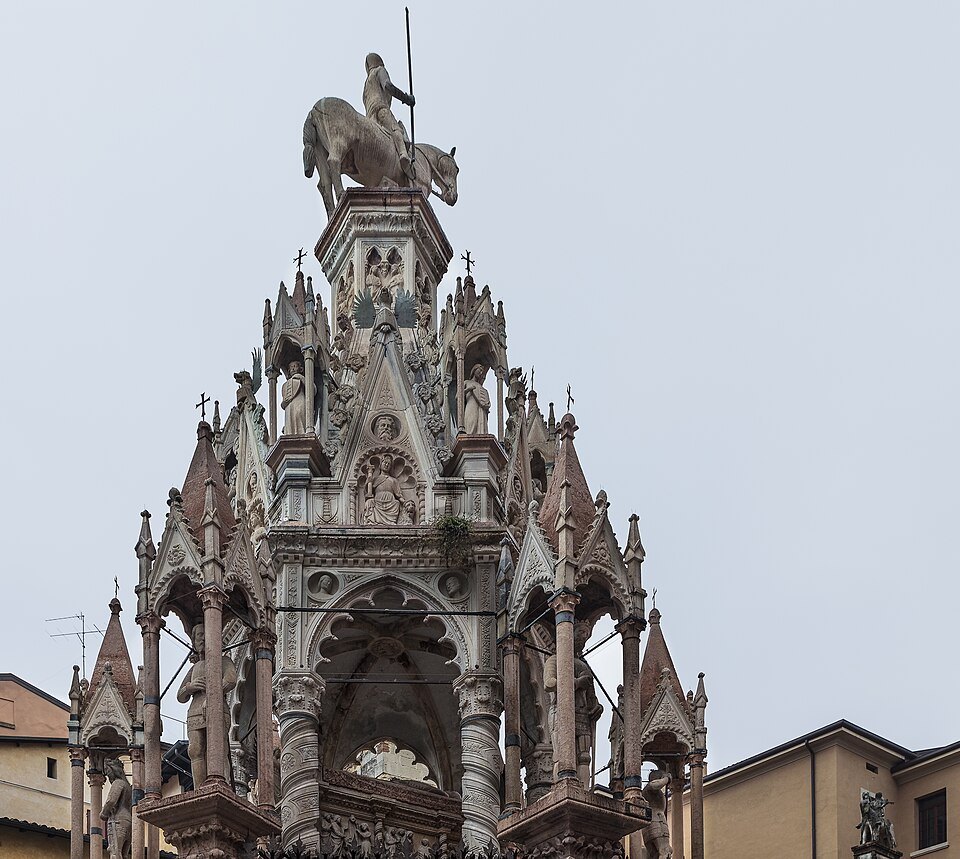
What makes them memorable is their shape. Instead of lying inside a church, the most important lords were placed outdoors, high on stone canopies, their effigies lying under pinnacles and their armoured figures riding on top. They were meant to be seen from the street, and they still are: the whole group can be studied through the railings without setting foot inside the enclosure.
Santa Maria Antica and the della Scala
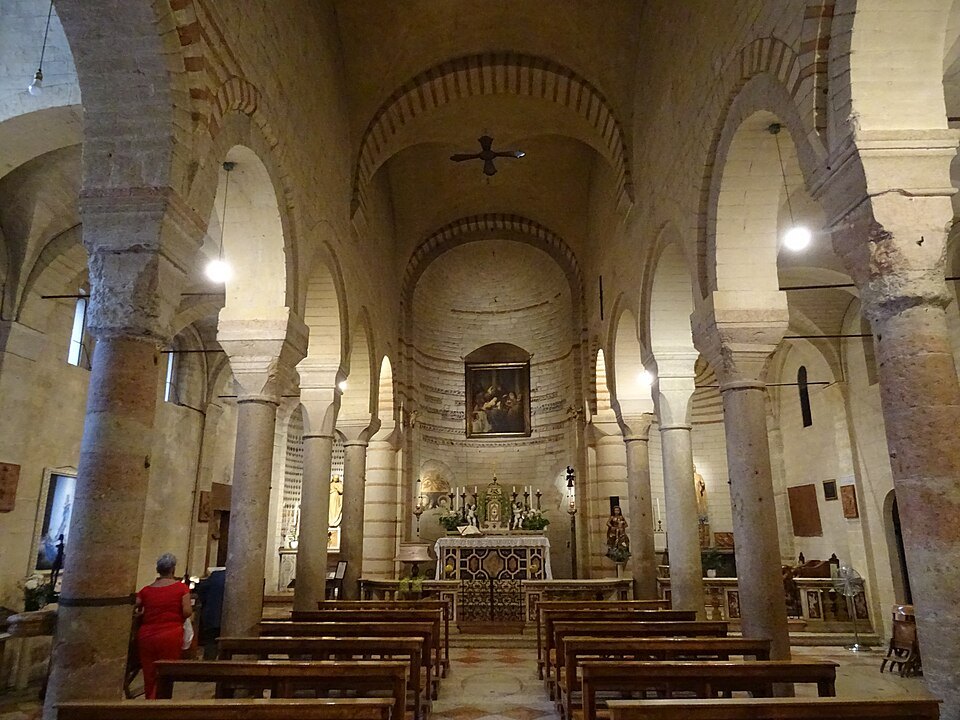
Santa Maria Antica is far older than the tombs beside it. It began as the oratory of a convent founded in the eighth century by two sisters, Auctonda and Natalia. After an earthquake in the twelfth century it was rebuilt in Romanesque style and consecrated later that century, and the della Scala made it their family chapel across the thirteenth and fourteenth centuries.
The most famous of them, Cangrande the First, lived from the late thirteenth century into the early fourteenth and ruled Verona from early in that century. He was a patron of Dante, who praised him in the seventeenth canto of Paradiso. He died in Treviso; a modern examination of his remains found lethal amounts of digitalis, pointing to poisoning rather than the illness long reported.
Cansignorio, the last lord to build a great tomb here, came to power after the murder of his brother Cangrande the Second and ruled until his own death a little over a decade later. For all the violence of his rise, he spent heavily on the city, building the Torre del Gardello on Piazza delle Erbe and a new masonry bridge over the Adige.
Cangrande over the church door
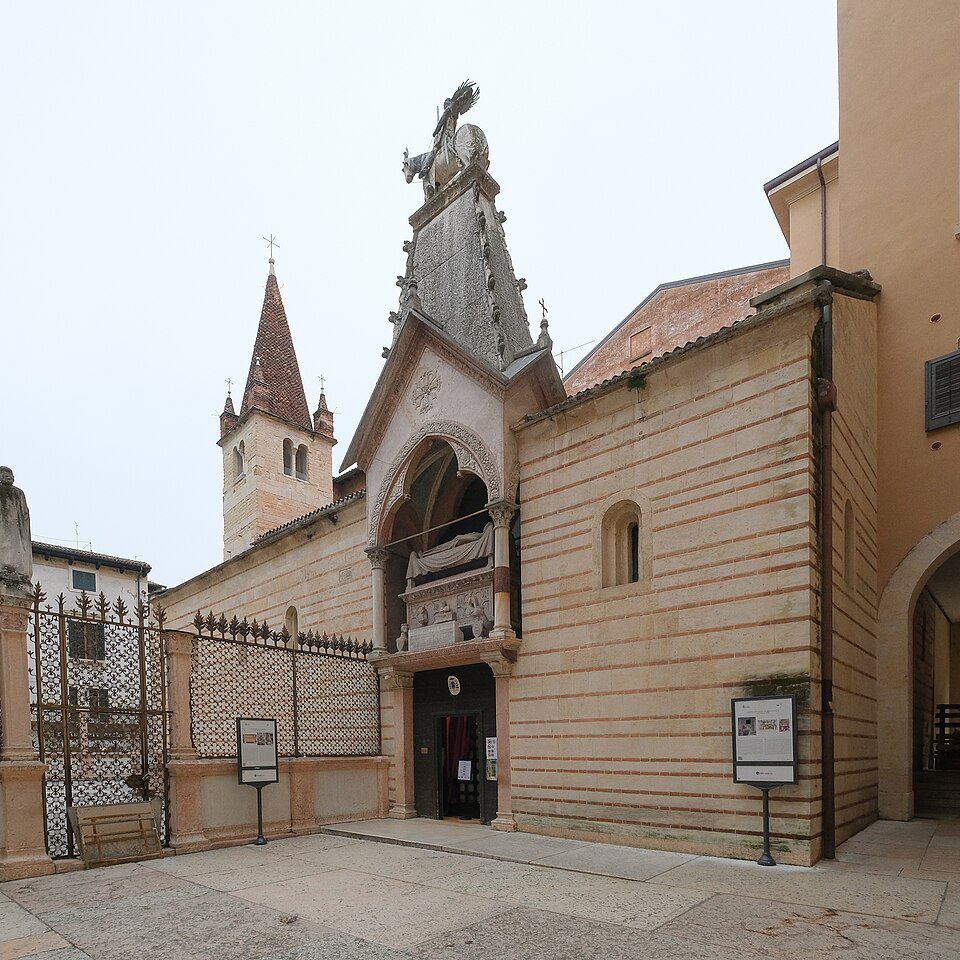
Cangrande's tomb sits above the side entrance of Santa Maria Antica, built according to his own wishes. The city museums attribute its design to the architect responsible for the church of Sant'Anastasia. His effigy lies on the sarcophagus lid, with religious scenes and reliefs of his military campaigns carved on its sides, under a Gothic canopy.
On top rides the figure that has become the emblem of Verona: Cangrande in armour on a horse draped in long trappings, his face set in a broad smile, with a helmet shaped as a dog's head and an ornate sword. The statue is attributed either to Giovanni di Rigino or to Bonino da Campione and dated to the middle of the fourteenth century.
What visitors see on the tomb today is a copy, made by the sculptor Rodolfo Dusi. The original was taken down in the early twentieth century and moved to the civic museum, where it now stands in Castelvecchio in a setting designed by Carlo Scarpa.
Mastino II and Cansignorio
Mastino the Second, who died in the mid-fourteenth century, began his own tomb some years before his death. It was originally painted and gilded and had its own fence with four Virtues at the corners. Reliefs of sacred history run around the base, and on the lid two angels watch over his effigy beneath a canopy of trefoil arches. As with Cangrande's monument, the equestrian figure on top is a copy, with the original kept at Castelvecchio.
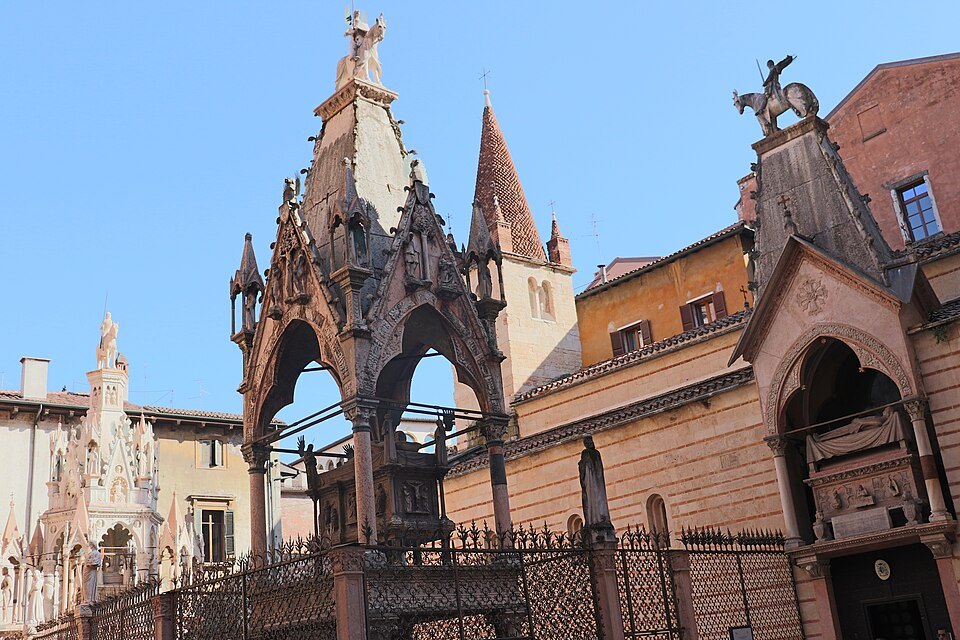
Cansignorio's tomb, also commissioned during his lifetime, is the most elaborate of all. Built on a hexagonal plan inside its own hexagonal railing, it rises in six Gothic tabernacles holding warrior saints, with Virtues, Apostles and Gospel figures, and a horseman at the summit. An inscription names the sculptor as Bonino da Campione, and the cost is recorded at ten thousand florins, a figure that gives some sense of how much the family wanted this corner of the city to impress.
The grille and the smaller tombs
Look closely at the ironwork before moving on. The wrought-iron fence and the grilles set into the wall along the street are worked with a repeating ladder motif, the emblem of the della Scala, whose name means of the stair. It is a detail easy to miss while looking up at the carved canopies, but it ties the whole enclosure together.
Inside the railings, simpler sarcophagi hold other members of the dynasty, including Mastino the First, Alberto the First, Bartolomeo the First, Alboino and Cangrande the Second. The tomb of Giovanni della Scala, finished in the mid-fourteenth century by Andriolo de' Santi, was brought here from the church of San Fermo, though sources disagree on when exactly that move took place.
The tombs have not survived untouched. Restoration work began in the late eighteenth century and a thorough campaign started in the nineteenth. Santa Maria Antica itself was restored in the years around the turn of the twentieth century, when later baroque additions were stripped out to recover its Romanesque look, a project still described as controversial.
How to visit
The street view is the visit for most people, and it is a good one: the sarcophagi can be seen fully from outside the enclosure, and the canopies are best read from a few steps back rather than pressed against the railings. Allow around a quarter of an hour, more if carrying binoculars or a zoom lens for the carving high above eye level. Check the church door as well: when services or openings allow, the small Romanesque interior is worth a few minutes.
Note The enclosure is a protected monument, not a bench or a ledge: do not climb on the wall or reach through the grilles. Walk the full length of the railings instead, because the three great canopied tombs stand at different points of the enclosure and each needs its own angle to make sense of the carving.
Nearby, and what to see next
The tombs make an easy pairing with the Torre dei Lamberti, whose terrace looks down on this corner, and with the courtyard of Juliet's House, a few minutes' walk south. Continue north to the great Gothic church of Sant'Anastasia, then to Castelvecchio later in the day to meet the original Cangrande face to face.
For anyone planning a day that works through the historic center in order, the detour to this small enclosure costs very little time and rewards a second look. The ladder motif in the ironwork and the carved reliefs on the sarcophagi reward patience more than speed.
Read next
- Torre dei LambertiClimbing the Torre dei Lamberti or taking the lift, and what the bells are calledHow to choose between the stairs and the lift up the Torre dei Lamberti, and what the tower's two medieval bells are called.Read
- Piazza dei SignoriHow Piazza dei Signori became the stately room next door to the market squareHow Verona's political square evolved from Scaliger palaces to a Venetian showpiece beside the market.Read
- Juliet's HouseJuliet's House is a story Verona chose to tell, and still worth an hourThe Casa di Giulietta is tied to Romeo and Juliet by literary tradition, not record. What the city built there, what to look at, and how entry works.Read