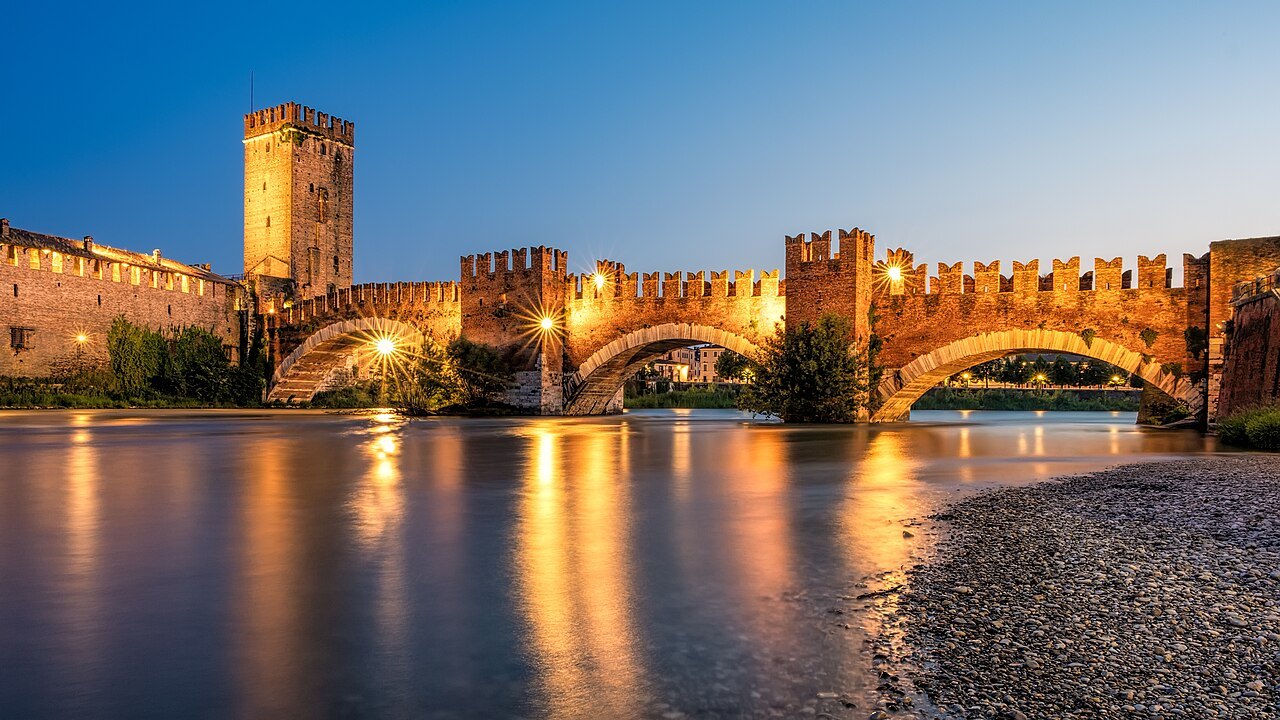
A brick fortress of the della Scala lords on the Adige, with its own fortified bridge and one of Italy's most admired modern museum designs inside.
The parts to look at
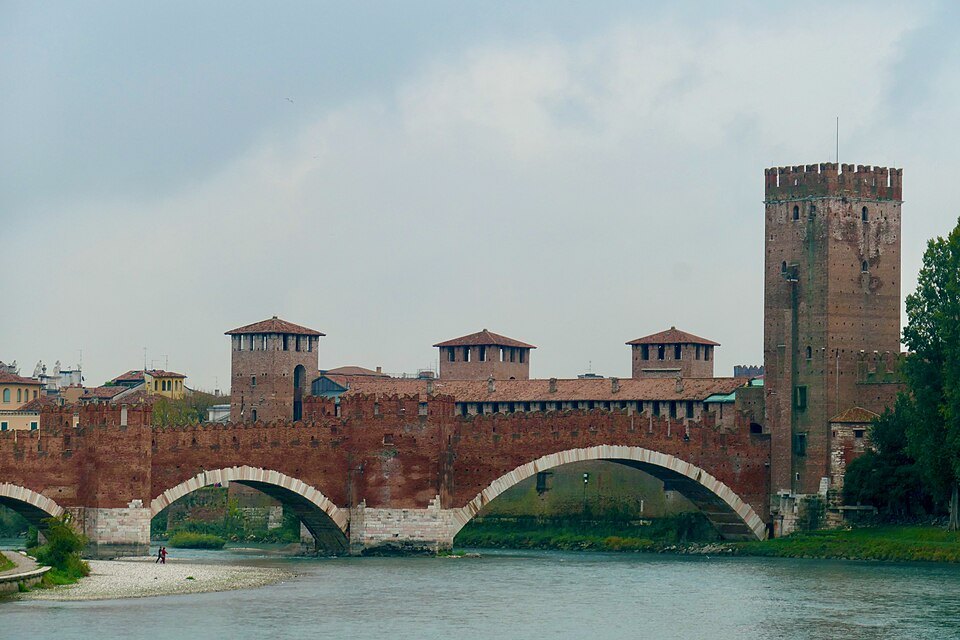
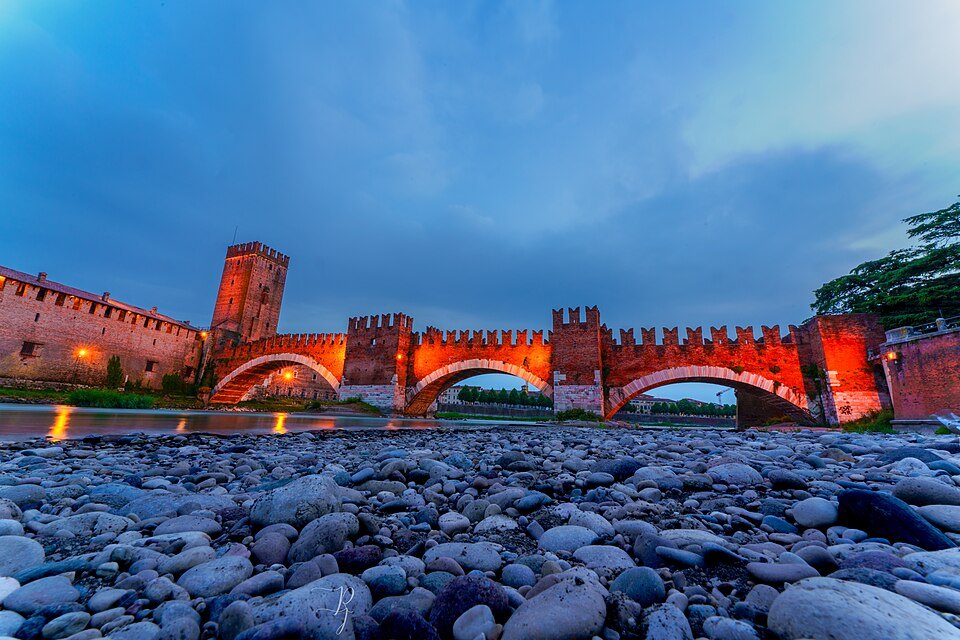
- 1Ponte ScaligeroThe castle's fortified brick bridge, three unequal arches carrying a crenellated walkway across the Adige
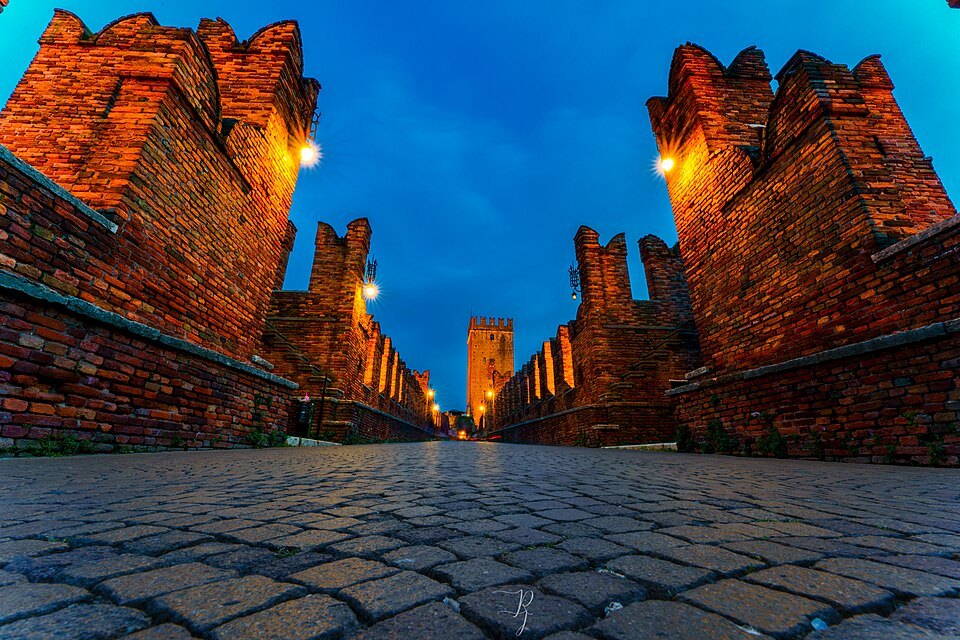
- 2Swallowtail merlonsM-shaped battlements running along the castle walls and both parapets of the bridge
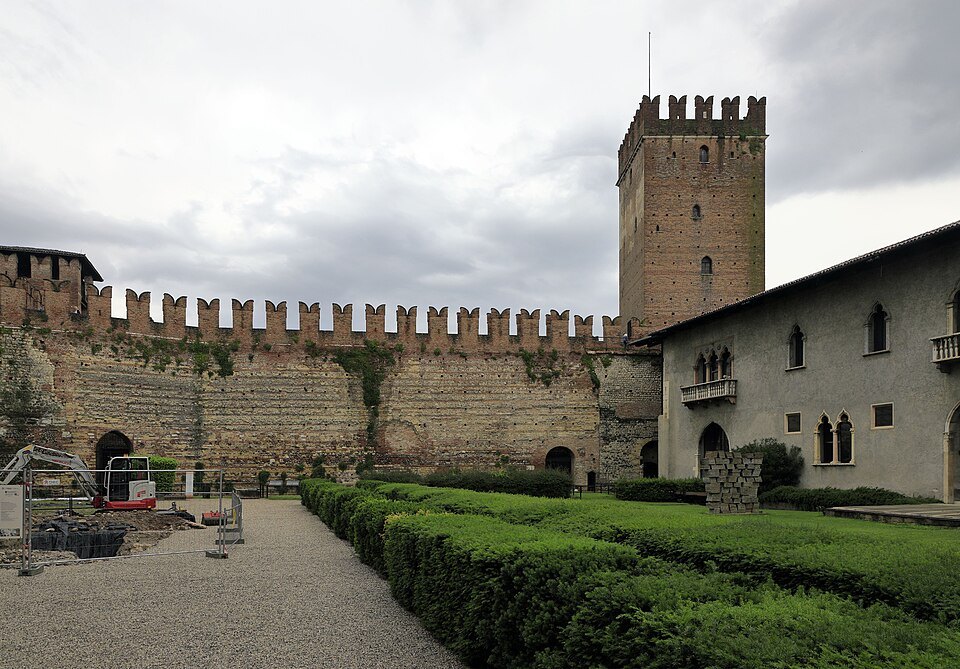
- 3The keepThe tall tower on the river front that watched over the whole defensive system
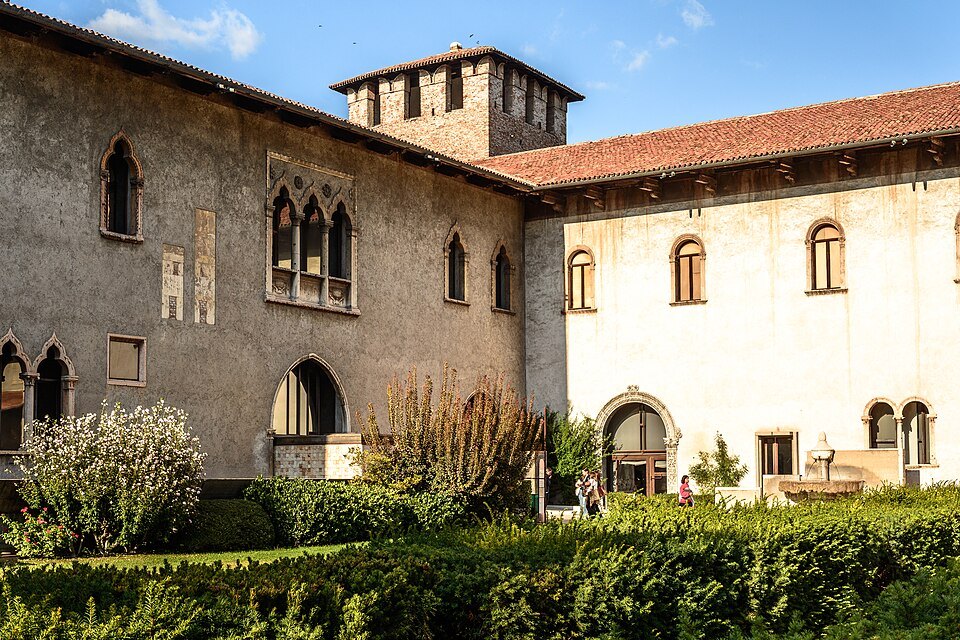
- 4Courtyard and wallsThe inner courtyard, where the walkway along the walls looks down over the river and city
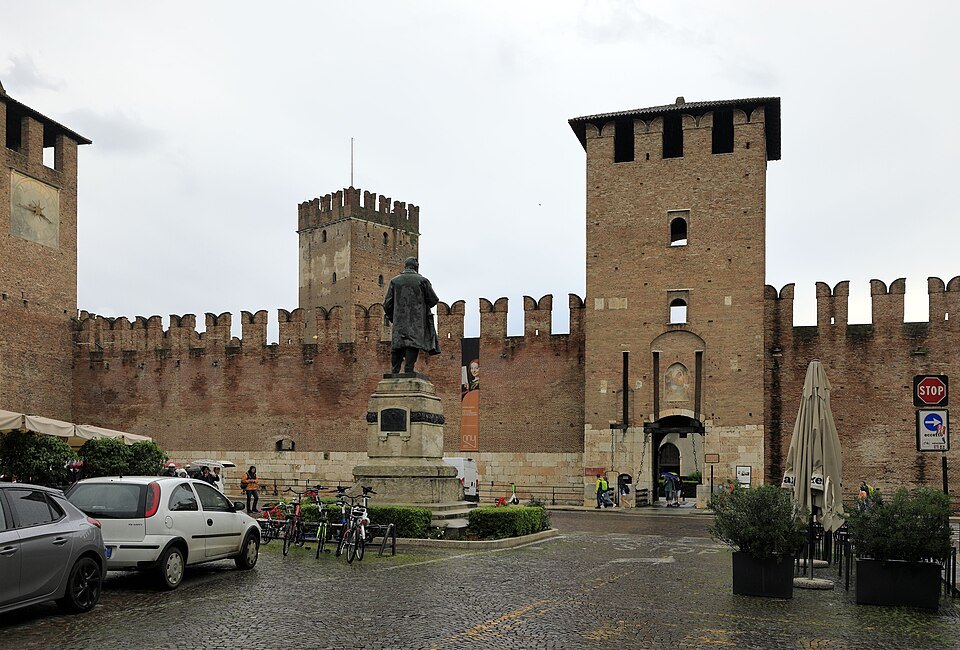
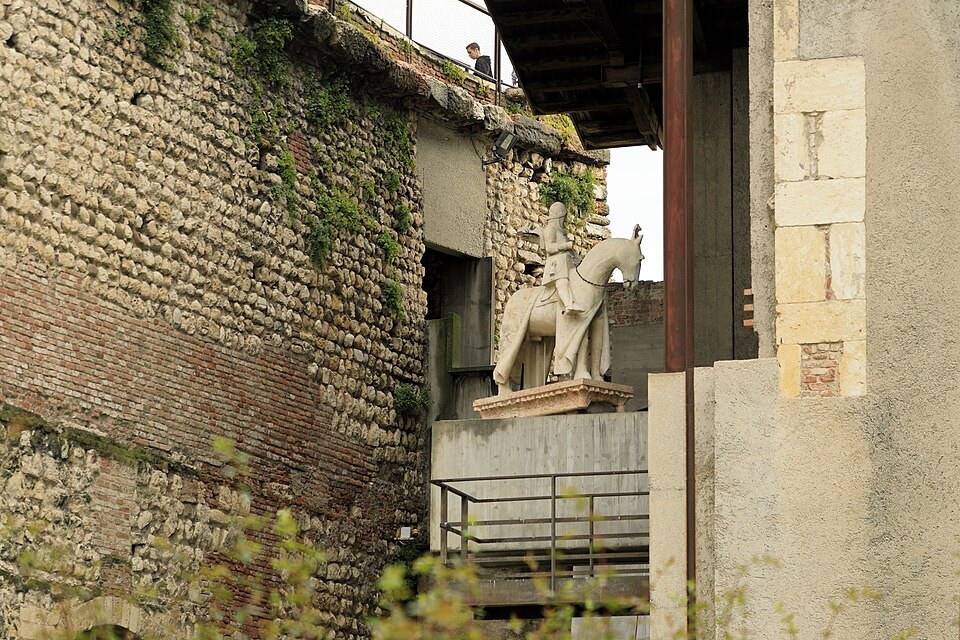
- 5Cangrande statueThe fourteenth-century equestrian figure raised on a concrete support where the medieval walls meet
- 6Sculpture galleryGround-floor rooms of medieval stone saints, crucifixes and tomb carvings from Verona's churches
- 7Painting galleriesUpper rooms of Veronese and Venetian painting, from Pisanello and Mantegna to the eighteenth century
Along the Adige, in the order you meet them.
A castle built to hold the city
Castelvecchio is the red-brick castle that the della Scala family, lords of Verona, built on the right bank of the Adige in the fourteenth century. It is two things at once: a fortress with its own bridge, and the city's main art museum, the Museo di Castelvecchio.
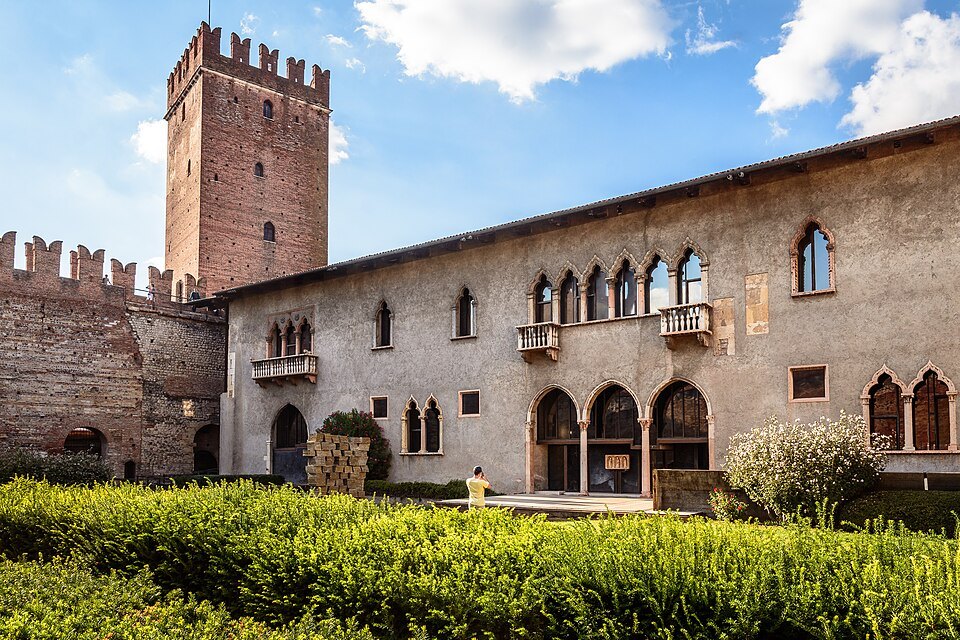
Come for both. The walk across the Ponte Scaligero costs nothing and shows the castle at its most warlike, while the museum inside is a landmark of twentieth-century design, where the architect Carlo Scarpa turned the old barracks into a sequence of rooms built around the art.
From the river the castle reads as a long line of walls, towers and battlements, with the tall keep on the water side. The bridge is built of pale stone in its lower courses and red brick above, and its piers are pentagonal, pointed against the current. The three arches are deliberately unequal, sized to the way the river's flow divides across this bend.
Cangrande II and the bridge
The castle was ordered by Cangrande II della Scala, with work generally dated from 1354; he died in 1359, and the keep was added in 1376 under his successors. It was meant to deter powerful neighbors such as Venice and the Gonzaga, and to guard the lords against their own subjects.
The bridge, built most likely between 1354 and 1356, gave the rulers a protected route out across the river towards the north if the city rose against them. Its largest arch spans just under forty-nine meters, which some scholars consider the widest in Europe when it was built.
On 24 April 1945 retreating German troops blew the bridge up. It was rebuilt between 1945 and 1951, with stone blocks recovered from the riverbed and new material taken from the original quarries, so what you cross is largely the medieval bridge put back together.
Arsenal, barracks and museum
Under Venice the castle served as a residence for the castellan, an arsenal, an armory and a powder store, with prison cells in the keep. From 1759 it housed a military engineering college. French forces between 1802 and 1805 turned it into an arsenal, demolishing buildings inside, among them a chapel, and the Austrians kept it as barracks from 1814 to 1866.
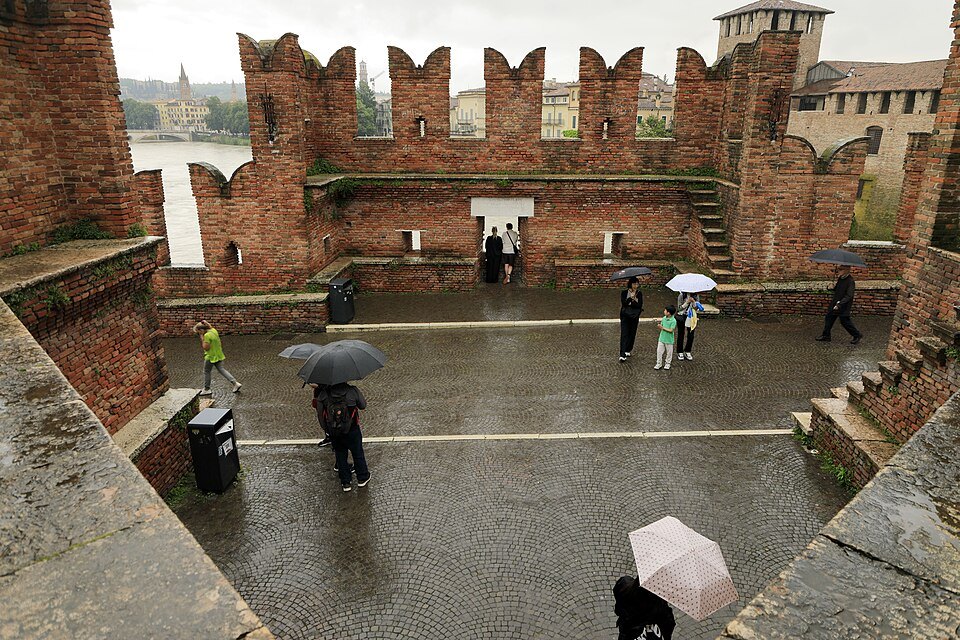
In the 1920s the city restored it in a medieval style and opened the museum, whose core was about two hundred works that the painter Saverio Dalla Rosa had saved from Napoleonic dispersals. From 1956 the director Licisco Magagnato brought in Carlo Scarpa, whose work began in 1958 and continued in phases into the 1970s.
Carlo Scarpa's museum
Scarpa treated castle and collection as one organism. He stripped away arbitrary additions, exposed older layers, and combined stone, wood and plaster with steel and bare concrete. The museum keeps more than six hundred of his drawings for the project.
The high point is the equestrian statue of Cangrande I della Scala, lord of Verona from 1309 to 1329 and host of Dante. It was taken down from the Scaliger Tombs in 1909 and for years stood almost invisible in a courtyard. Scarpa set it on a concrete support about seven meters high, at the point where the medieval walls meet, so visitors see it again and again from different floors and walkways.
The route through the museum is designed as a walk with pauses: rooms open onto the courtyard, stairs climb into the towers, and walkways run along the top of the walls with views over the Adige. Beyond painting and sculpture, the collections include medieval arms and armor, among them a sword associated with Cangrande, as well as ceramics, jewelry and a coin cabinet.
What you actually see
The ground-floor sculpture gallery holds Romanesque and Gothic stonework, including a fourteenth-century crucifix in tuff by the Master of Sant'Anastasia. Watch the floors and plinths: each piece stands on a base Scarpa designed for it, often set at an angle so the figure catches side light.
Upstairs, the painting galleries occupy the upper floor of the nineteenth-century barracks. Paintings hang from iron rods, and the ceilings shift color; the last room, given to eighteenth-century painting, has a cobalt-blue ceiling taken from the paintings of Luca Giordano. Look for Pisanello's Madonna of the Quail and works by Jacopo Bellini and Mantegna.
In November 2015 seventeen paintings, including works by Rubens, Tintoretto and Mantegna, were stolen in an armed robbery. Ukrainian border guards recovered them near Odesa in May 2016, and they came back to Verona in December 2016.
How to visit
Allow ten minutes for the bridge and courtyard, and two hours for the museum, longer if Scarpa's design is the reason for coming. The collection spreads over roughly thirty rooms with stairs and wall walkways, so wear sensible shoes. The civic museums share a weekly closing day, so check the museum's own calendar before going.
The castle sits on the Corso Castelvecchio, a short, straight walk from Porta Borsari, and a riverside walk of about twenty minutes leads on to San Zeno. For the Roman city and the other bridges, see Roman Verona.
Note The bridge walkway is narrow and the parapet merlons are uneven underfoot. On summer weekends it fills with groups taking photographs, so an early crossing or one near dusk is calmer.
Nearby
- Inside the loopPorta BorsariA white limestone Roman gate still standing across a busy street, carved with the date an emperor rebuilt the…Read the page
- West along the AdigeSan Zeno MaggioreThe basilica of Verona's patron saint, with a Wheel of Fortune rose window, bronze doors of medieval panels,…Read the page
- The Arena and Piazza BraPiazza BraVerona's largest square, where the medieval gates open onto the Roman Arena, the town hall, a guardhouse…Read the page
- The Arena and Piazza BraThe ArenaA Roman amphitheatre finished around AD 30 that has been used, lived in and restored for nearly two thousand…Read the page