Why opera here is different
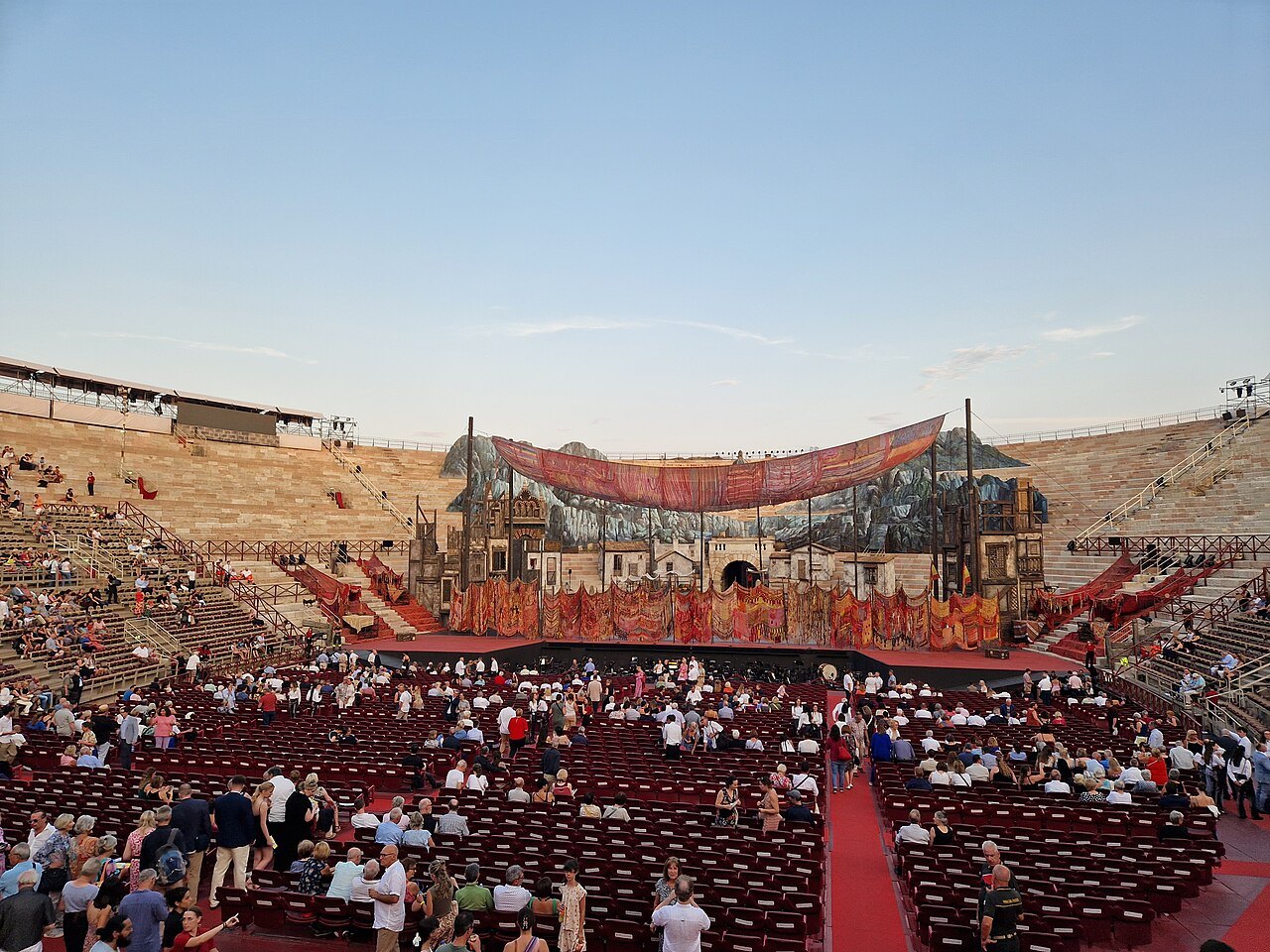
Opera in the Arena began on 10 August 1913, when Verdi's Aida was staged to mark a hundred years since the composer's birth. The idea came from the Veronese tenor Giovanni Zenatello and the impresario Ottone Rovato; Tullio Serafin conducted, and the architect Ettore Fagiuoli swapped painted backdrops for solid, monumental sets built to fill a Roman amphitheater.
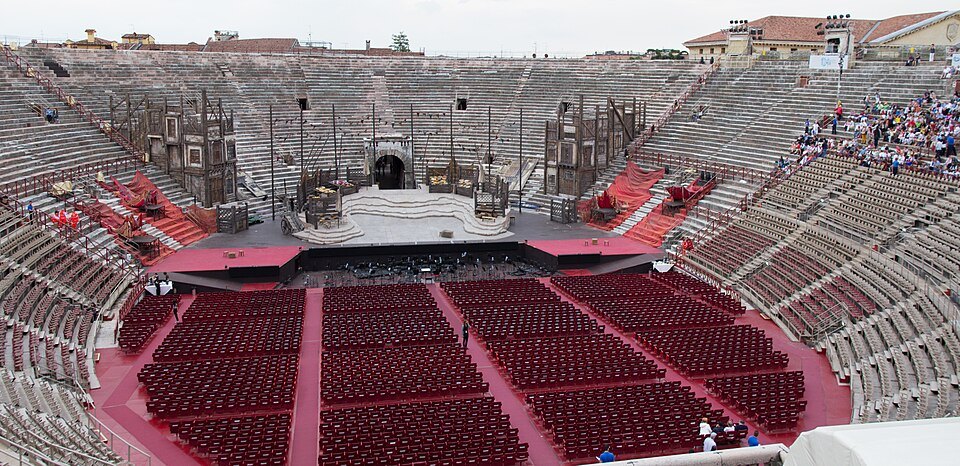
That scale still defines the evening. Wikipedia's article on the Arena gives its opera capacity as about 22,000, and the festival favors big works such as Aida, Nabucco, Turandot and Carmen. Recent programs even list a production billed as the 1913 edition of Aida. The season runs through the summer; dates and casts for each year are on the opera season page.
The festival is only the summer half of the Fondazione's year. Since 1976 its orchestra, choir and ballet company have also performed a winter-to-spring season at the rebuilt Teatro Filarmonico, so a visitor outside the summer can still hear the same ensembles indoors.
Some links on this page are affiliate links. If you book through one we may earn a commission, at no extra cost to you. It does not affect what is recommended here, and no sight page on this site carries one.
Opera tickets usually live on a phone — mobile data from arrival keeps them to hand.
Choosing a date and a seat
Seating falls into three kinds. The stalls on the arena floor have numbered seats with padded, upholstered backs. Side sectors have numbered chairs with backrests but no upholstery. Higher up, the numbered places on the ancient stone steps have no chair at all, which is why staff sell cushions and spectators may bring their own.
Tickets are for a dated seat. The Fondazione's rules state that tickets cannot be refunded or exchanged for another date or sector, are issued in the buyer's name after registration, and should be bought only through official channels: tickets obtained from unauthorized resellers can lead to entry being refused. Reduced tickets need an identity document at the gate. For timing a purchase, see booking ahead.
Families and some visitors need to plan further. Children under 14 must be accompanied by an adult, and from the 2026 festival children under four are admitted only to a dedicated family sector near the stage, with its own lounge, nursery and pram storage. Under-30 and over-65 reductions also depend on showing an identity document at entry.
What to wear and what to leave behind
There is no compulsory dress code, but the stalls have a floor. For men the minimum there is long trousers with a shirt or polo shirt, and shorts, tank tops and beach or pool sandals are refused, with no refund. On the stone steps comfort wins: a layer for later in the evening and something soft to sit on.
Note The bag rules are strict. Suitcases, trolleys, and bags or backpacks larger than 17 liters may not be brought in, there is no cloakroom, and storage at the entrance is not guaranteed. A small backpack and a small folding umbrella without sharp points are allowed. Food, drinks brought from outside, plastic bottles larger than half a liter, cameras, tripods and large binoculars all stay outside. Arriving straight from a flight? Read what to do with your bags on arrival.
Through the gates
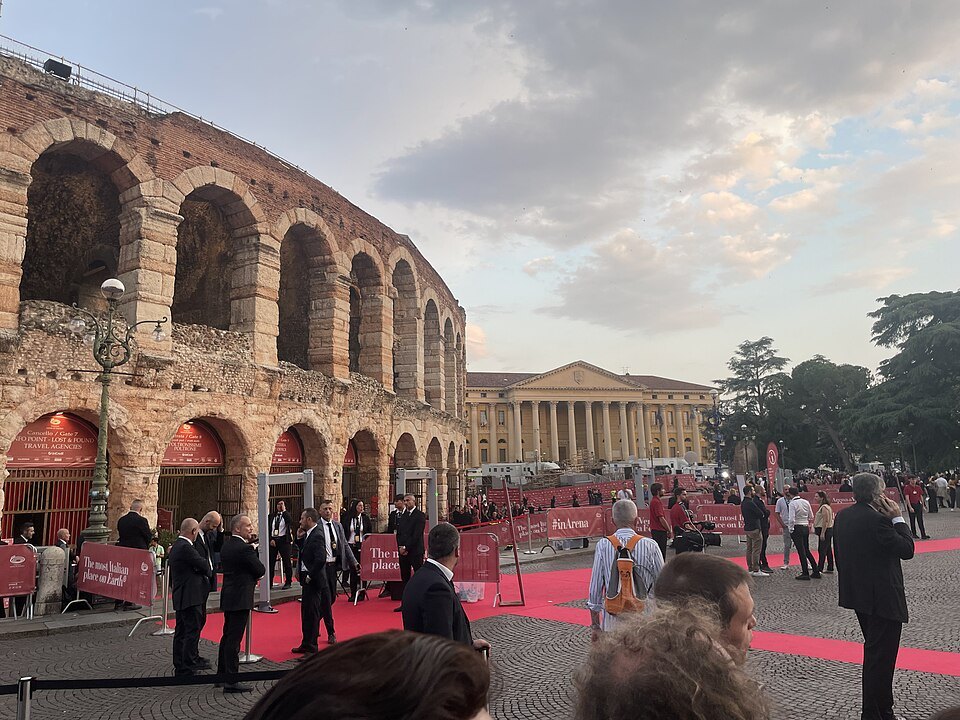
The gates open two hours before the performance, and the Fondazione asks spectators to be at the Arena at least an hour before it starts. The gate number printed on each ticket depends on the sector, but it can change at the last minute, so the signs above each entrance are what count. Before the gates there are security checks with walk-through metal detectors and bag inspections.
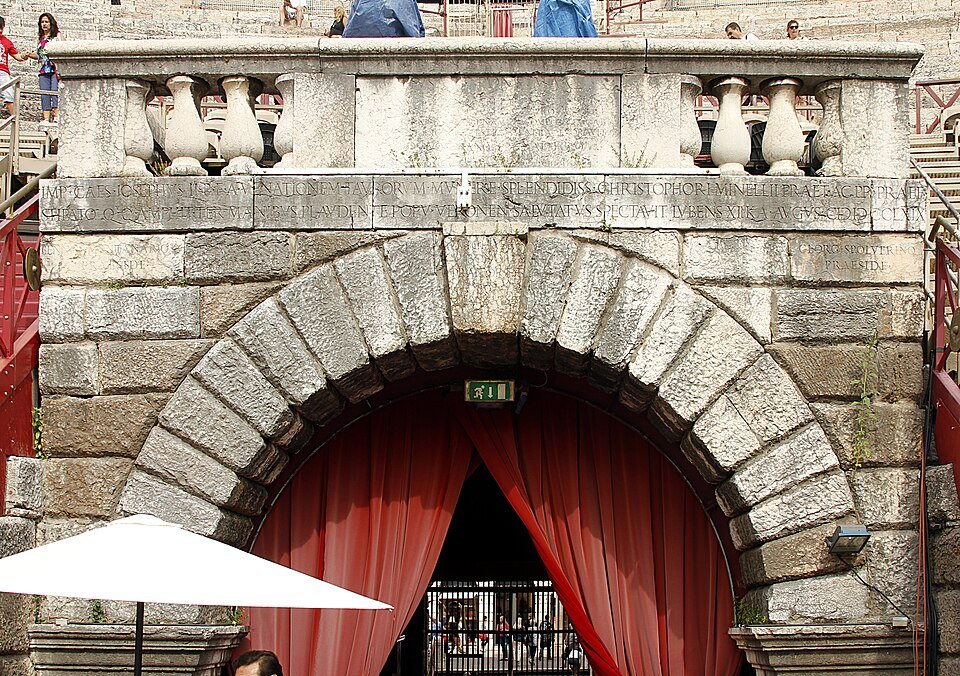
The waiting time is part of the evening. Inside there are bars, cushions for sale and an Info Point on performance days; librettos, programs and merchandise are sold at the Arena shop at gate 10. Eating and drinking are allowed only during the intervals and in the bar areas, so the hour before curtain is the time to settle, find the seat and watch the stone tiers fill.
Access for wheelchair users is arranged in advance. The Fondazione states that barrier-free access to the stalls is possible from gates 1, 4 and 8, reached from Piazza Bra by a metal ramp, that the stalls have two accessible toilets, and that designated seats are requested through its online form, subject to availability.
When the music starts
Performances traditionally begin at dusk, as the light goes over Piazza Bra. At some evenings, such as openings and galas, small candles are handed out at the entrance for spectators on the steps to light, a rite the Fondazione describes as historic.
Once the performance has begun, no one can reach their seat. Latecomers, and anyone who leaves their place, wait for the first interval. Phones must be switched off, and photographs or recordings are forbidden even with a phone, as are selfie sticks and standing up to watch. The rule on standing is easy to forget on the steps, where everyone behind depends on a clear line of sight.
If the weather turns
Rain is the one thing no ticket controls. Under the Fondazione's regulations a performance is never cancelled before its scheduled start, and the start may be pushed back by up to 150 minutes, two and a half hours, while the sky is watched. Stay near the Arena and check the official announcements rather than leaving at the first drops.
What happens next depends on how far the performance got. The rules distinguish between a show stopped before the end of the first act and one stopped after it, with different offers for tickets to other performances. A performance that has started is not refunded, while refunds for cancelled shows are requested through the original purchase channel within 14 days, following the procedure published on arena.it.
After the last act
The end of a big opera empties thousands of people into Piazza Bra at once, so there is no point rushing the exits. Evening and holiday bus lines 90, 92, 94, 96, 97 and 98 stop in the square for the ride back toward Porta Nuova station, the same lines that bring spectators in from the station.
Drivers have one extra service. At the end of each festival performance a free shuttle runs from Piazzetta Municipio, behind Palazzo Barbieri, back to the Park Centro car park. Anyone arriving by car should first read how Verona's limited-traffic zone works, since the Arena sits right on its edge.
Read next
- Getting HereGetting from Verona airport to the old town, and what to do with your bagsHow the Airlink shuttle, taxis and the walk up from Porta Nuova station get you into Verona's old town, and how to plan around your luggage.Read
- Getting AroundArriving in Verona by car when the old center is a limited-traffic zoneVerona's historic center is a camera-watched limited-traffic zone. Who may drive in, what hotel guests must do, and where visitors leave the car instead.Read
- Castel San PietroWhere to stand for the view of the Adige loop in the morning and at sunsetThe terrace below Castel San Pietro looks across the Adige at the whole old town. How to get up, what you see, and how the light changes morning to dusk.Read