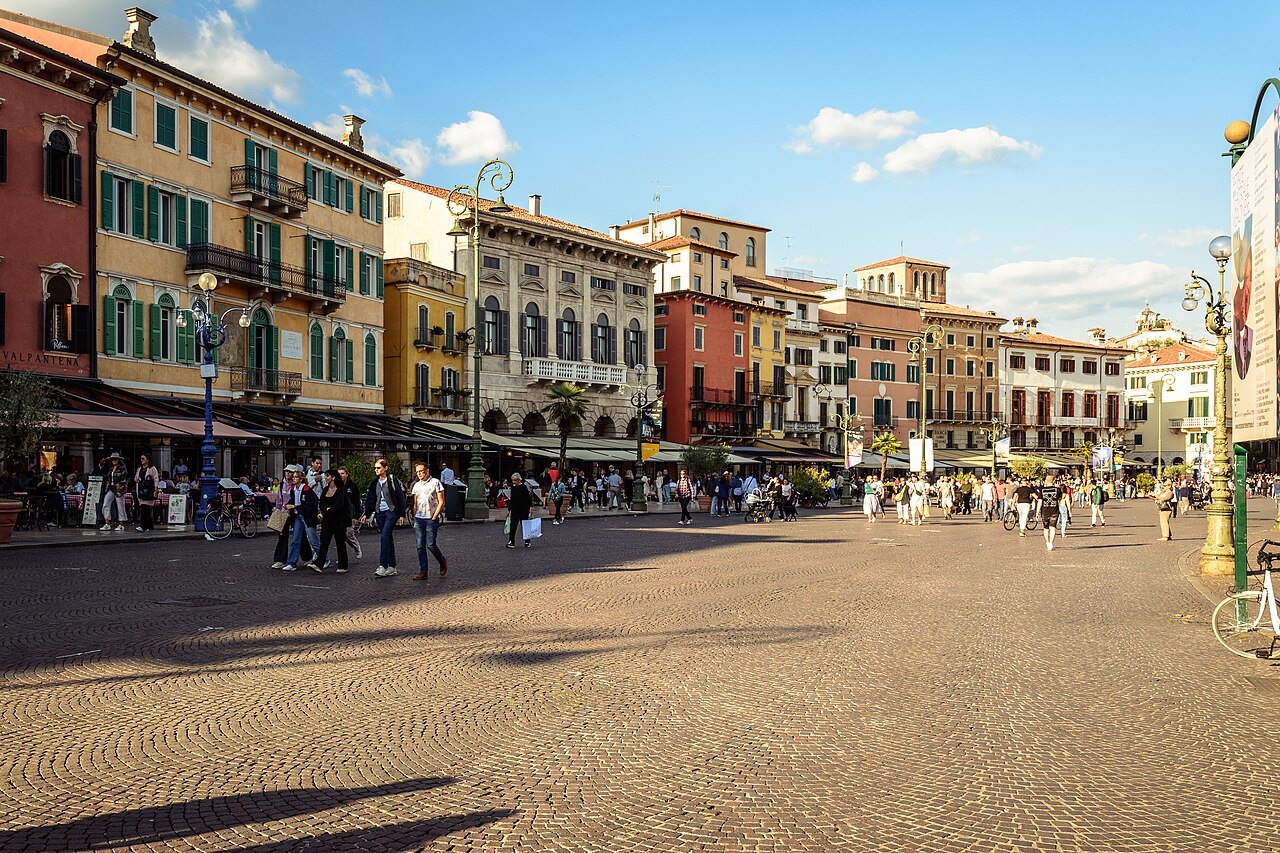
Verona's largest square, where the medieval gates open onto the Roman Arena, the town hall, a guardhouse centuries in the making and a promenade paved in red stone.
Around the square
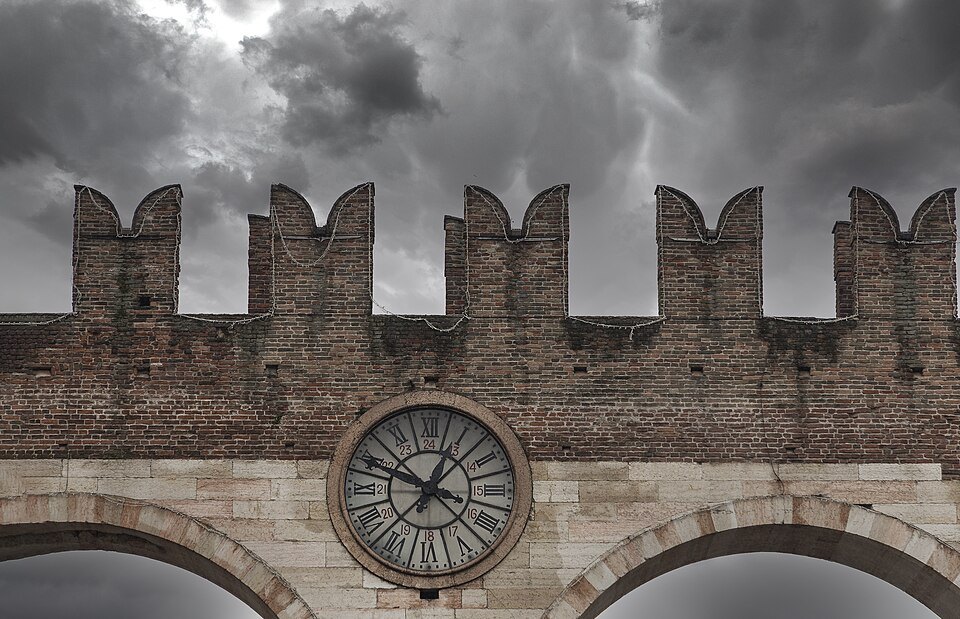
- 1Portoni della BraThe double-arched medieval gateway with its clock, between the square and Corso Porta Nuova
- 2The ListonThe broad paved promenade lined with terraces, running from the Portoni toward Via Mazzini
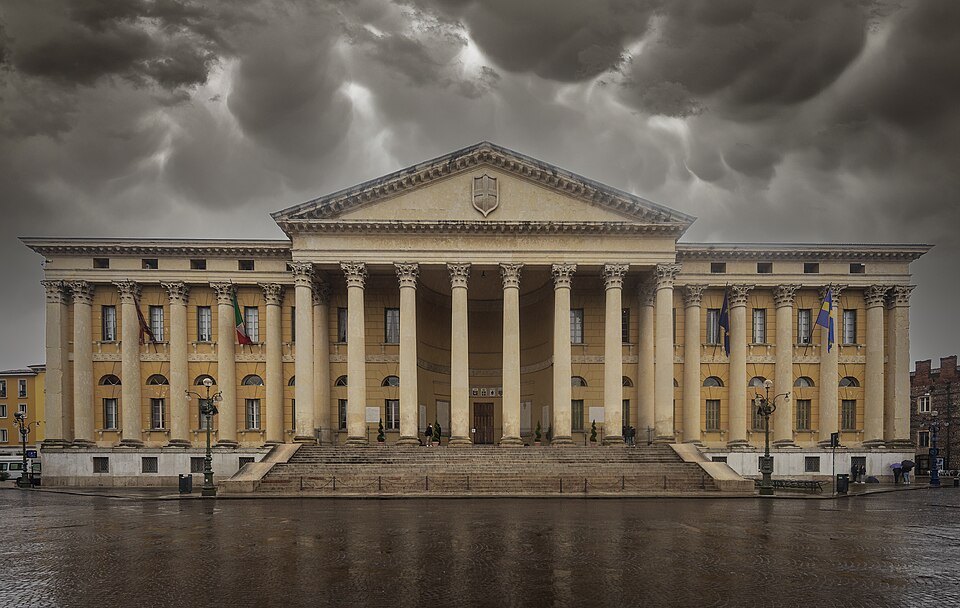
- 3Palazzo BarbieriThe neoclassical town hall with eight giant Corinthian columns and a wide flight of steps
- 4Gran GuardiaThe long rusticated guardhouse with a thirteen-arch portico, begun in 1610
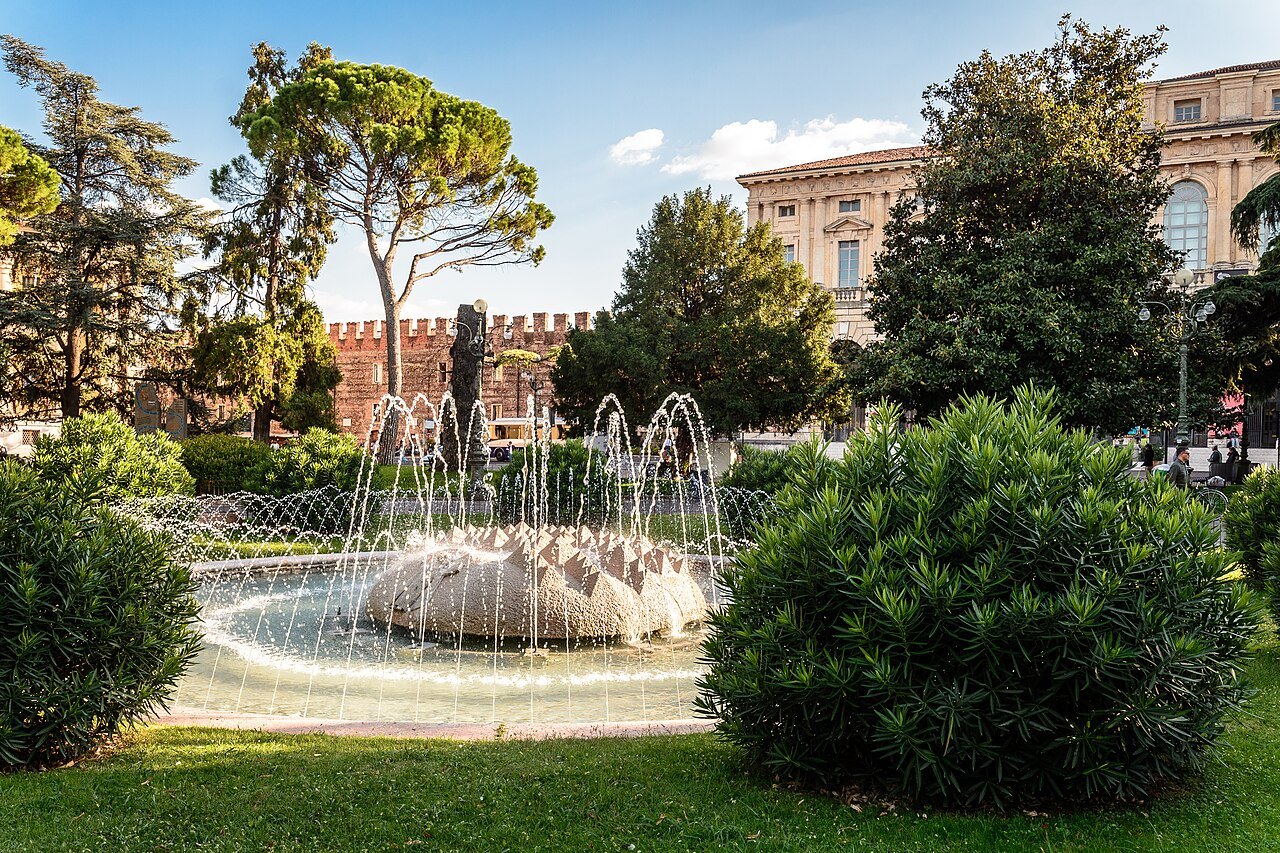
- 5The central gardensFlowerbeds laid out in 1873 around a fountain, near the bronze Victor Emmanuel II
- 6Museo Lapidario MaffeianoScipione Maffei's courtyard of ancient inscriptions, tucked beside the Portoni della Bra
- 7The ArenaThe Roman amphitheatre that gives the square its scale, open to visitors by day
The city's front room
Piazza Bra is the largest square in Verona and, for most visitors, the first one. Arriving along Corso Porta Nuova, the road passes through the medieval Portoni della Bra and opens onto a wide space with gardens in the middle, the Roman Arena on one side and the long curve of café terraces on the other.
It is less a monument than a stage set assembled over two thousand years: a Roman amphitheatre, fourteenth-century gates, a guardhouse begun under Venice and finished two centuries later, a neoclassical town hall rebuilt after the Second World War, and a garden laid out in the 1870s. Knowing which is which turns a crossing into a short lesson in the city's history.
A field outside the walls
The name comes from braida, itself from the Lombardic word breit, meaning broad. For centuries this was open ground, used for markets in wood, hay and cattle from the twelfth century onward, and for military reviews and fairs. The city's December fair of Saint Lucy still takes place here, carrying on the old livestock-market tradition.
The gateway came first. The inner arch of the Portoni della Bra dates from the late fourteenth century and the second from the mid-fifteenth. In 1871 Count Antonio Nogarola gave the clock set between the arches, with dials facing both the square and the avenue; it was inaugurated in 1872.
Building a square
Domenico Curtoni's Gran Guardia, commissioned in 1606, was started in 1610, but money ran out in 1614 and the building stood unfinished for more than two centuries, finally completed in 1853. Michele Sanmicheli's Palazzo degli Honorij, from the mid-sixteenth century, had already defined the western edge.
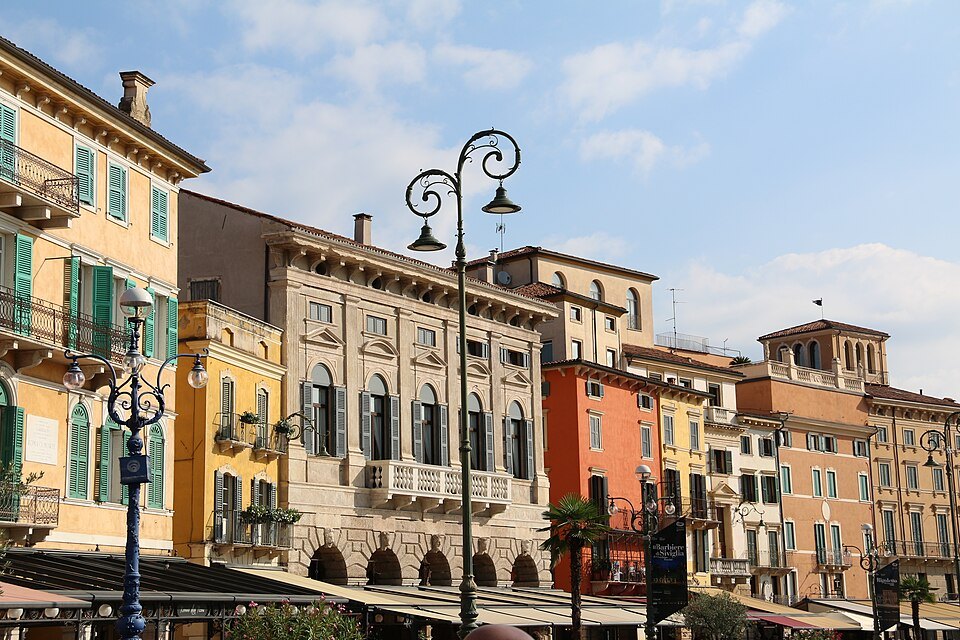
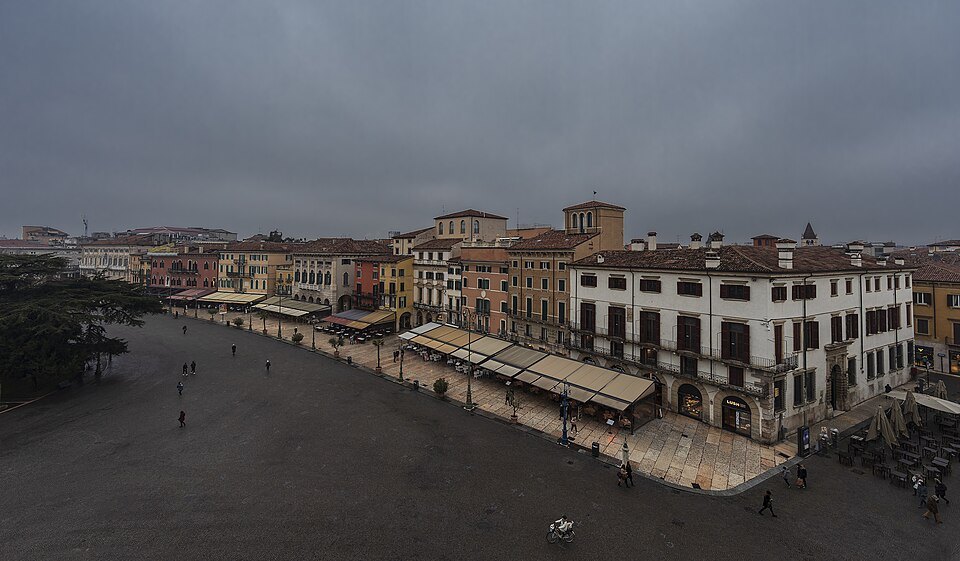
In 1770 the podestà Alvise Mocenigo opened the first stretch of the Liston, a paved walk linking Corso Porta Nuova to Via Mazzini, and a plan to finish it followed in 1782. It became the city's favorite place for an evening stroll. In 1820 the level of the square was lowered by about seventy centimeters, the same year the families living in the Arena's arches were evicted.
Town hall, king and gardens
Palazzo Barbieri, the building with the giant columns, was designed by Giuseppe Barbieri and built from the 1830s, with Francesco Ronzani completing it after the architect's death. It was meant as a new guardhouse but became the city's municipal offices in 1868. Allied bombing in February 1945 badly damaged it, and it was restored between 1947 and 1950, when a semicircular wing was added at the back.
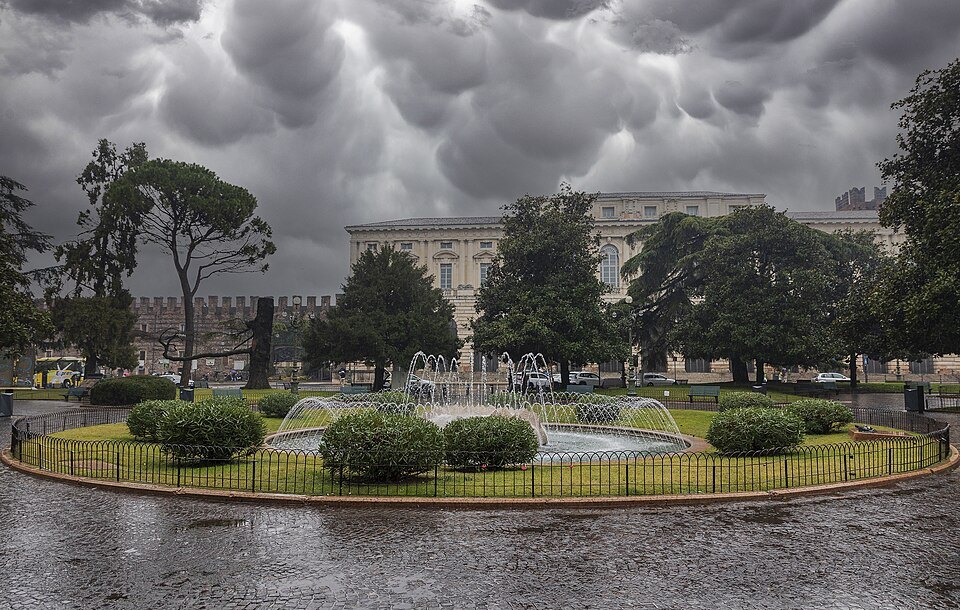
The gardens in the middle were planted in 1873, with flowerbeds arranged around a fountain. Ambrogio Borghi's bronze equestrian statue of Victor Emmanuel II, the first king of united Italy, was unveiled on 9 January 1883; its pedestal had to be reinforced months later to carry the weight of the bronze.
What you actually see
Stand by the Portoni and look at the Liston underfoot: the paving, laid between 1770 and 1782, is the same red stone as the Arena, quarried in the hills north of the city. The Gran Guardia has a lower portico of thirteen arches in heavy rustication and fifteen windows above under alternating triangular and curved pediments. Across the square, Palazzo Barbieri's facade has eight central Corinthian columns of giant order under a pediment, reached by a broad staircase.
In the gardens, the modern fountain shaped like a range of peaks is the Fountain of the Alps, given by Munich in 1975 to mark the twinning of the two cities. Locals nickname it the strucca limoni, the lemon squeezer. Beside it a plaque remembers Italians deported to Nazi concentration camps.
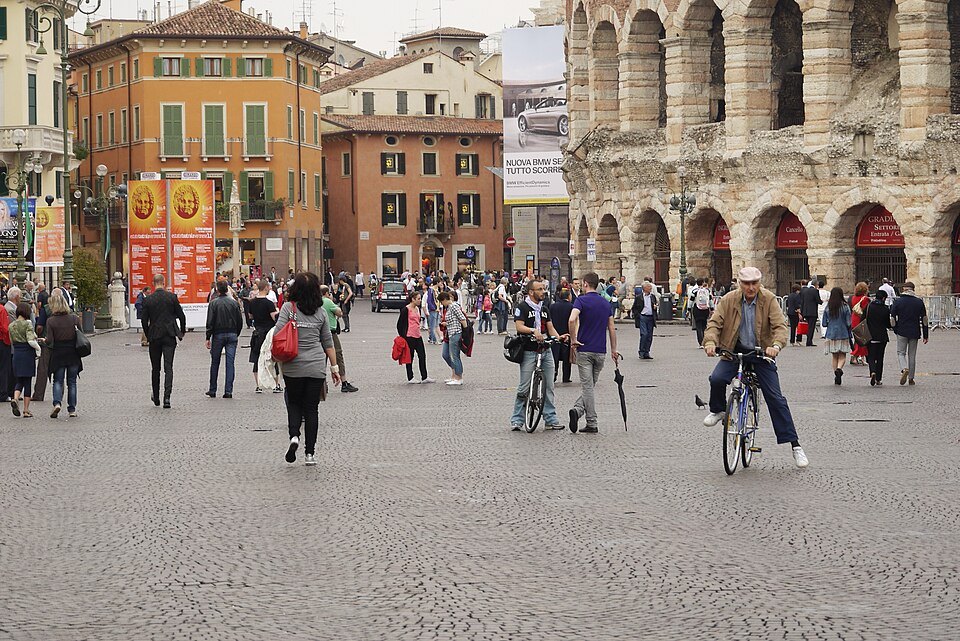
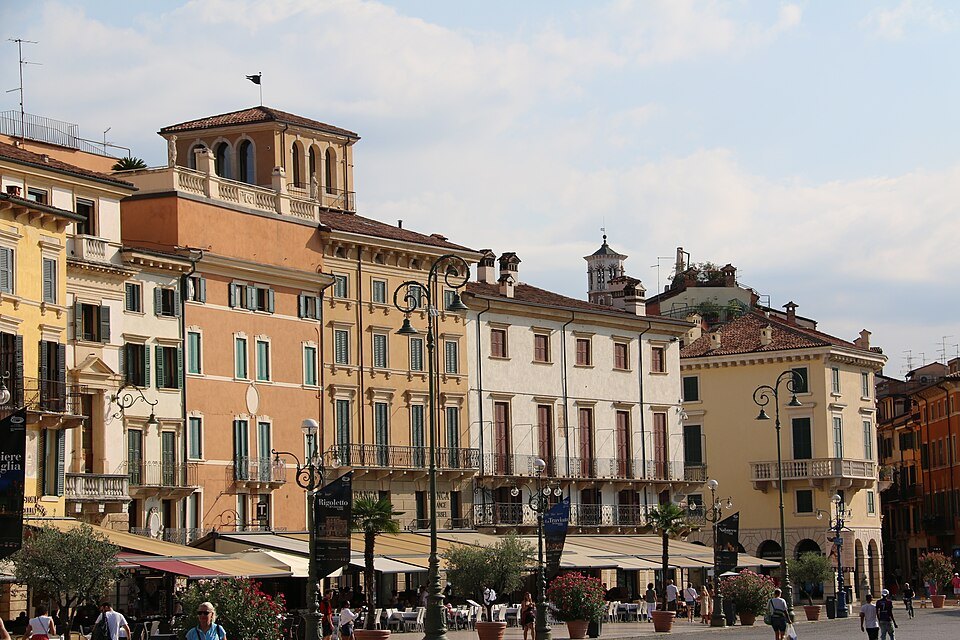
Along the Liston, look up at the older houses behind the terraces. Palazzo Guglienzi-Brognoligo is a fifteenth-century Renaissance building whose facade carries a fresco by Francesco Morone, and it housed the city's Società Letteraria. Palazzo Fracasso-Giafilippi, also fifteenth-century, has a painted facade by Caroto.
The stone museum by the gates
Right next to the Portoni della Bra, in the courtyard of the Accademia Filarmonica building, is the Museo Lapidario Maffeiano. The scholar Scipione Maffei assembled it in the first half of the eighteenth century from hundreds of Greek, Etruscan and Roman inscriptions, and it is counted among the oldest public museums in Europe.
Maffei sold paintings to pay for acquisitions, and wanted the collection open freely to the public. Alessandro Pompei designed the Doric portico around the courtyard, completed in 1745, and the museum became a regular stop for Grand Tour travellers. Inside are Greek funerary stelae, Etruscan cinerary urns and rows of Roman inscriptions, a quiet contrast to the square outside.
How to visit
Crossing the square takes minutes, but give it half an hour to walk the Liston, circle the gardens and look at the buildings in turn. It fills up on summer evenings when opera audiences gather for the Arena, and in December during the Saint Lucy fair.
The square is flat and fully accessible, with public transport stopping close by. Combine it with the Arena interior, then walk on to Piazza delle Erbe and Casa di Giulietta, or head the other way to Castelvecchio. For opera nights, see the opera season.
Nearby
- The Arena and Piazza BraThe ArenaA Roman amphitheatre finished around AD 30 that has been used, lived in and restored for nearly two thousand…Read the page
- West along the AdigeCastelvecchioA brick fortress of the della Scala lords on the Adige, with its own fortified bridge and one of Italy's most…Read the page
- Inside the loopJuliet's HouseA genuine medieval tower-house on Via Cappello, tied to Romeo and Juliet by a family name, a hat carved in…Read the page
- Inside the loopPiazza delle ErbeThe long market square laid over Verona's Roman forum, crowded with stalls, painted houses, a Roman statue on…Read the page