The terrace and what it looks over
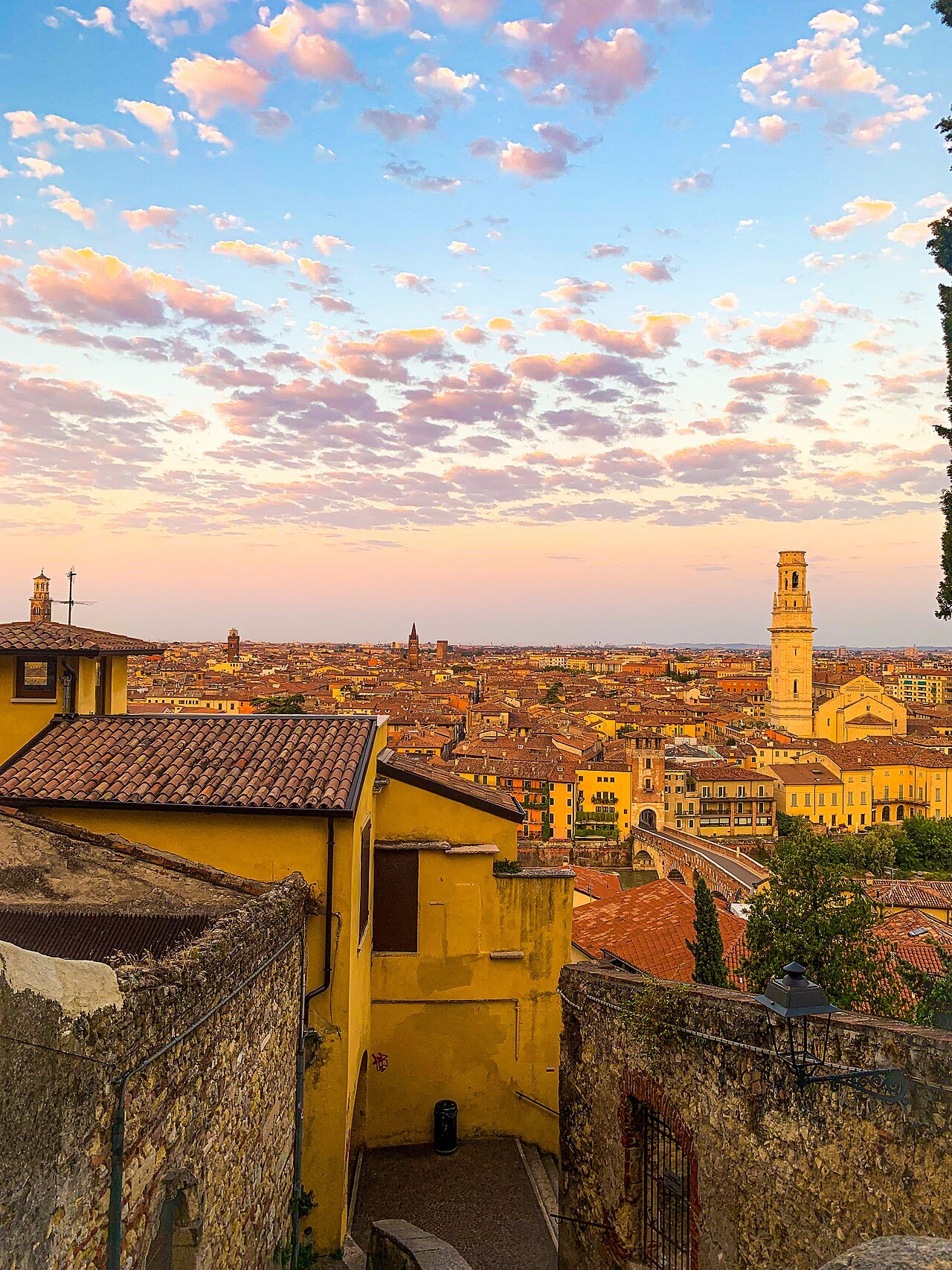
The best-known view of Verona is from the terrace in front of Castel San Pietro, on the hill across the Adige from the old town. From the parapet the river curls around the historic center, passing right below under Ponte Pietra, and the town inside the loop spreads out as a single field of roofs and towers.
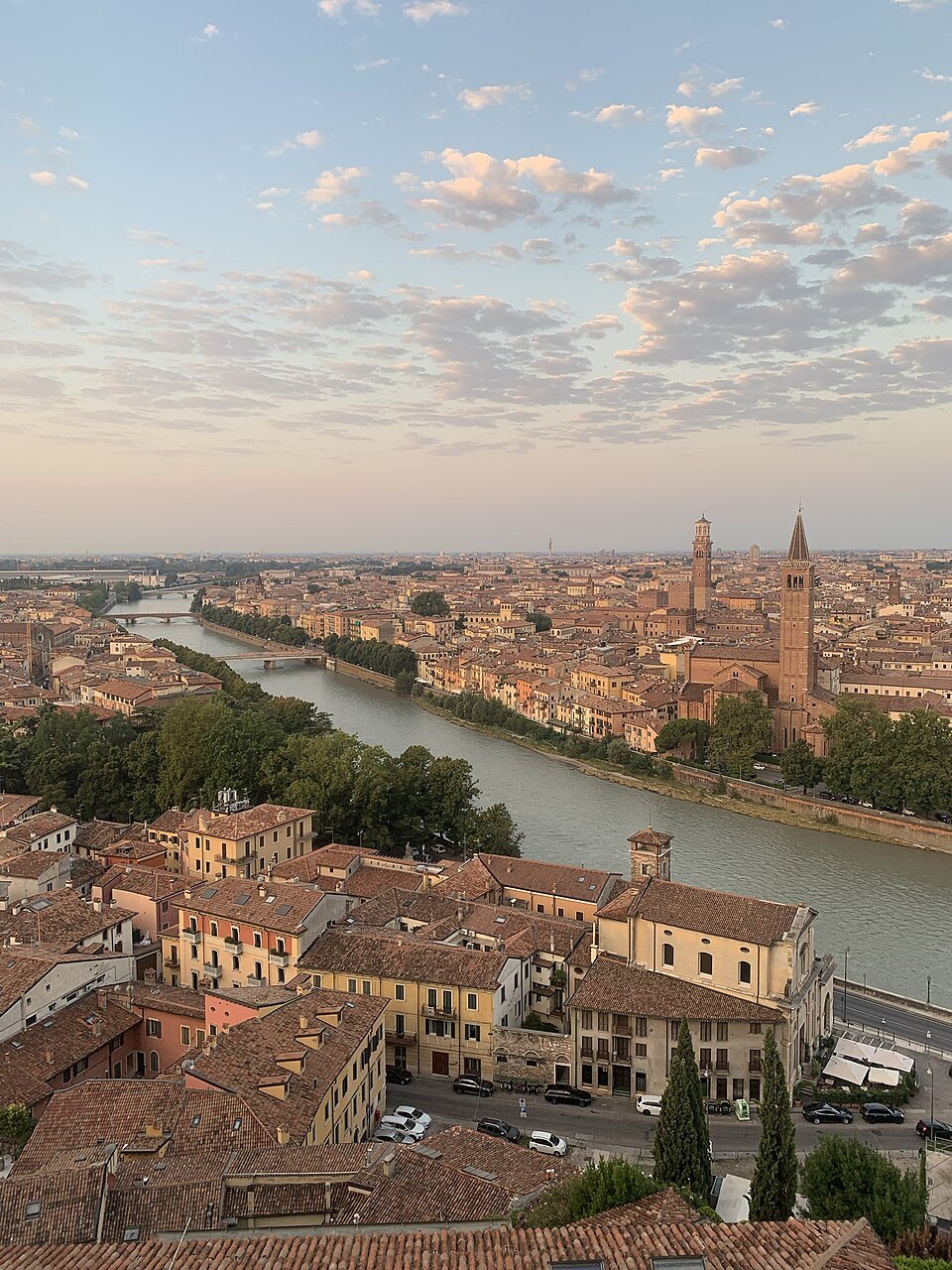
The tourism office lists what to pick out: the dome of San Giorgio in Braida, the Duomo and Sant'Anastasia with their bell towers, the Torre del Gardello and the Torre dei Lamberti, and the bridges linking the city's districts. The map explains the composition. The castle stands north-east of Piazza delle Erbe, so the terrace faces west and south-west across the loop.
The bridge below is worth knowing before looking down at it. Ponte Pietra, completed around 100 BC on the line of the Via Postumia, is the oldest bridge in Verona. One arch was rebuilt in 1298 under Alberto I della Scala, and after retreating German troops blew up four arches in the Second World War, the bridge was reconstructed and finished in 1957.
Why this hill matters
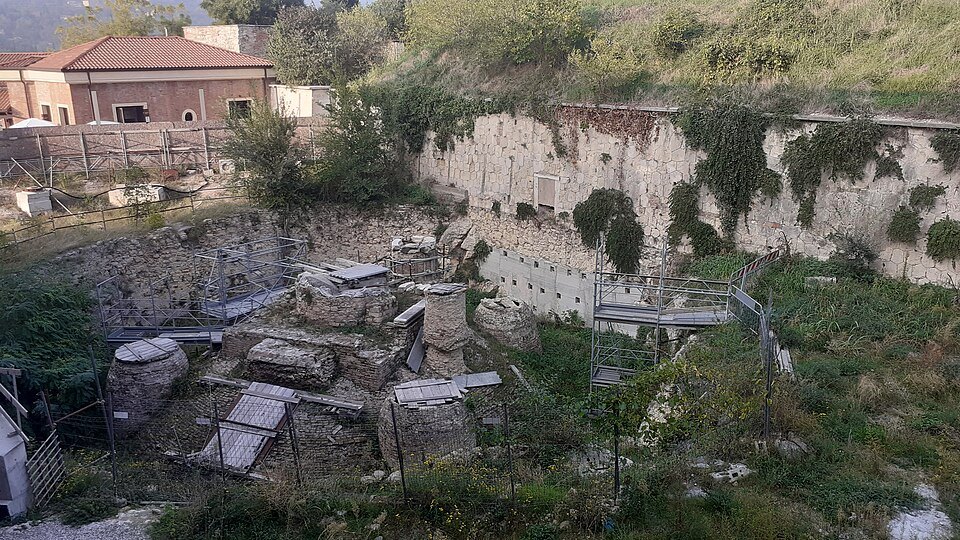
Colle San Pietro was the first inhabited part of the city, with settlement dating back to the Iron Age; the tourism office places it between the sixth and fifth centuries BC. In Roman times the slope became a stage set in itself, with the Roman Theater built into it and, it is thought, a temple on the summit.
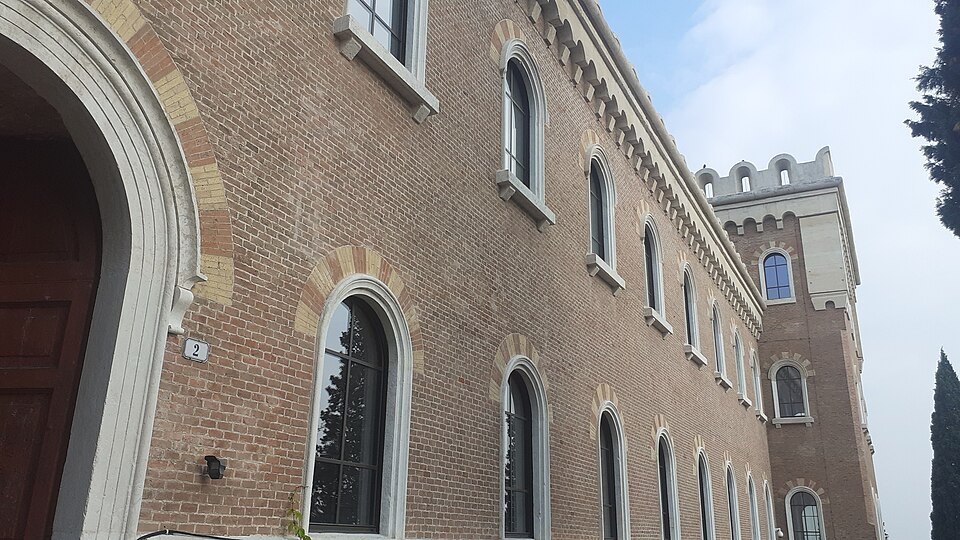
The hill kept its commanding role. Theodoric, king of the Ostrogoths, had a palace built at the top, a Visconti castle followed in 1393, and Napoleon's troops destroyed the castle and nearby buildings, including a church, in 1801. The building seen today is an Austrian barracks in neo-Romanesque style from the 1850s; sources give its construction years slightly differently.
The barracks is a long brick building in three parts, rising four floors in the middle with five-floor towers at the ends and arches picked out in alternating colors, designed to house about 461 soldiers. After military use it served as an art academy and an orphanage, and plans to turn it into a city museum have been studied since 2002.
Getting up: funicular or steps
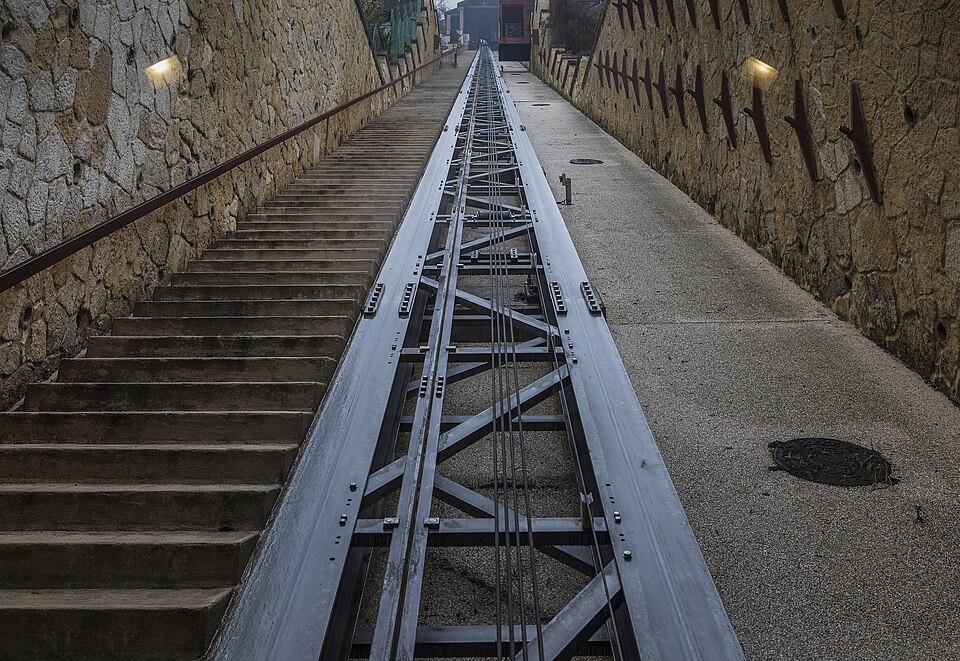
The funicular starts in Via Fontanelle Santo Stefano, on the right just past Ponte Pietra toward Via Santo Stefano. First built for students of the fine arts academy that occupied the castle, it ran from 1941 to 1944 and reopened on 9 June 2017 as an inclined lift with a 25-passenger cabin. The ride takes a little over a minute and climbs 55 meters.
The alternative is the staircase, which the tourism office counts at 231 steps, with the view opening up as you climb. A path also leads down through the green area between the castle and the Roman Theater. The funicular is fully accessible and runs later in summer than in winter, so check its hours before planning a sunset ride down.
The lower station has its own story. From 1975 it housed the Teatro Laboratorio, an avant-garde theater company founded by Ezio Maria Caserta, which moved out in 2011 so the line could be rebuilt. The new lift climbs a gradient of 37 percent and can carry 800 passengers an hour, and the green area below the castle covers some 18,000 square meters.
The morning view
In the morning the sun rises in the east, behind the hill and to the left of anyone facing the city. The light therefore comes from the viewer's side and falls on the old town rather than into the lens, so towers, roofs and the water under the bridge are lit from the front instead of standing as silhouettes.
Stand at the parapet directly above Ponte Pietra for the classic composition, with the bridge at the bottom of the frame and the towers of the center beyond it. Morning is also the practical time to combine the terrace with the archaeological museum at the Roman Theater, which the funicular serves with an intermediate stop, before walking back across the river.
The view at sunset
In the evening the city is backlit, and where the sun goes down shifts with the season. Working from the positions of the landmarks, around the winter solstice it sets roughly beyond the towers of the center, close to the line of Piazza delle Erbe. Around the equinoxes it drops near San Giorgio in Braida, and in midsummer it sets well to the right of that dome.
That makes the stance different in each season. In winter the Torre dei Lamberti and the towers around it stand against the glow; in summer the sun sits off to the right of the main view, so the roofs of the loop take a low side light instead. Sunset is the hour most guides recommend, so expect company along the parapet and arrive early enough to find a place at the rail.
Planning the visit
Allow an hour for the climb, the terrace and the way down, longer if the Roman Theater's museum is on the list. The tourism office's walking route around the funicular, the castle and the museum covers about one kilometer and takes roughly an hour.
The hill fits neatly into a day built around the old town. A morning here can be followed by a late morning at Juliet's House across the river, and a sunset visit leaves time to walk back down for an evening of opera in the Arena in summer.
Read next
- Juliet's HouseJuliet's House is a story Verona chose to tell, and still worth an hourThe Casa di Giulietta is tied to Romeo and Juliet by literary tradition, not record. What the city built there, what to look at, and how entry works.Read
- The Opera SeasonWhat an evening of opera in the Arena is like, from the gates to the last actSeats, dress, bags, candles, rain delays and the walk out: how an opera night inside Verona's Roman amphitheater actually unfolds, step by step.Read