Home · Sights · Palazzo Maffei
The baroque palace that closes the end of Piazza delle Erbe, built over Roman Verona's temple and home to a private collector's house museum.
The parts to look at
- GroundRoman foundationsRemains of the Capitolium temple complex beneath the palace, on the lowest level
- Level 1Ground-floor arcadeFive arches of a false portico with shops, framed by rusticated Doric pilasters
- Level 2Piano nobileBalconied door-windows with alternating pediments, stuccoes, frescoed rooms and the Carlon collection
- Level 3Helical staircaseSelf-supporting elliptical stone stair winding from the cellars to the roof
- Level 4Second floorNine thematic rooms added to the museum in 2021, with windows onto the square
- Level 5Balustrade statuesHercules, Jupiter, Venus, Mercury, Apollo and Minerva lined along the roofline
- Level 6Roof terraceOnce planned as a hanging garden with citrus trees, now a viewpoint over the piazza
The palace at the end of the square
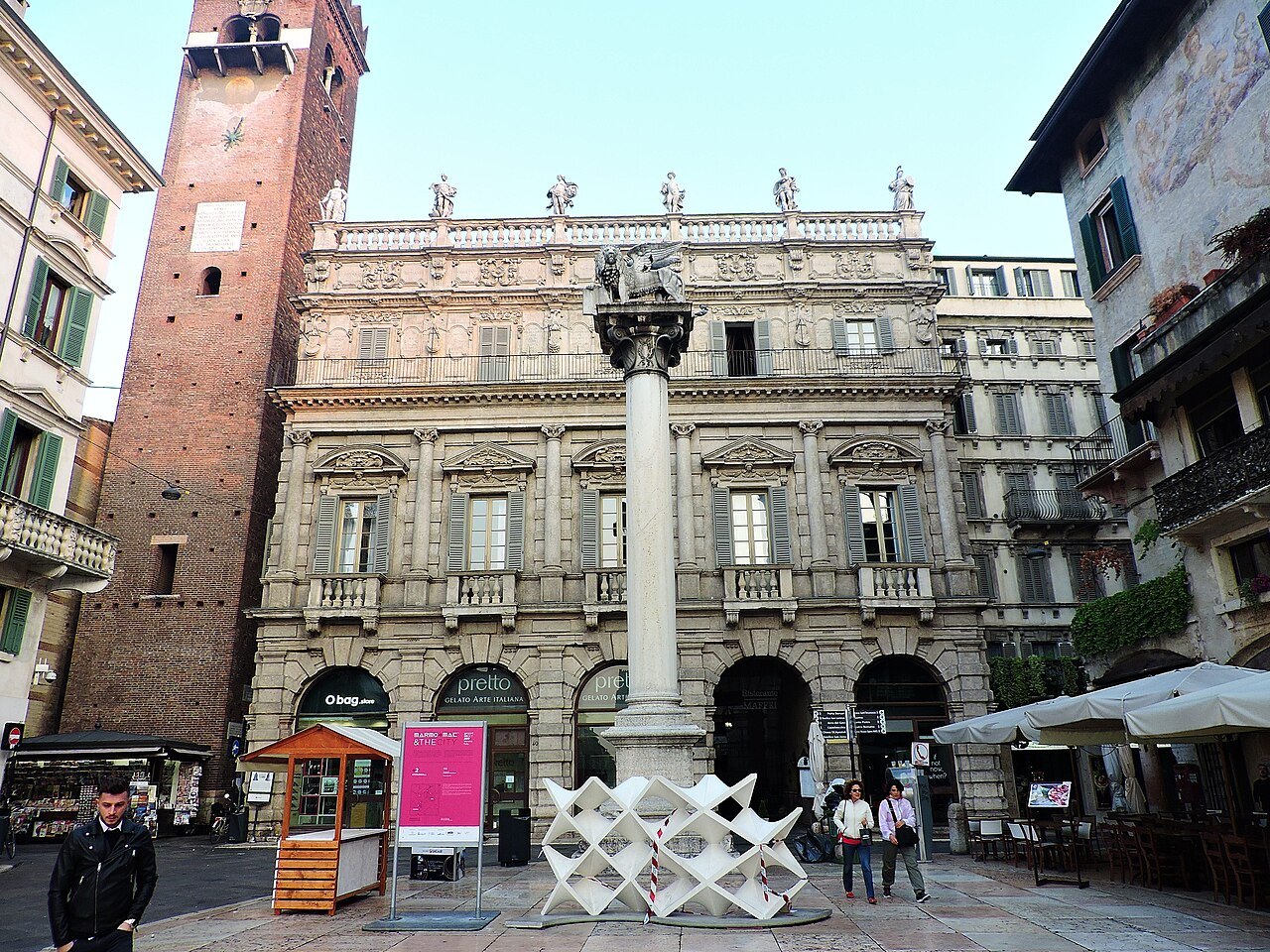
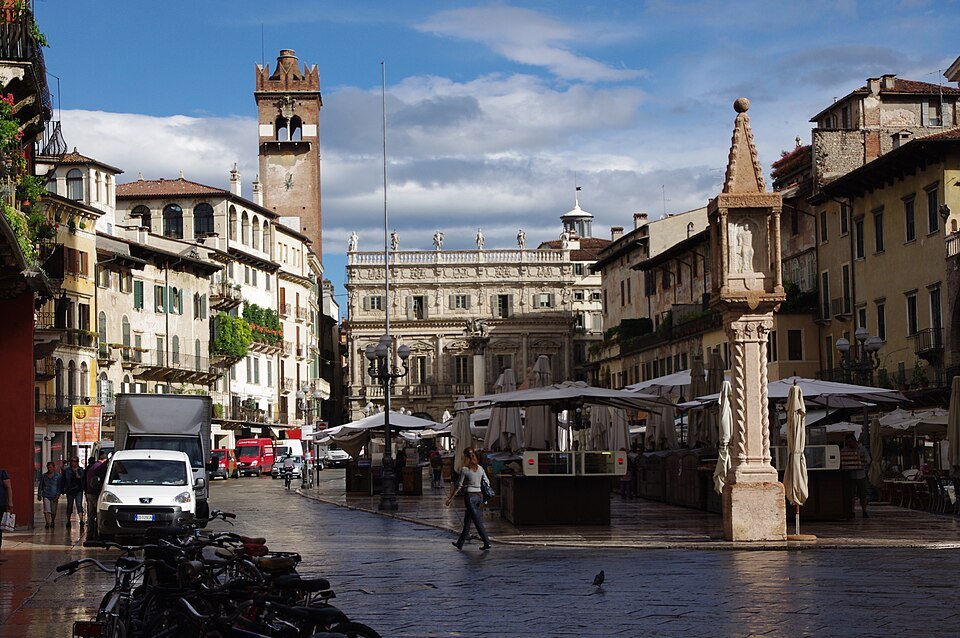
Stand anywhere in Piazza delle Erbe and look north-west: the long market square ends at a pale, heavily ornamented front with a row of statues along its roof. That is Palazzo Maffei, the one fully baroque building in a square otherwise made of medieval towers and painted Renaissance houses.
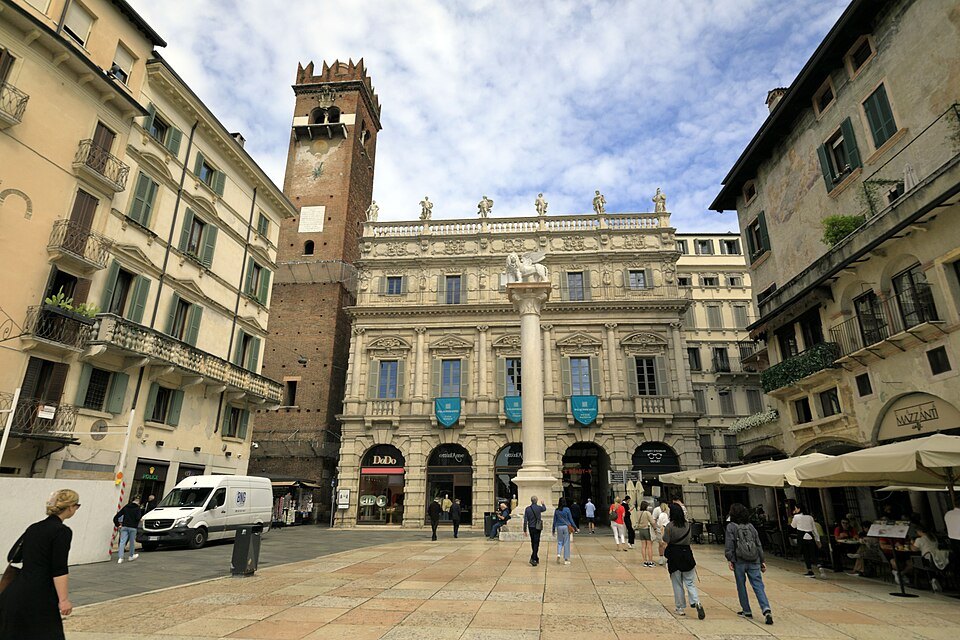
It rewards a visitor twice. From outside it is a lesson in how a seventeenth-century banking family advertised itself on the city's main stage. Inside, since 2020, it has been a house museum, where a Veronese collector's paintings, sculpture and objects fill the old reception rooms, and a terrace looks straight down the length of the piazza.
Built over the Roman temple
The palace stands on the site of the Capitolium, the temple complex dedicated to the Capitoline Triad that Roman Verona built when the town became a municipality in 49 BC. According to the museum, the foundations of that complex are still visible beneath the building. The oldest parts of the palace above ground are late medieval.
The present building belongs to the seventeenth century. Marcantonio Maffei and his nephew Rolandino, both bankers, asked the city council for permission to enlarge their house, and Italian Wikipedia dates the start of work to December 1626. The ground floor and piano nobile went up before the plague of 1630 halted everything.
Work resumed after the epidemic, probably from 1663, and an inscription in the courtyard records completion in 1668. The architect is unknown. The scholar Scipione Maffei, from another branch of the family, wrote that the design came from Rome, which fits the family's ties to the papal city.
Reading the facade
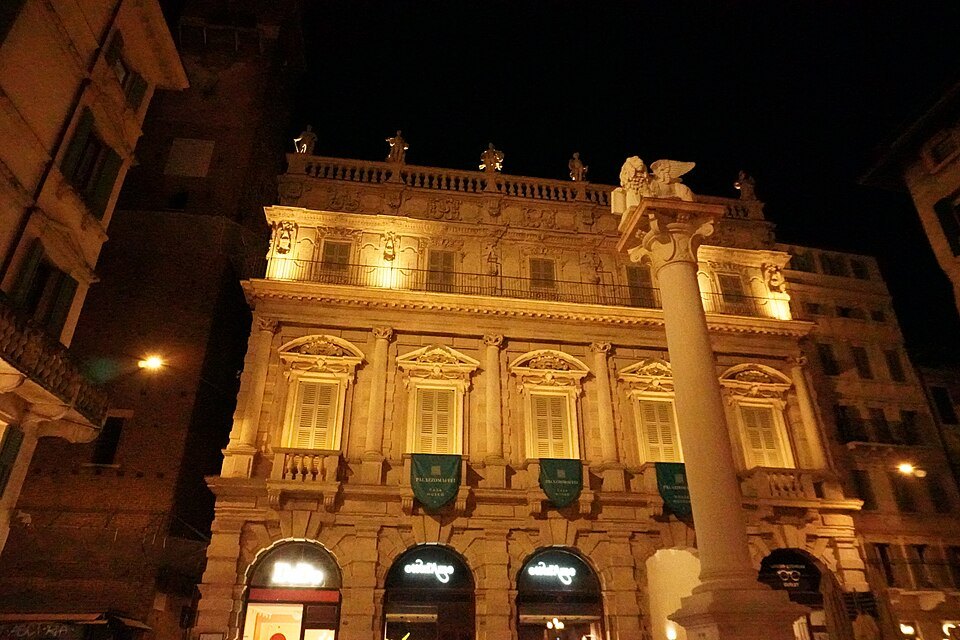
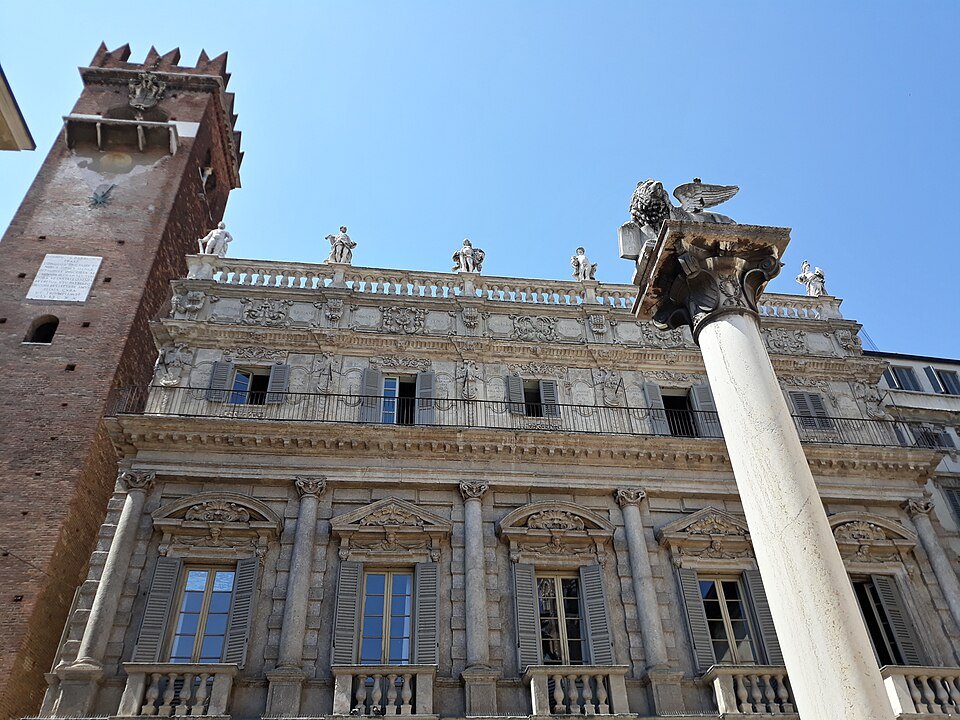
The front mixes late Renaissance motifs with baroque ones. At street level, five arches form a false portico with shops, separated by rusticated Doric pilasters. The main floor has five tall door-windows with balustraded balconies, their pediments alternating between curved and triangular, framed by Ionic half-columns carrying carved masks.
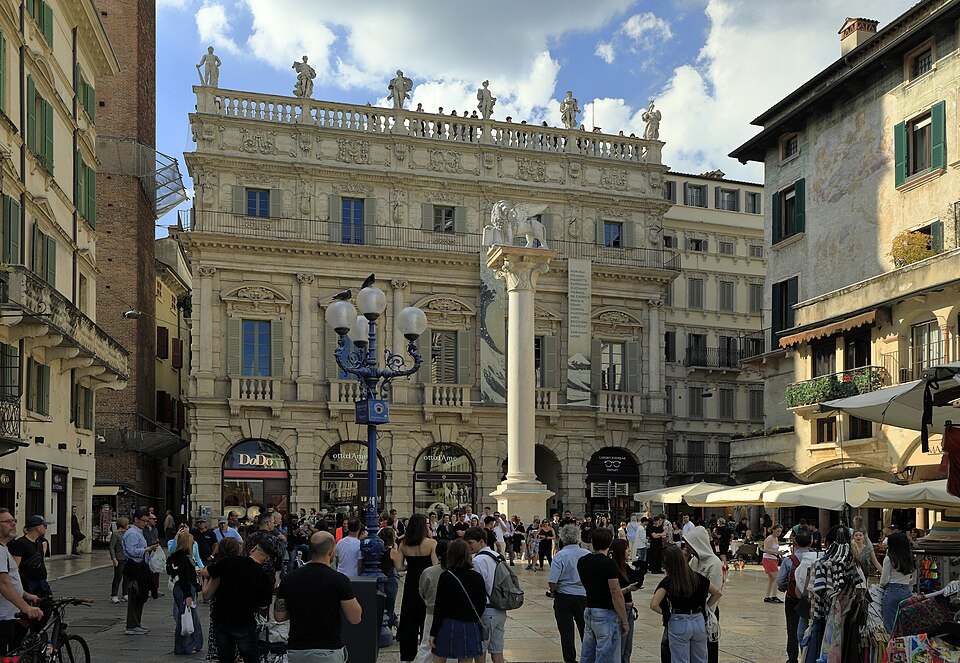
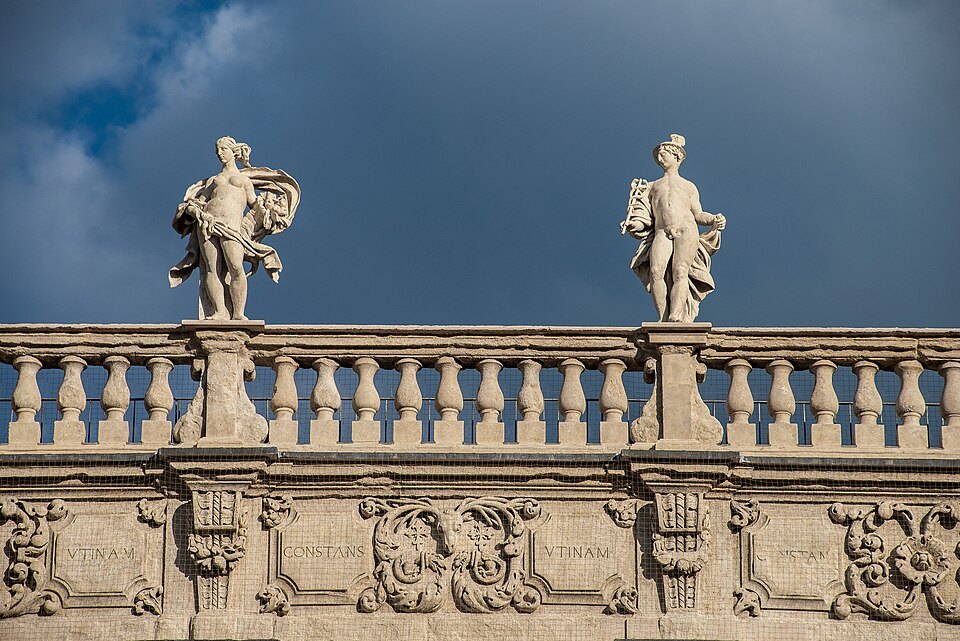
Along the roof stand six marble gods: Hercules, Jupiter, Venus, Mercury, Apollo and Minerva. Look at Hercules, on the left: he is noticeably paler than the rest. The museum says he was carved from a single block of Parian marble found in excavations beneath the palace, and Wikipedia describes the figure as believed to be of Roman origin.
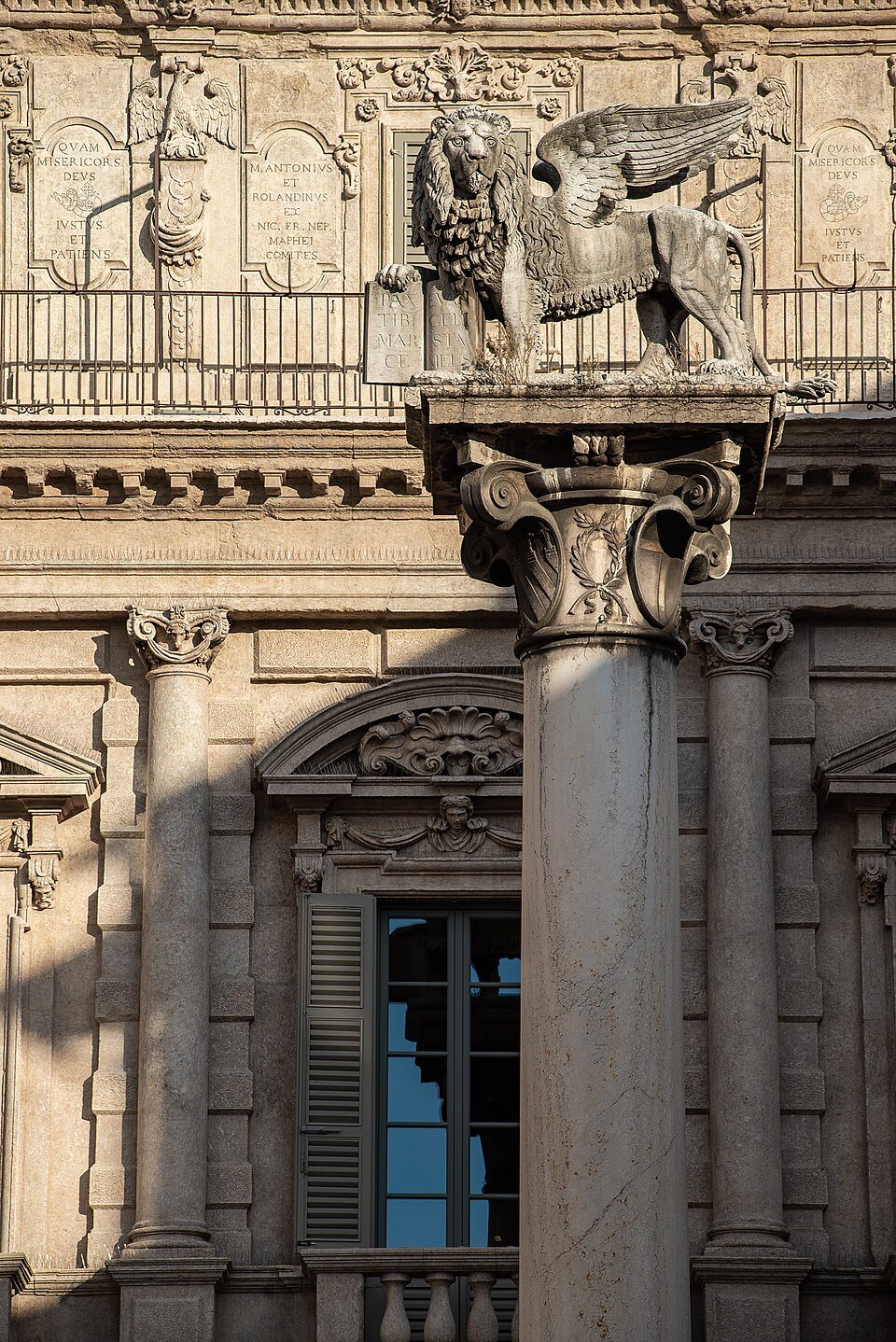
In front of the palace rises the Colonna di San Marco, a marble column set up in 1517 when Verona returned to Venetian rule. Its lion of Saint Mark was destroyed in 1797 under French occupation; the one on top now was made by Cesare Poli and raised in 1886.
The staircase and the roof garden
The palace's most daring piece of building is inside. An elliptical helical staircase in stone winds from the cellars to the roof without a central support, crowned by a lantern and statues. Scipione Maffei described it as standing entirely in the air, and it still looks improbable from below.
At the top, the roof terrace was designed to hold a hanging garden with citrus trees. It was recorded in 1714 in the engraved illustrations of the German naturalist Johann Christoph Volkamer. Behind the facade, two square courtyards are linked by a passage, and the reception rooms keep stuccoes, eighteenth- and nineteenth-century frescoes and a black marble fireplace.
The Casa Museo and the Carlon collection
The Palazzo Maffei Casa Museo opened in February 2020 to show the collection of Luigi Carlon, a Veronese entrepreneur who spent some fifty years buying art for his own home. The museum concept was developed by Gabriella Belli, and the restoration and fit-out were designed by the studio Baldessari e Baldessari.
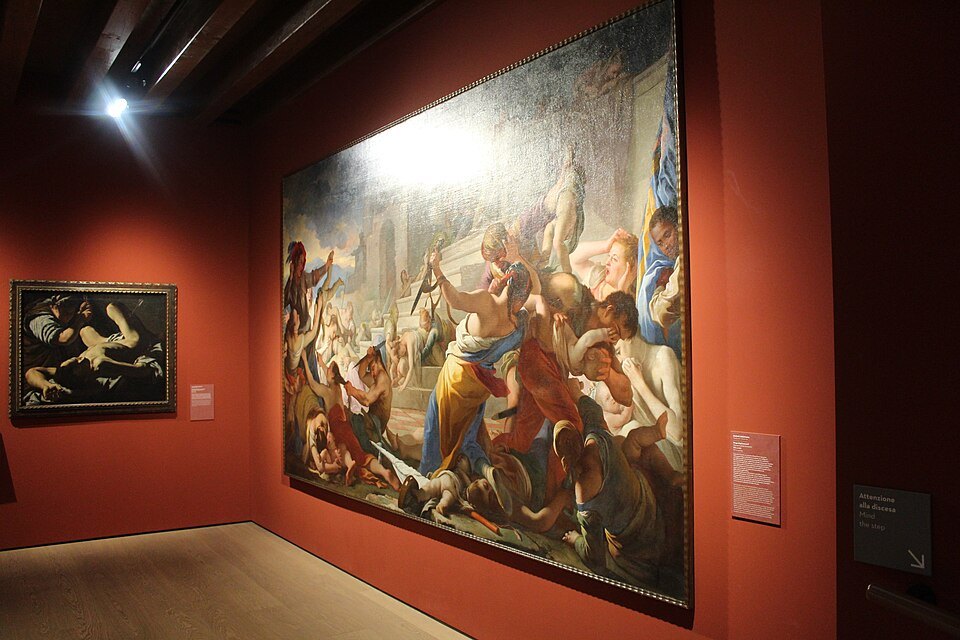
The first stage presented more than 350 works, among them nearly 200 paintings, about twenty sculptures, drawings, furniture, ancient glass, Renaissance ceramics, majolica, silver, ivories and oriental objects. They are hung in eighteen themed rooms in the spirit of a Wunderkammer, deliberately mixing periods rather than following a timeline. The range runs from a medieval work attributed to the Second Master of San Zeno to Lucio Fontana and Marcel Duchamp.
A second stage opened in October 2021 on the second floor, adding nine rooms arranged as themed meditations on subjects such as time and metamorphosis, plus a small theater and an art library. Names across the collection include Picasso, Magritte, Kandinsky, Boccioni, de Chirico, Warhol, Burri, Manzoni and Canova, alongside Veronese artists.
How to visit
Allow an hour for the museum and terrace at an easy pace, longer if twentieth-century art is your interest. The facade costs nothing: the best view of the statues is from the middle of the square, a little back from the market stalls. Check the museum's official site for its schedule and for occasional closures for private events before planning around it.
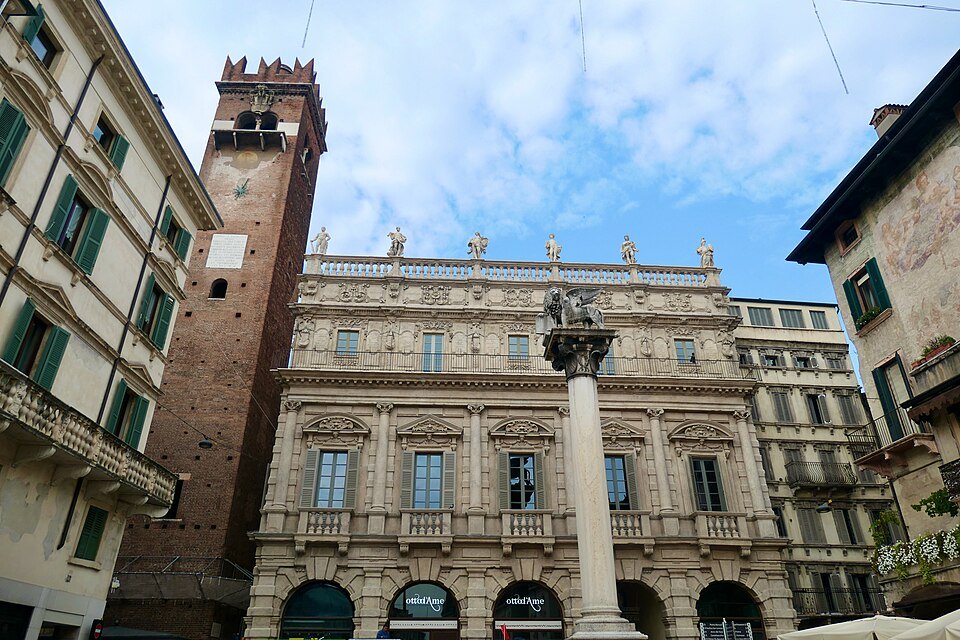
The palace sits in the most compact corner of the old town. The Torre dei Lamberti rises from the other end of the same square, the Roman gate of Porta Borsari is a short walk away, and Juliet's House is a few minutes south-east. Pairing the museum terrace with the tower gives two very different views of the same square in one morning.
Nearby
- Inside the loopPiazza delle ErbeThe long market square laid over Verona's Roman forum, crowded with stalls, painted houses, a Roman statue on…Read the page
- Inside the loopTorre dei LambertiThe medieval civic tower between Piazza delle Erbe and Piazza dei Signori, with two old bells at the top and…Read the page
- Inside the loopPorta BorsariA white limestone Roman gate still standing across a busy street, carved with the date an emperor rebuilt the…Read the page
- Inside the loopJuliet's HouseA genuine medieval tower-house on Via Cappello, tied to Romeo and Juliet by a family name, a hat carved in…Read the page