Home · Sights · Torre dei Lamberti
The medieval civic tower between Piazza delle Erbe and Piazza dei Signori, with two old bells at the top and the widest view over the old center.
The parts to look at
- FootCortile Mercato VecchioThe old market courtyard of the Palazzo della Ragione, where the climb begins
- Scala della RagioneThe open stone staircase of 1447 rising along one side of the courtyard
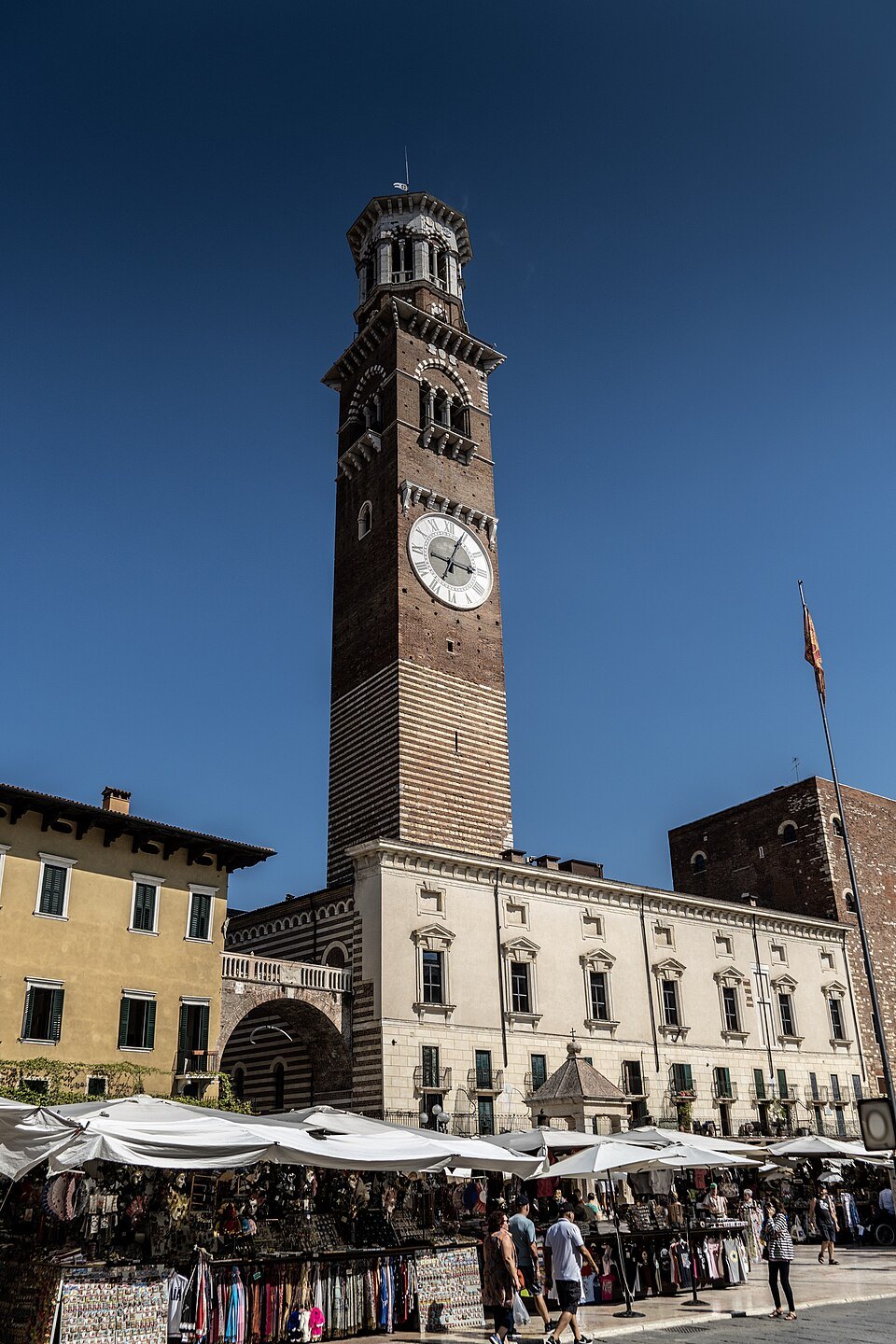
- Romanesque shaftThe lower tower of 1172, laid in alternating bands of tufa and brick
- Clock faceThe large clock added to the tower in the late eighteenth century
- Octagonal bell chamberFifteenth-century upper stage in marble and brick, with tall Gothic windows
- Marangona and RengoThe two historic bells of 1295, hanging close to the viewing level
- TopPanoramic terraceThe top platform, looking over rooftops, piazzas, the Adige and the hills
The tallest lookout in the old town
The Torre dei Lamberti rises 84 meters from the block that separates Piazza delle Erbe from Piazza dei Signori. It is the vertical marker you keep seeing over the rooftops, the one that tells you where the market is from almost anywhere inside the river bend.
It is worth the climb for two reasons. The first is the view: from the top the whole medieval center lies spread out below, with the Arena, the Adige and the hills north of the river in one sweep. The second is the tower itself, a building that records eight centuries of civic life in its bands of stone, its bells and its clock.
Begun in 1172, finished three centuries later
Construction began in 1172. Tradition credits the powerful Lamberti family, who gave the tower its name; the city's tourist board notes that much about its origins is undocumented. The first tower was Romanesque, built in alternating courses of tufa and fired brick, the striped pattern still visible on the lower shaft.
In May 1403 lightning struck the top of the tower and wrecked its upper part. Rebuilding started in 1448 and ran until about 1464, according to both the Italian and English Wikipedia accounts. The builders raised the tower to its present height and crowned it with an octagonal bell chamber in white marble and brick, opened by tall, elegant Gothic windows.
The seam between the medieval shaft and the fifteenth-century top is easy to read from the piazza below: the plain striped masonry gives way to the paler, more decorated octagon. The tower belongs to the Comune di Verona and has been open to the public for its view since 1972.
The bells and the clock
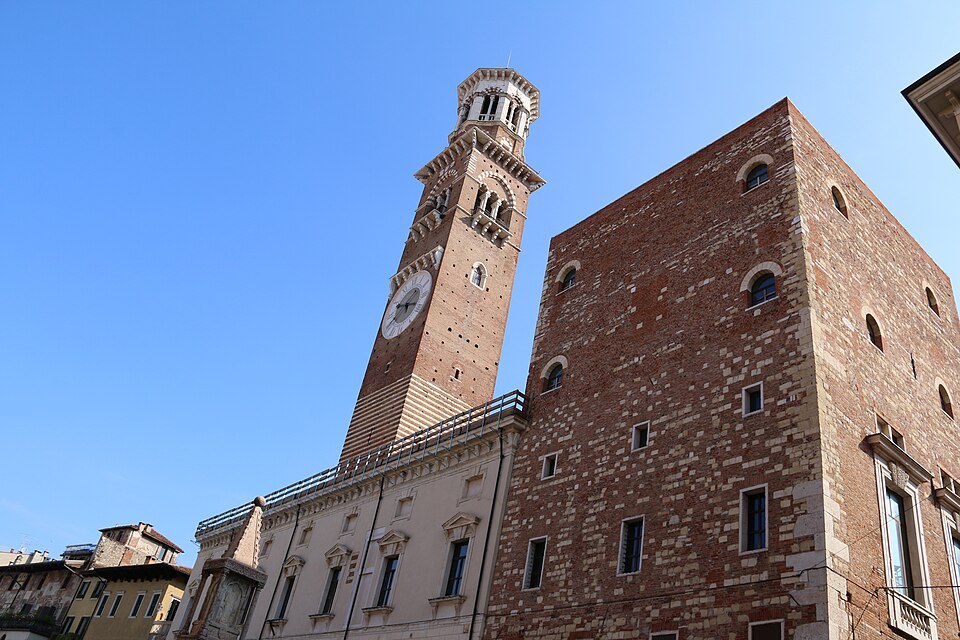
Two bells were hung in the tower in 1295, and both are still there. The smaller, the Marangona, takes its name from marangon, Veronese dialect for carpenter: it marked the working hours of the day and sounded the alarm for fires. The larger, the Rengo, is named after the arengo, the medieval assembly. It summoned the city councils and called citizens to arms.
The Rengo was rung during the Veronese Easter uprising of 1797 against the French. A clock came later: English Wikipedia dates it to 1779, while the tower's own site credits Count Giovanni Sagramoso and gives 1795. The tourist board adds that it was installed after the clock on the nearby Torre del Gardello stopped working. Either way, it is an eighteenth-century addition to a medieval tower.
What you pass on the way up
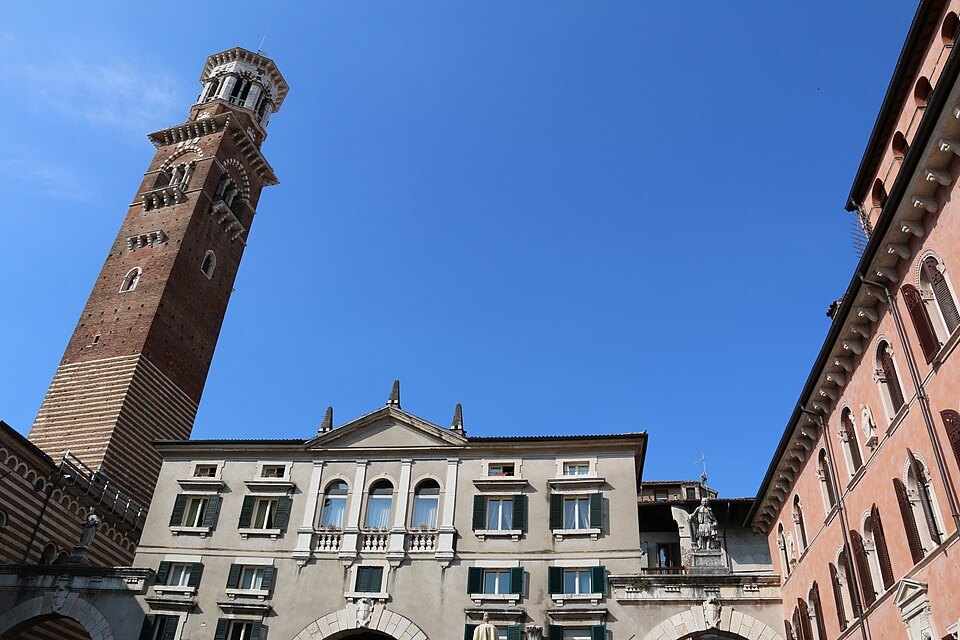
The entrance is not on either square. It lies inside the Cortile Mercato Vecchio, the courtyard of the Palazzo della Ragione, the medieval palace that shares the block with the tower. Look at the courtyard before you go in: its main building was completed in 1194 and it was heavily restored in the late nineteenth by the architect Camillo Boito.
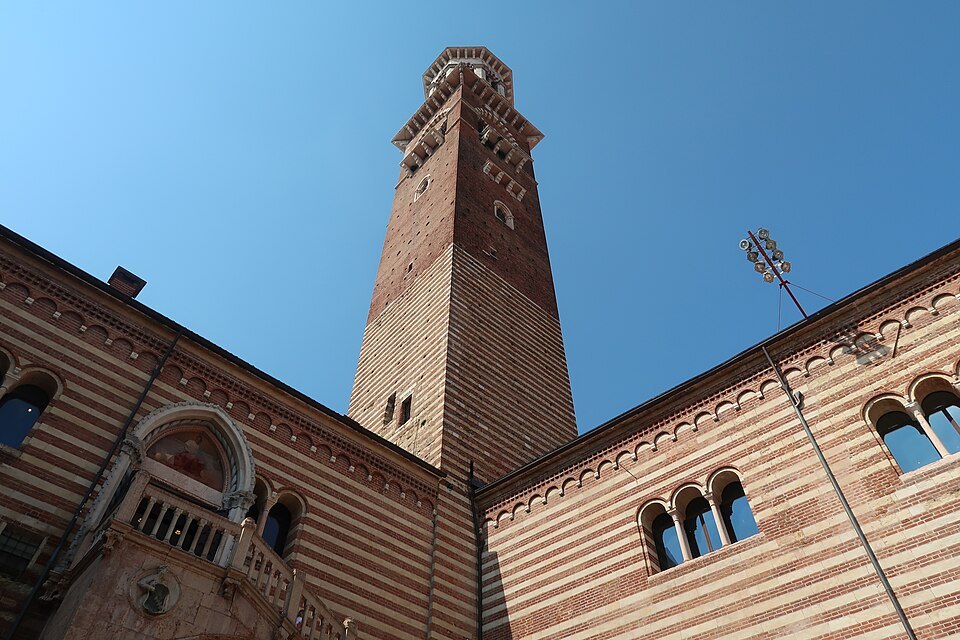
Along one side runs the Scala della Ragione, an open stone staircase built in 1447. It was once roofed over; the covering was removed during restoration in the 1890s, which is why it now reads as a sculptural flight of steps climbing into the light. The palazzo's upper floors house the Galleria d'Arte Moderna Achille Forti, opened in 2014.
Inside the tower, visitors choose between the internal stairs and a glass-walled lift that shows the structure as it rises. The tourist board counts 368 steps; the tower's own site gives a lower figure, so treat the number as several hundred either way.
The view from the top
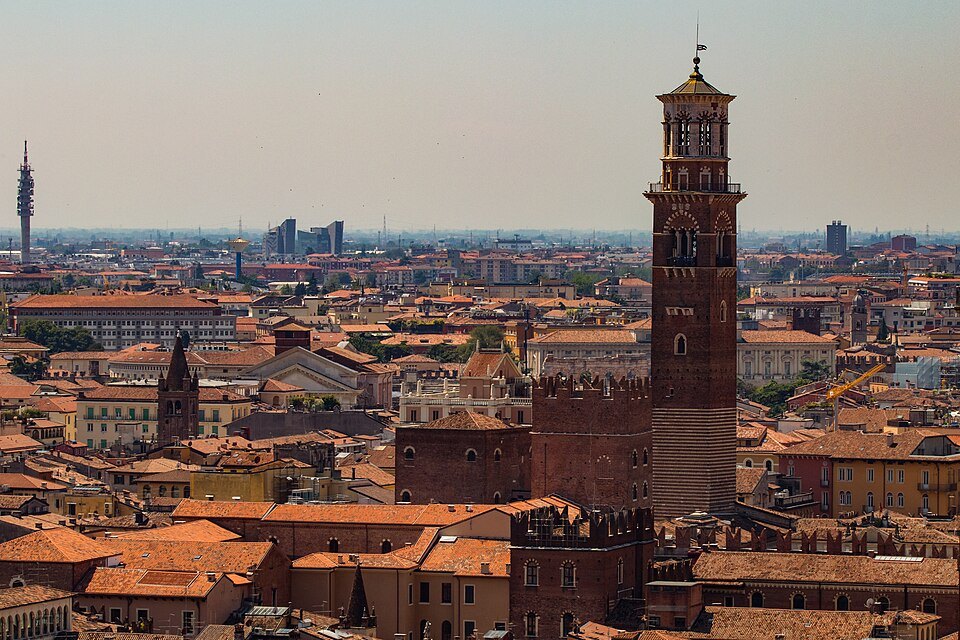
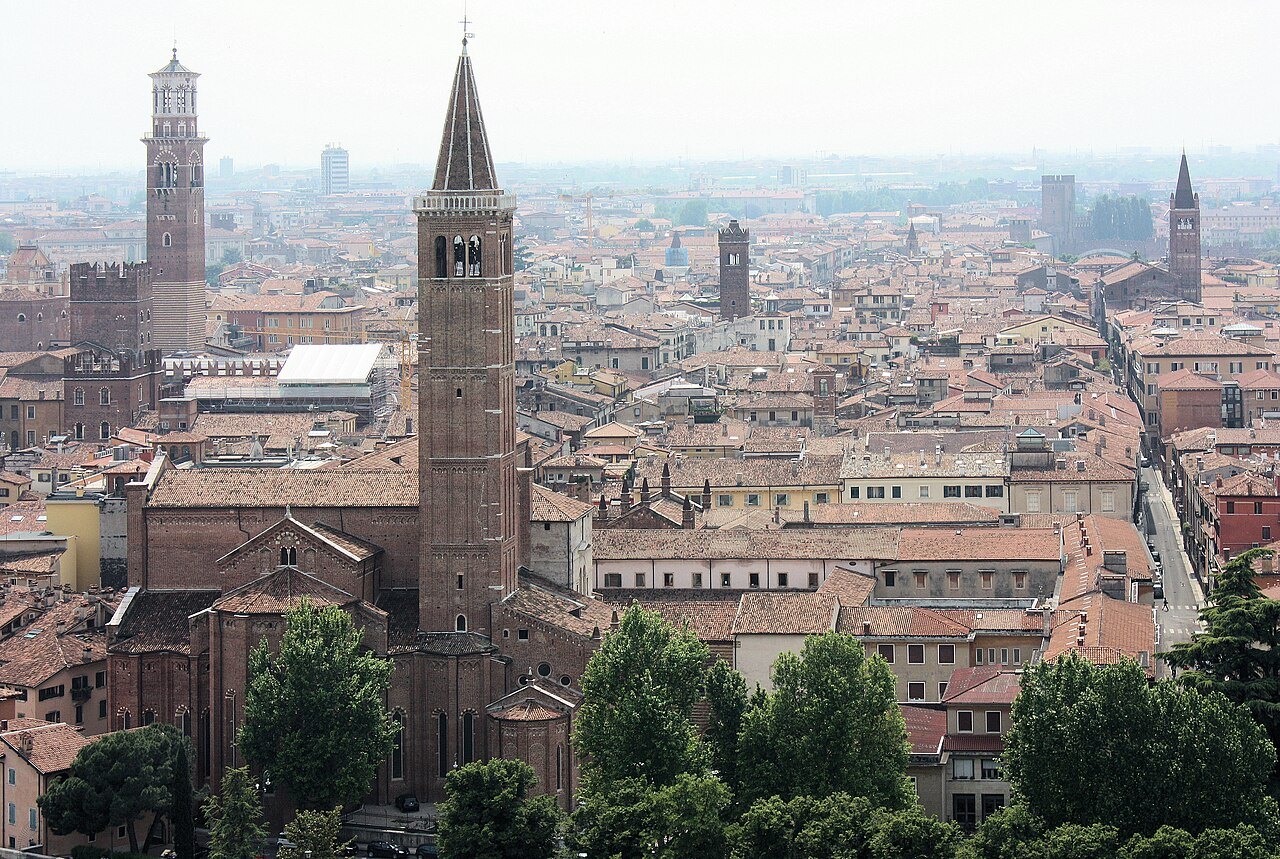
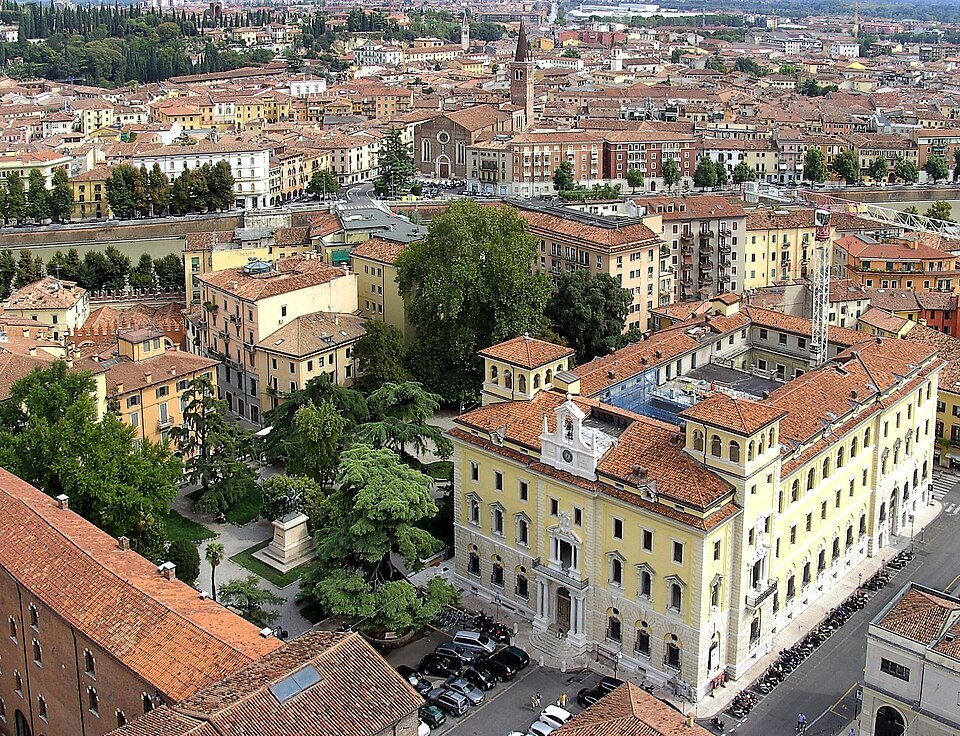
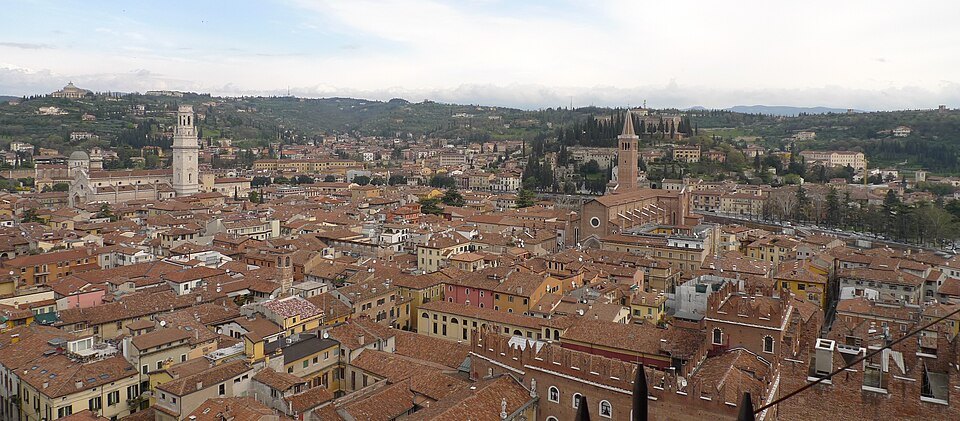
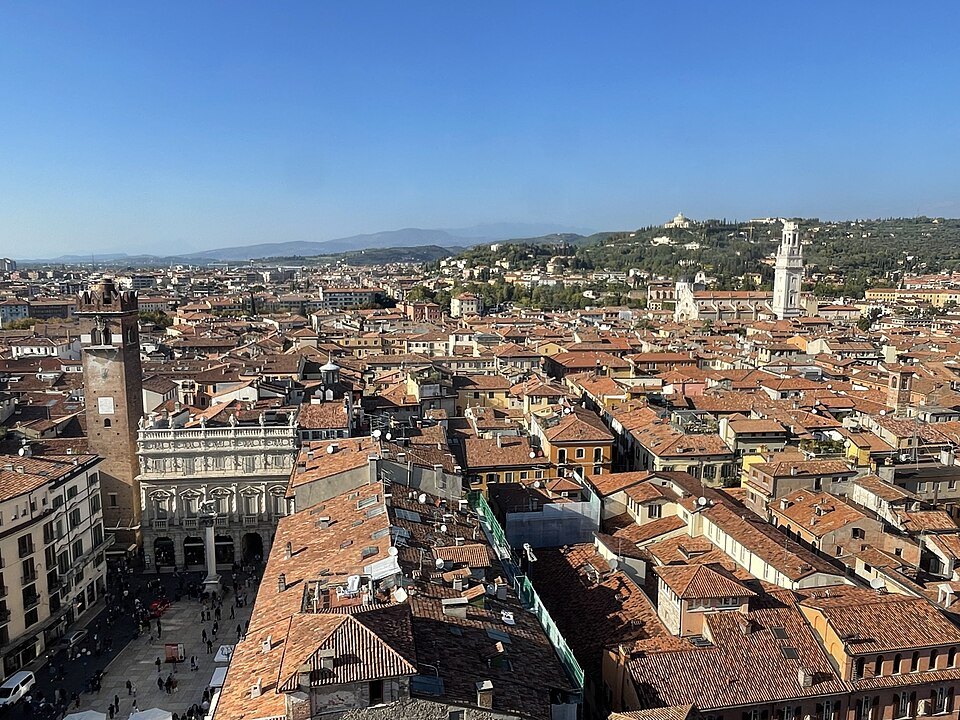
The terrace gives a full circle over the historic center. Directly below lie the market stalls of Piazza delle Erbe and the quieter rectangle of Piazza dei Signori. Beyond the roofs, the oval of the Arena stands out to the south, and the Adige curls around the old town.
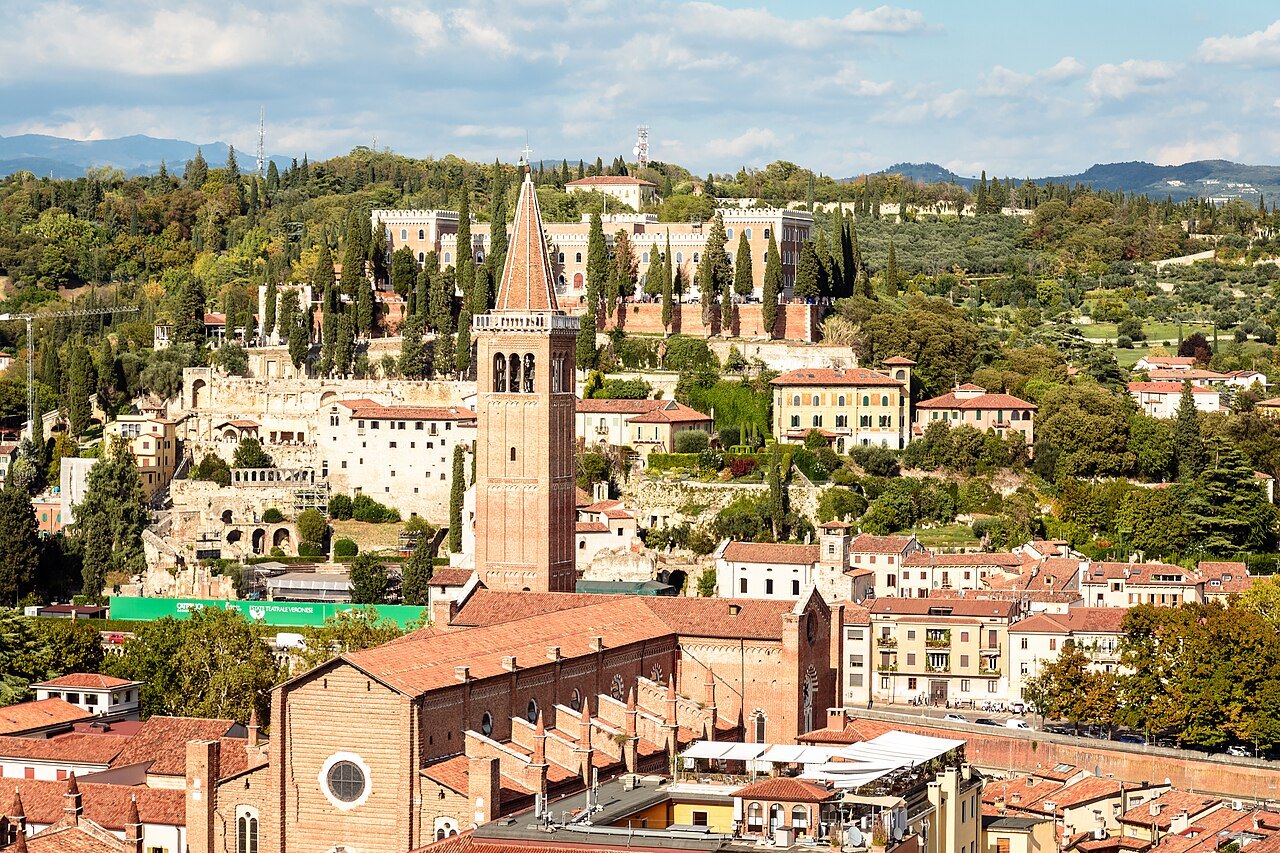
Across the river to the north-east, look for the stone arches of Ponte Pietra, the terraces of the Roman theater cut into the slope, and Castel San Pietro on the hill above it. On a clear day the mountains to the north close the horizon. The bells hang close to the viewing level, so their size is easy to judge from up here.
How to visit
Allow between half an hour and an hour, depending on whether you take the lift or the stairs and how long you stay at the top. The tower keeps a seasonal schedule and shuts on a handful of holidays, so check the official site for the day you plan to go rather than relying on a guidebook.
Note Anyone with limited mobility should ask at the entrance exactly how far the lift goes before paying. Clear weather matters more than anything else for the view; on a hazy day the hills disappear and the far landmarks flatten out, so it is worth keeping the climb flexible within your stay.
The tower sits at the center of the most compact sightseeing cluster in Verona. The Scaliger Tombs are a couple of minutes' walk beyond Piazza dei Signori, the baroque front of Palazzo Maffei closes the far end of Piazza delle Erbe, and the courtyard of Juliet's House is a short walk south-east.
Nearby
- Inside the loopPiazza delle ErbeThe long market square laid over Verona's Roman forum, crowded with stalls, painted houses, a Roman statue on…Read the page
- Inside the loopPiazza dei SignoriThe enclosed square where Verona was governed for centuries, ringed by linked palaces, a Renaissance council…Read the page
- Inside the loopThe Scaliger TombsThe Gothic tombs of the della Scala family, raised on canopies beside the little church of Santa Maria Antica…Read the page
- Inside the loopPalazzo MaffeiThe baroque palace that closes the end of Piazza delle Erbe, built over Roman Verona's temple and home to a…Read the page