Home · Sights · Castel San Pietro
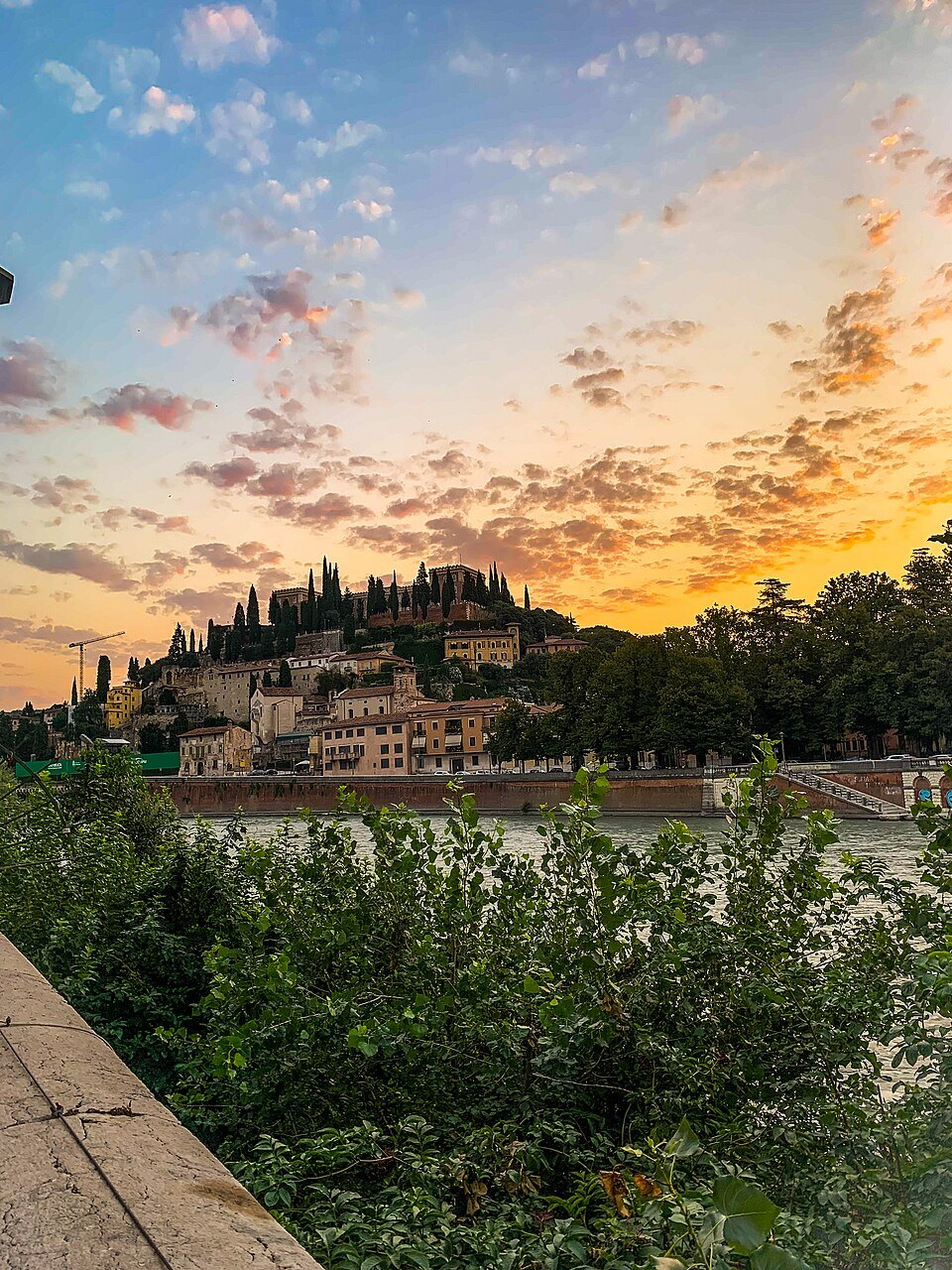
The hill above the Roman theater, crowned by Austrian barracks, where a terrace looks straight down on the river bend and the whole old city.
The parts to look at
- 1Foot of the stairsThe start of the stepped climb near Via Santo Stefano, just across Ponte Pietra
- 2Funicular valley stationThe lower station of the inclined lift on the left bank below the hill
- 3Museum stopThe funicular's intermediate stop, serving the Archaeological Museum above the Roman theater
- 4The terraceThe open esplanade in front of the barracks, looking south over the Adige and the city
- 5Austrian barracksThe long neo-Romanesque military building of the 1850s crowning the hill
- 6Castle wall remnantsStretches of older fortification that survived the demolitions of the nineteenth century
Along the Adige, in the order you meet them.
The best view of Verona
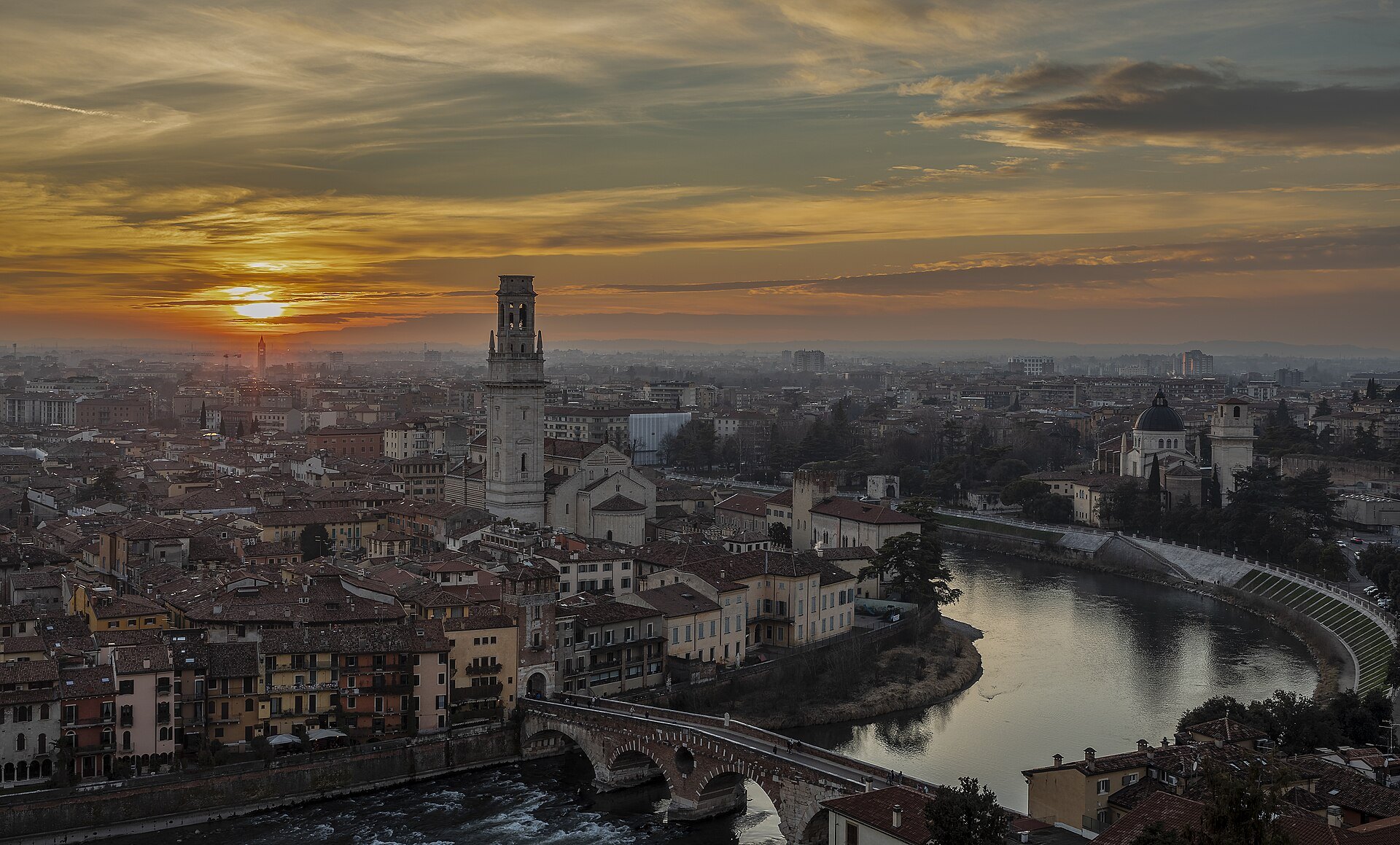
Castel San Pietro is the name of the hill across the Adige from the old city, and of the barracks on its top. The building itself is not part of a visit. What people climb for is the terrace in front of it, which looks straight down on Ponte Pietra, across the river bend and over the roofs, towers and domes of the centro storico.
Nowhere else shows so clearly why Verona grew where it did. The Adige wraps around the old city in a tight loop, and from up here the loop reads like a map: the bridges, the bell towers, the Arena and the hills beyond are all laid out at once.
A hill older than the city
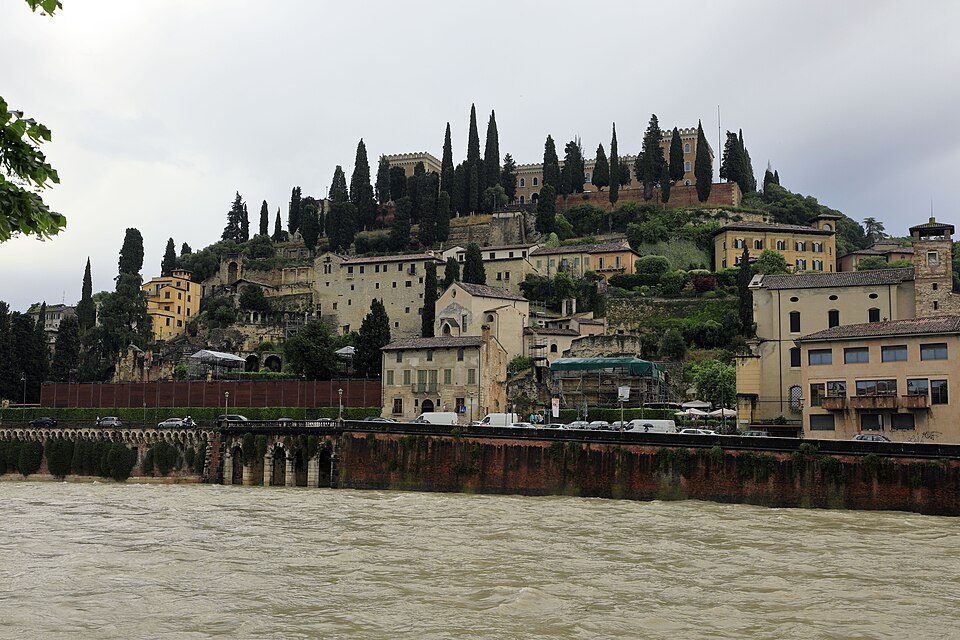
The Colle San Pietro was lived on long before Rome. Archaeological evidence points to settlement in the Iron Age, and the official tourism site dates the first inhabitants to the sixth and fifth centuries BC. In Roman times the hill carried a fortified sanctuary and a temple, with the Roman theater built into its lower slope.
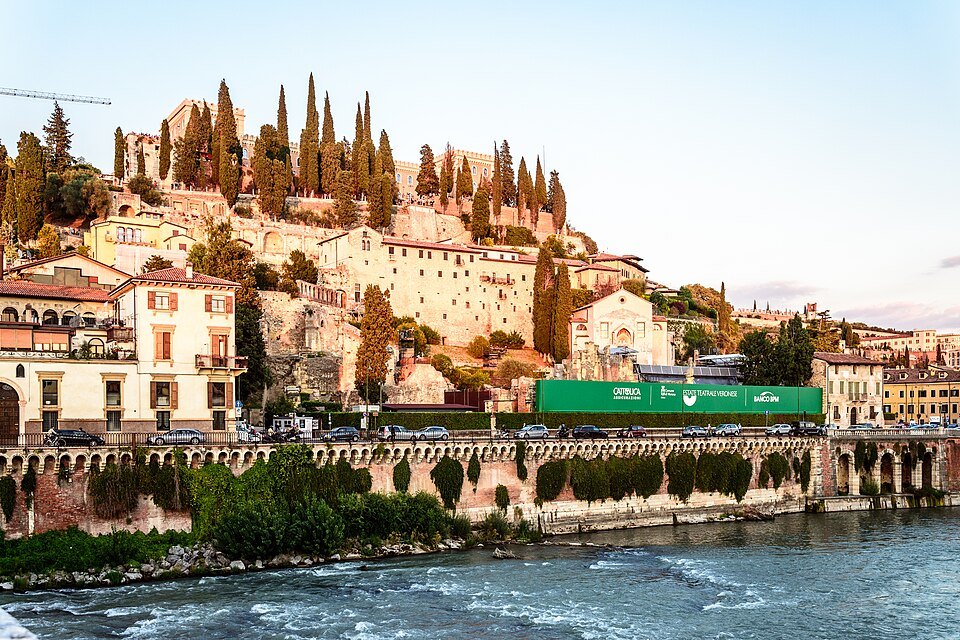
A church of San Pietro, first recorded by the eighth century, later rose where the temple had stood and gave the hill its name. Some sources say that Theodoric, the Ostrogothic king, and later the Lombard king Alboin kept palaces on the hill; the claim is repeated more often than it is documented, and nothing of that period stands out on the hilltop.
The Italian account says Berengar reorganized the fortress around 890. In the late fourteenth century Gian Galeazzo Visconti, lord of Milan, had a larger castle built over the older works; sources give both 1393 and 1398.
From castle to barracks
Venice kept the castle as a military post and extended its barracks. In 1801 Napoleonic troops mined it and destroyed most of the old buildings, and around 1840 the Austrians cleared much of what remained, including the church of San Pietro.
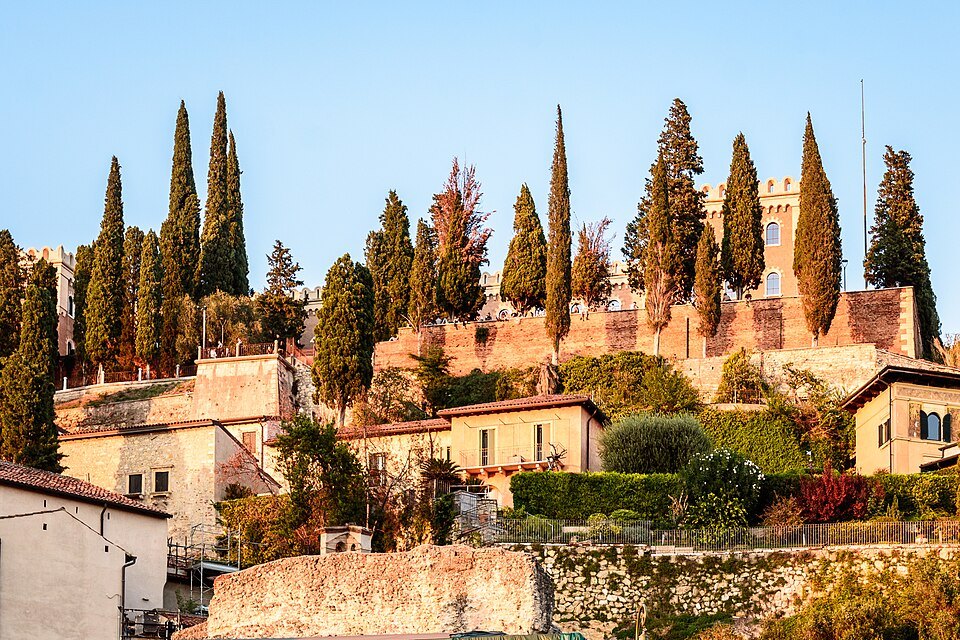
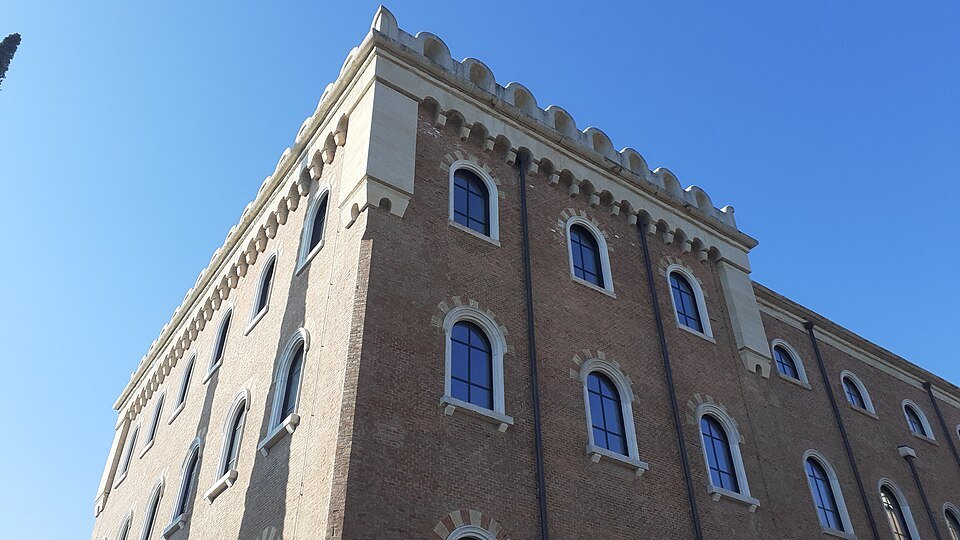
The present building is Austrian. It was put up in the 1850s as a fortified barracks, in the round-arched neo-Romanesque style that Austrian military engineers favored; sources differ on the exact years, giving dates from 1851 to 1858. The city of Verona has owned it since 1932.
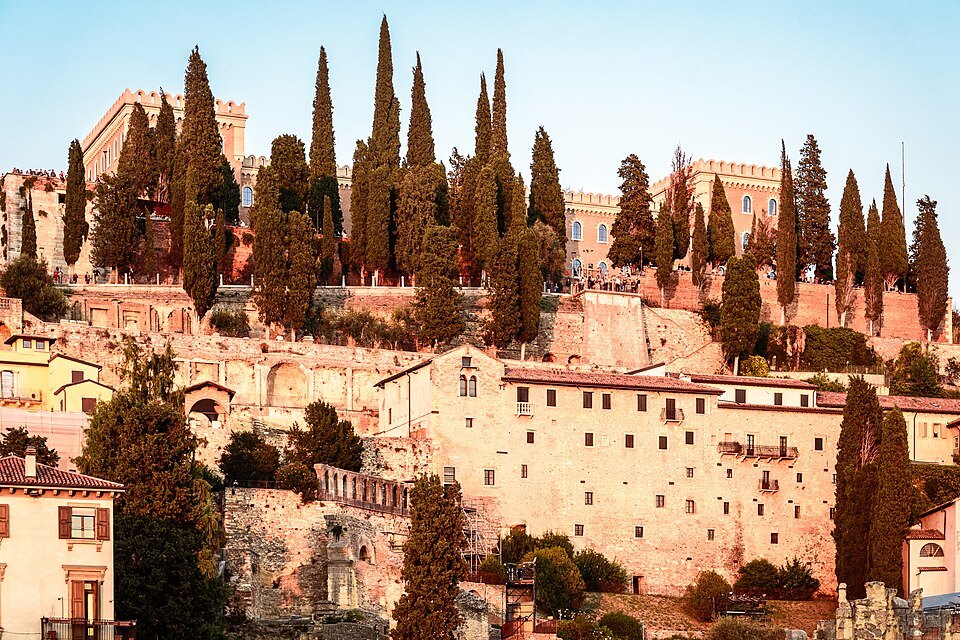
In the twentieth century it housed a welfare center, then the Cignaroli art academy from 1939 to 1949, and an orphanage until 1978. Restoration plans aimed at a new museum use have been discussed since 2002.
The funicular and the stairs
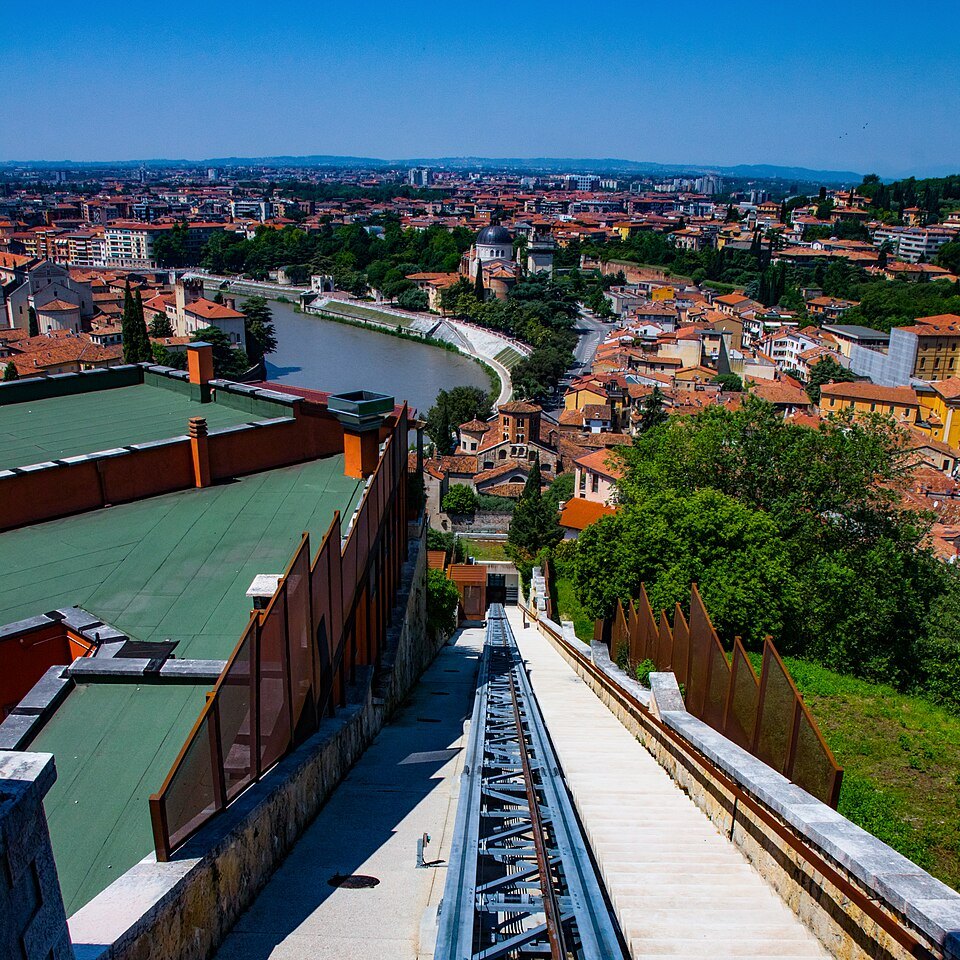
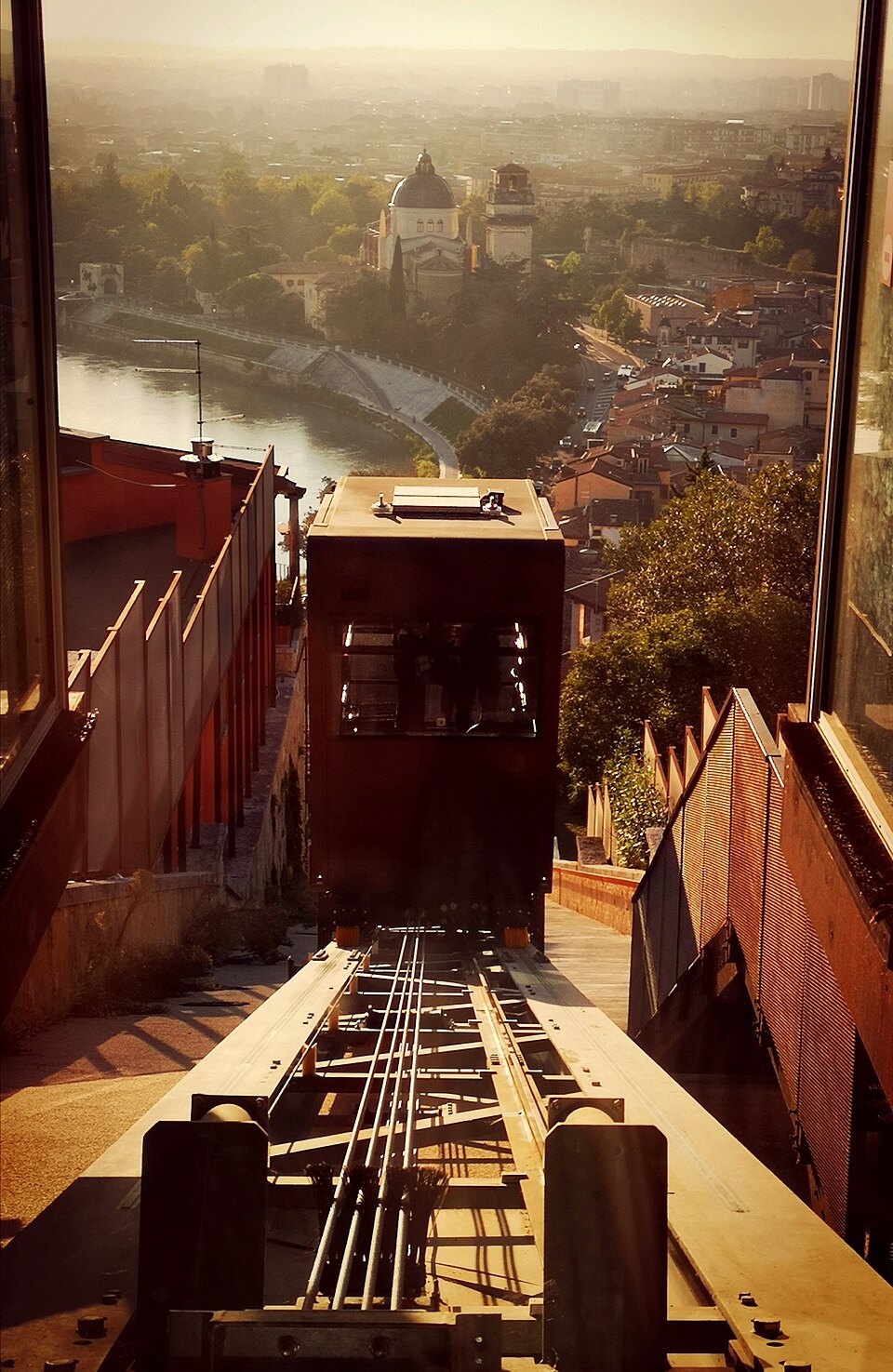
The first funicular was designed in 1939 to carry students up to the academy on the hill. It opened on 4 November 1941 and stopped in 1944, a casualty of the war. After decades of proposals, it was rebuilt as an inclined lift and inaugurated in June 2017.
The new line climbs about fifty-five meters over roughly a hundred and fifty-five meters of track, in a cabin that holds twenty-five people, and the ride takes little more than a minute. An intermediate stop serves the Archaeological Museum, and the lift is fully accessible to wheelchair users.
The alternative is the stepped path that starts near Via Santo Stefano, just after Ponte Pietra, and climbs beside the theater. It is steady rather than hard, and the view opens up at every turn, which is reason enough to walk at least one way.
What you actually see
From the terrace, the river runs directly below, with Ponte Pietra at the foot of the hill. Beyond it the old city fills the loop: look for the cathedral quarter nearest the water, the tall Torre dei Lamberti in the middle distance and the curve of the Arena further off.
Turn round and look at the barracks. Its long front and round-arched openings are a nineteenth-century idea of a medieval fortress, chosen by the Austrians as better suited to a military building than neoclassical dress. Pieces of older wall survive around the edges of the hilltop.
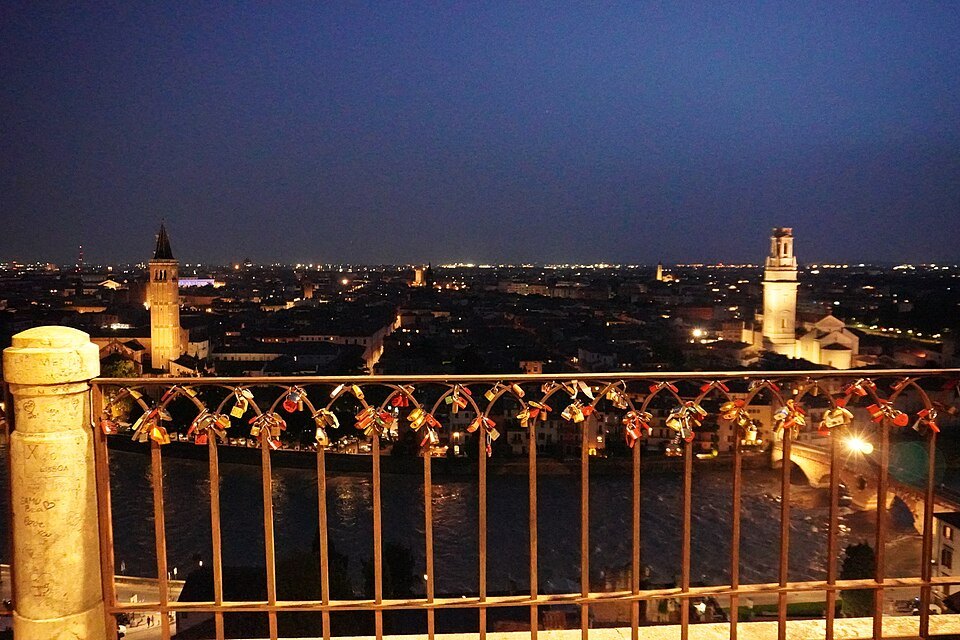
Because the city lies to the south and west of the hill, the late afternoon light falls across the roofs and the river from the far side, and the domes and towers warm to gold before dusk. After dark the bridges and embankments light up below.
How to visit
Allow forty-five minutes to an hour, including the climb and time on the terrace. It combines naturally with the Roman theater below and with Giardino Giusti, a short walk away on the same side of the river.
One efficient sequence: cross Ponte Pietra, visit the theater and the museum, then ride the funicular up from its lower station, and walk back down the steps with the view in front of you. Going down on foot is easier on the legs, and the city stays in sight almost the whole way.
Note The terrace is at its busiest in the hour before sunset, when people gather along the parapet for the light. Arrive early to find a place at the edge, and bring a torch or a phone light if walking down the steps after dark. The funicular runs to seasonal times, so check them before relying on it for the descent.
Nearby
- Over Ponte PietraThe Roman TheatreA Roman theater cut into the slope across the Adige, with a medieval church sitting in its seating and an…Read the page
- Over Ponte PietraPonte PietraVerona's oldest bridge, begun by the Romans and patched by every age since, then blown apart in 1945 and…Read the page
- Over Ponte PietraGiardino GiustiBehind a palace in Veronetta, a cypress avenue runs from box parterres and an old maze up to a grotto, a…Read the page
- Inside the loopThe DuomoVerona's cathedral complex layers a Romanesque church, a Titian altarpiece, a cloister, a baptistery and…Read the page