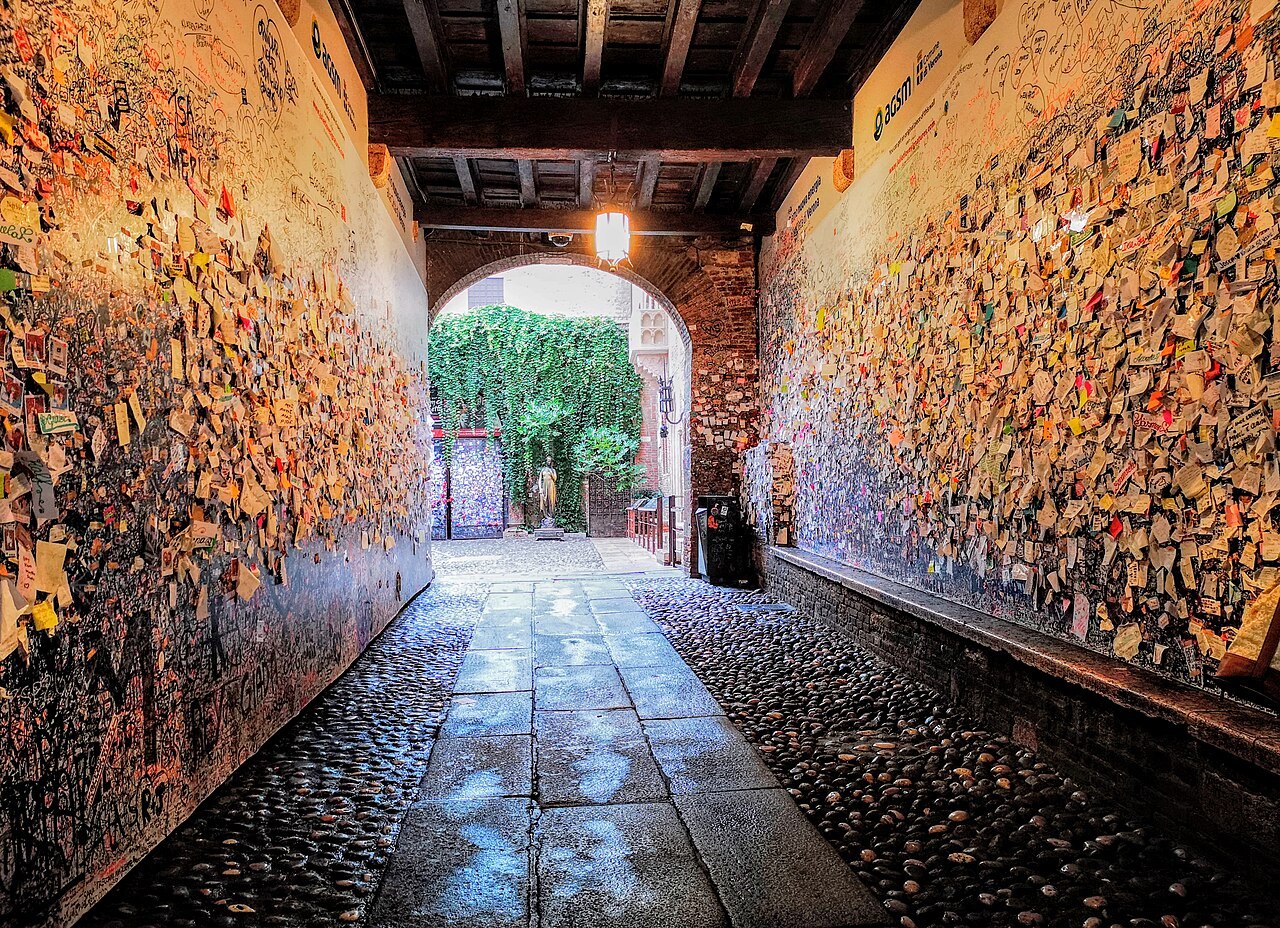
What the house is, and what it is not
The Casa di Giulietta, at Via Cappello 23, is a real medieval tower house, documented since 1351 and now run as a civic museum. What it is not is the home of a real Juliet. Romeo and Juliet are characters in fiction, and the building's link to them rests on literary tradition, not a record of anyone who lived there.
That is exactly what makes it interesting. Over several centuries Verona took a story set within its walls and gave it an address, a courtyard, a balcony and a statue. An hour inside shows how a city stages a legend, and the brick house underneath is worth seeing in its own right.
Where the story came from
The tale Shakespeare made famous reached him through Italian writers. Luigi da Porto wrote a novella about two noble lovers before 1524; it was published anonymously in Venice around 1531. He set it in Verona under Bartolomeo I della Scala, who ruled in the early 1300s, and he gave the lovers the names Romeo and Giulietta.
Da Porto drew on an earlier tale by Masuccio Salernitano and added much of what later readers recognized, including Mercutio, Tybalt, Friar Laurence and Paris. Scholars have noted that his Verona reads more like Udine, where he had lived through a love affair of his own, than like the real city of the Scaligeri.
Matteo Bandello retold the story some decades later, and from there it passed through other versions to Shakespeare, whose play the city's tourism office dates to 1596. The family names had a real echo: Dante mentions the Montecchi and the Cappelletti in the sixth canto of Purgatorio. That echo helped the legend attach itself to Verona's streets.
How the city built the scene
According to the tourism office, the house once served as an inn and was identified as the Capulets' house in the 18th century, when it began to draw romantic pilgrims. The city of Verona bought it in 1905. The decisive restoration came in the late 1930s under Antonio Avena, director of the city museums, who added the famous balcony.
The balcony is an assembly, not an original feature. The tourism office describes it as 14th-century marble fragments that until 1920 lay in the Castelvecchio museum as stones for reuse; Italian Wikipedia describes a 14th-century slab with new corbels, shaped to recall the hanging tombs of that century. Avena also redesigned the so-called Tomb of Juliet in a former 13th-century convent in 1937, shaping an ancient stone sarcophagus into the scene visitors expected.
The courtyard and the statue
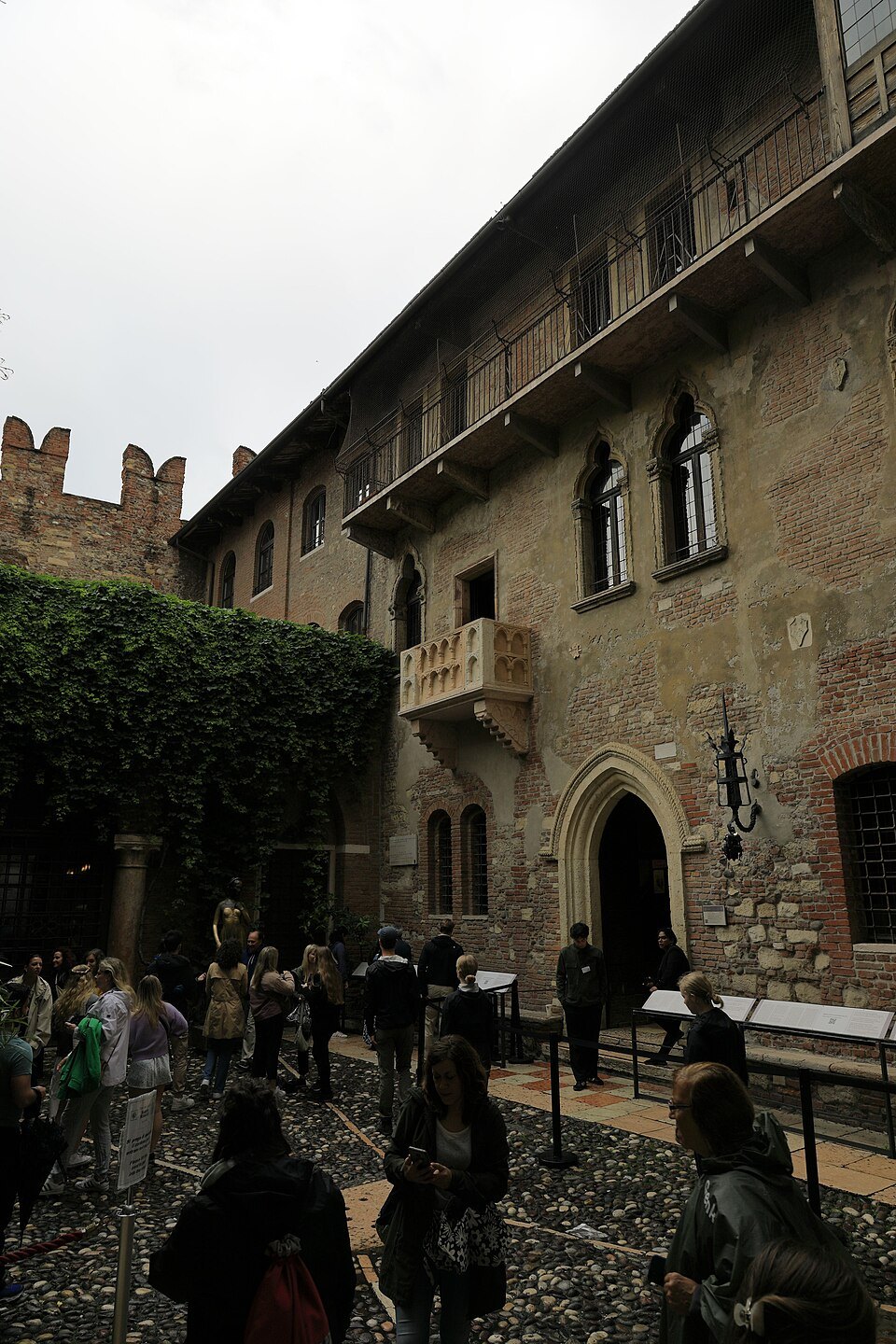
The courtyard is where most people stop. Its interior facade of exposed brick has a Gothic doorway, trefoil windows and a balustrade tying the parts of the house together, with the balcony above. The bronze Juliet below is by the sculptor Nereo Costantini, who the tourism office says drew on the statue of Madonna Verona in Piazza delle Erbe.
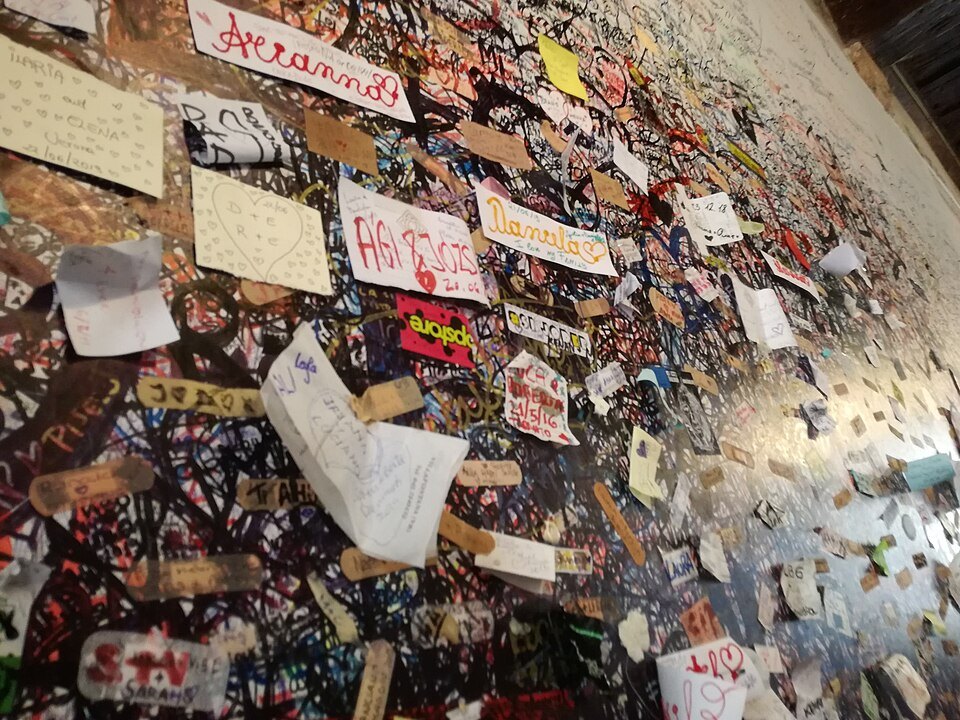
Sources give different dates for the statue, from the late 1960s to 1973, but agree on what followed. Visitors rubbed its right breast for luck in love until the bronze wore and cracked, and in 2014 a copy took its place while the original went indoors for conservation. Names written on the entrance walls, known as Juliet's wall, are part of the same habit.
Letters are another. Mail addressed to Juliet has reached Verona since the 1930s, and volunteers organized since the 1980s as the Club di Giulietta answer it, with funding from the city. By 2010 more than 5,000 letters were arriving each year, and the club inspired the film Letters to Juliet.
Inside the house
The rooms were given medieval-style decoration during the restoration and hold frescoes, engravings and 19th-century paintings of the legend, including Cosroe Dusi's Juliet and Romeo of 1838. There is a desk where visitors write messages to Juliet, and period furnishings fill out the floors.
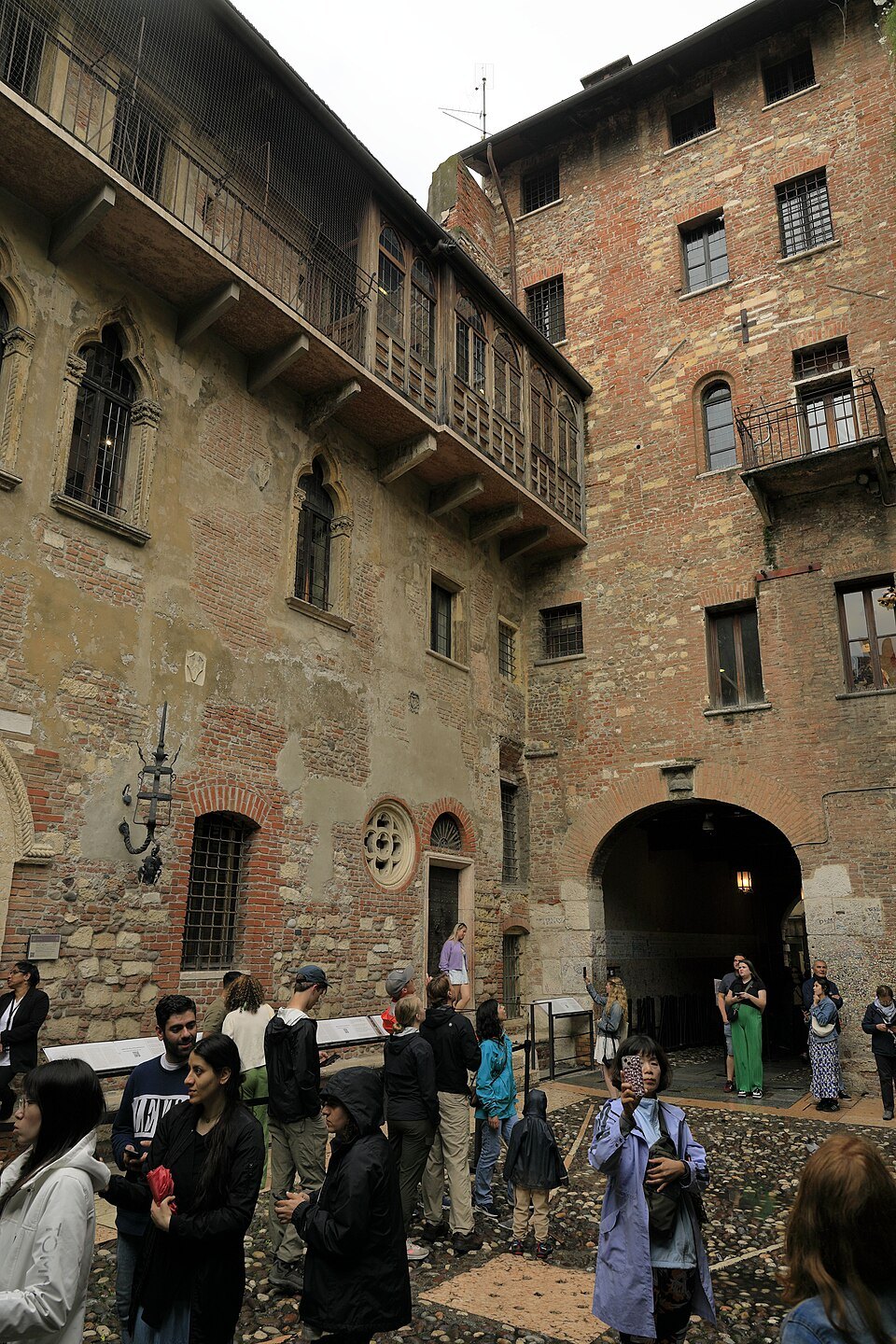
Film is the other thread. The house displays costumes from Franco Zeffirelli's 1968 Romeo and Juliet and the bed made for it, designed by Lorenzo Mongiardino. The balcony is reached from inside, and the upper rooms look out over the rooftops of the old town. Most visitors see the balcony from below; stepping onto it requires the ticket option that includes the house.
The house is among the most visited places in Verona, and its Capulet Hall is also used for civil wedding ceremonies. In hot spells the city has closed the upper floors while keeping the courtyard, the balcony floor and the floor above open, so check the museum notices before booking a summer slot.
How to visit in about an hour
Note Entry no longer works the way older guides describe. Under arrangements the city introduced in April 2026, the tourism office states that the courtyard and house are entered only through the Teatro Nuovo in Piazzetta Navona, tickets are sold only online through museiverona.com, and a timed booking is required even for free entry and VeronaCard holders. Check what each ticket option includes, since not every option reaches the house and balcony.
An hour covers the theater foyer, the courtyard, the rooms and a wait for the balcony. Slots can be limited on days with performances at the Teatro Nuovo, and the visit for people with limited mobility is restricted to the balcony floor. It pairs naturally with Piazza delle Erbe a few streets away; for how far ahead to book, see booking ahead. For an evening in the city afterwards, read what an opera night in the Arena is like, or head over the river for the view of the Adige loop.
Read next
- Castel San PietroWhere to stand for the view of the Adige loop in the morning and at sunsetThe terrace below Castel San Pietro looks across the Adige at the whole old town. How to get up, what you see, and how the light changes morning to dusk.Read
- The Opera SeasonWhat an evening of opera in the Arena is like, from the gates to the last actSeats, dress, bags, candles, rain delays and the walk out: how an opera night inside Verona's Roman amphitheater actually unfolds, step by step.Read