A fortress with its own bridge
Castelvecchio is the red-brick castle the della Scala family built on the right bank of the Adige in the fourteenth century, and it works as two sights at once. The walk across its bridge, the Ponte Scaligero, costs nothing and shows the castle at its most defensive. Inside the walls, the same building holds the Museo di Castelvecchio, one of the more important examples of twentieth-century museum design anywhere in Italy.

From the riverbank the castle reads as a long run of walls, towers and battlements, with a tall keep standing over the water. The bridge beside it mixes pale stone in its lower courses with red brick above, carried on pointed, pentagonal piers shaped to split the current. Its three arches are deliberately unequal in size, matched to how the river's flow divides at this bend of the Adige.
Cangrande II and a bridge built for escape
The castle was ordered by Cangrande II della Scala, with construction generally dated from 1354; he died in 1359, and the keep followed in 1376 under his successors. It was built to discourage ambitious neighbors such as Venice and the Gonzaga of Mantua, and just as much to protect the ruling family from its own subjects inside the city.
The bridge, raised most likely between 1354 and 1356, gave the lords of Verona a protected route out of the city toward the north if the population turned against them. Its largest arch spans just under forty-nine meters, a span some scholars consider the widest built anywhere in Europe at the time.
What the rebuilt battlements hide

On 24 April 1945, retreating German troops blew up the bridge. What stands today is a reconstruction, built between 1945 and 1951 using stone blocks recovered from the riverbed itself and new material cut from the original quarries. The crenellations, the brickwork, the pointed piers: all of it looks medieval because it largely is medieval, pieced back together rather than invented from scratch.
That history is worth keeping in mind while crossing. The walkway is narrow and the parapet merlons are uneven underfoot, so this is not a bridge to cross while looking only at a phone screen. On summer weekends it fills with groups stopping for photographs; an early crossing or one near dusk is calmer and gives a clearer view down the Adige.
From arsenal to barracks to museum
Under Venetian rule the castle held the castellan's residence, an arsenal, an armory and a powder store, with prison cells inside the keep. From 1759 it became a military engineering college. French troops occupying the city between 1802 and 1805 turned it into an arsenal outright, demolishing several buildings inside the walls, including a chapel, and Austrian forces kept it as barracks through most of the nineteenth century.

The city restored Castelvecchio in a deliberately medieval style during the 1920s and opened it as a museum, built around roughly two hundred works that the painter Saverio Dalla Rosa had rescued from Napoleonic dispersals. From 1956 the museum's director, Licisco Magagnato, brought in the architect Carlo Scarpa, whose redesign began in 1958 and continued in phases into the 1970s.
Carlo Scarpa's museum inside the walls
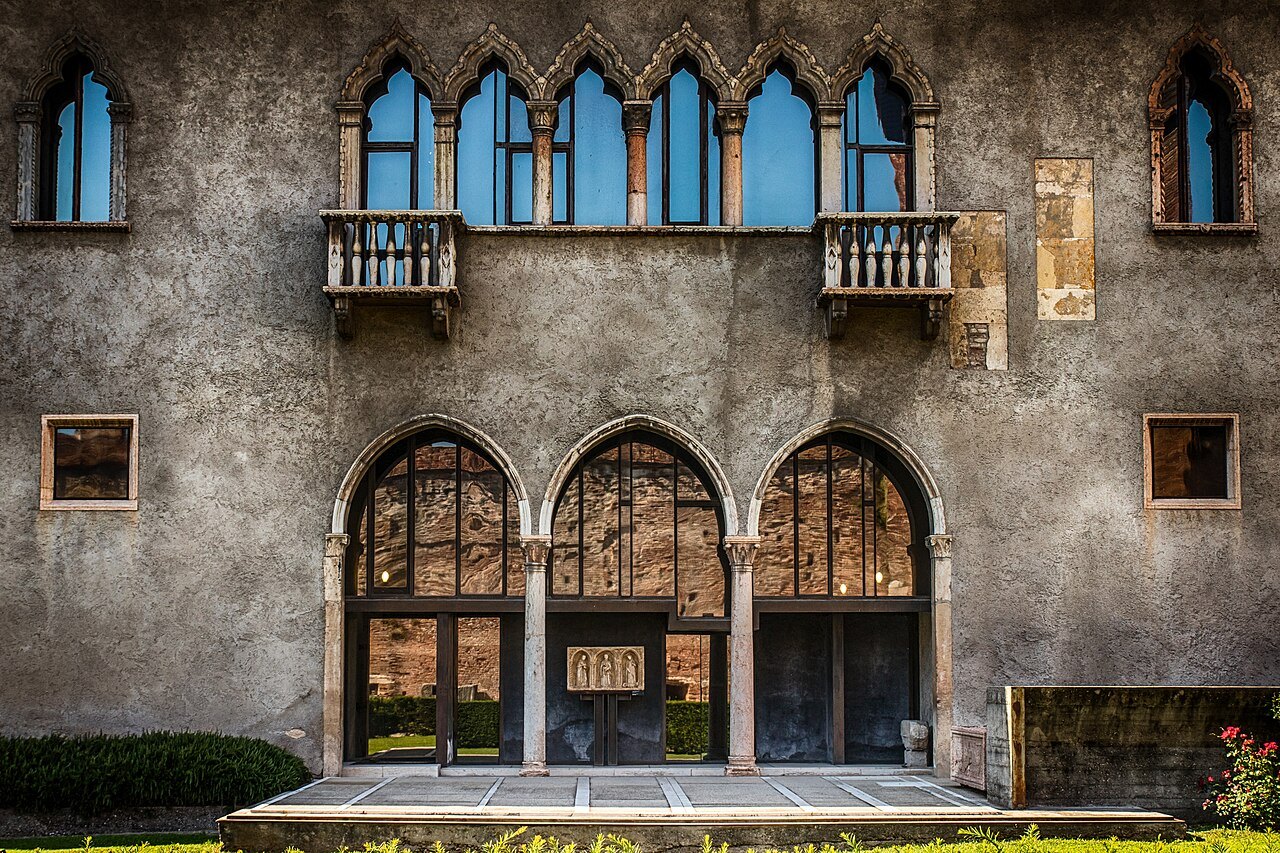
Scarpa treated the castle and its collection as a single project rather than a building with objects placed inside it. He stripped away later additions that obscured the medieval structure, exposed older masonry where he found it, and combined stone, wood and plaster with raw concrete and steel. The museum still holds more than six hundred of his drawings for the scheme.
The clearest expression of his method is the equestrian statue of Cangrande I della Scala, lord of Verona from 1309 to 1329 and host to Dante during his exile, a connection also traced at the Scaliger tombs. Taken down from the tombs in 1909, the statue spent years standing almost unseen in a courtyard. Scarpa raised it on a concrete support about seven meters high, set at the point where two stretches of medieval wall meet, so it comes into view again and again from different floors and walkways as visitors move through the museum.
What to look for room by room
The ground-floor sculpture gallery holds Romanesque and Gothic stonework, including a fourteenth-century crucifix carved in tuff by the Master of Sant'Anastasia. Each piece stands on a base Scarpa designed specifically for it, often angled so that side light falls across the carving rather than flattening it.

Upstairs, the painting galleries occupy the former barracks, with canvases hung from iron rods rather than fixed flat to the wall. The ceiling color shifts from room to room; the last gallery, devoted to eighteenth-century painting, has a cobalt-blue ceiling drawn from the paintings of Luca Giordano hung beneath it. Among the collection are Pisanello's Madonna of the Quail and works by Jacopo Bellini and Mantegna, along with medieval arms and armor, a sword associated with Cangrande, ceramics, jewelry and a coin cabinet.
In November 2015 an armed robbery took seventeen paintings from the museum, including works by Rubens, Tintoretto and Mantegna. Ukrainian border guards recovered them near Odesa in May 2016, and the paintings returned to Verona by the end of that year, a reminder that the collection behind Scarpa's walkways is not simply a backdrop to the architecture.
Planning the visit
Allow about ten minutes for the bridge and the courtyard, and closer to two hours for the museum, more if Scarpa's design is the main reason for the trip. The collection runs across roughly thirty rooms linked by stairs and wall walkways, so wear shoes suited to uneven stone floors. Civic museums in Verona share a weekly closing day, so check the museum's own calendar before setting out; for general timing across the city, see when to come.

Castelvecchio sits on Corso Castelvecchio, a short, straight walk from Porta Borsari, and a riverside walk of about twenty minutes continues on to San Zeno. Anyone building a day around Roman and medieval Verona together can treat the castle as one stop on a longer route; see Roman Verona for the bridges and gates that sit alongside it along the river.
Read next
- Ponte PietraHow Ponte Pietra was pulled out of the Adige stone by stone and put back togetherHow Verona's oldest bridge was blown up in 1945 and rebuilt from its own recovered stones.Read
- The Scaliger TombsReading the Scaliger Tombs, from Cangrande's rider to the iron ladders in the railingsA guide to the della Scala family tombs beside Santa Maria Antica, from Cangrande's rider to the ironwork in the railings.Read
- Castel San PietroWhere to stand for the view of the Adige loop in the morning and at sunsetThe terrace below Castel San Pietro looks across the Adige at the whole old town. How to get up, what you see, and how the light changes morning to dusk.Read