Two ways to the same terrace
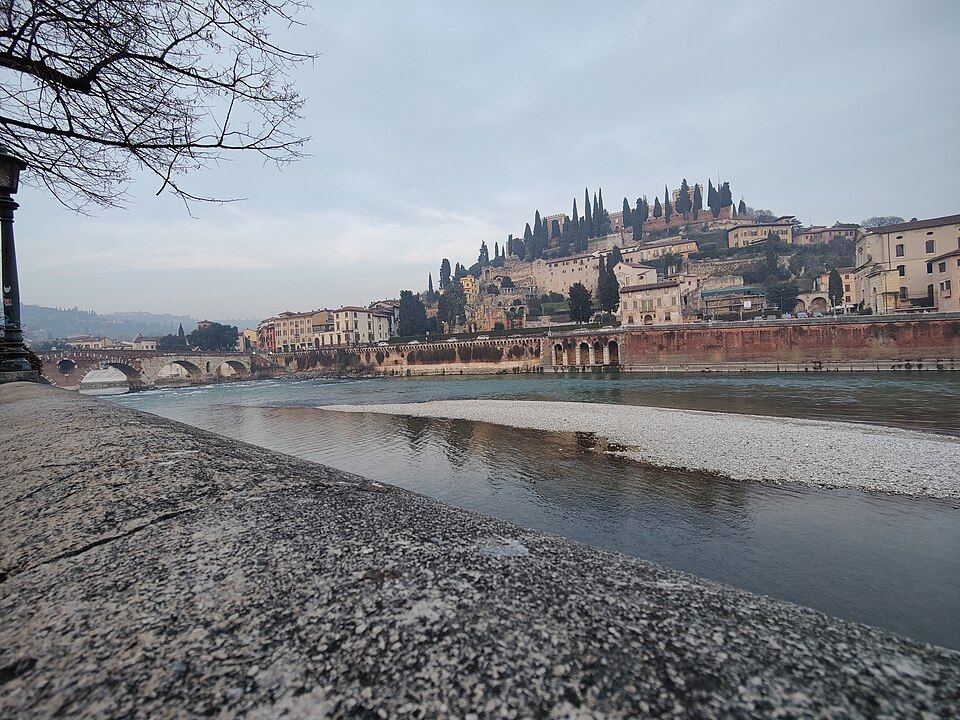
Castel San Pietro sits on the hill across the Adige from the old city, and nearly everyone who goes up is heading for the same thing: the terrace in front of the barracks building, with its view straight down the river bend and over the rooftops of the centro storico. There are only two ways to get there. One is the inclined lift that climbs the hillside in about a minute. The other is a stepped path that starts near Via Santo Stefano, just after crossing Ponte Pietra, and climbs beside the Roman theater.
Taking the steps instead of the lift is not a hardship. The path is steady rather than steep, broken into flights with landings, and it never stops offering a reason to pause. Anyone with ordinary mobility can manage it without strain, and the walk down is considerably easier than the walk up, which is worth keeping in mind when deciding which direction to use the stairs for.
Where the path starts and where it leads
The stepped route begins on the north bank of the river, a short walk from the bridge, in the small knot of streets below the hill. From there it climbs in the open, with the Roman theater just below and to one side, before switching back through trees and old retaining walls toward the top. There is no ticket and no gate; the path is simply there, part of the public street network of that side of the city.
The climb gains roughly the same height as the funicular line covers, somewhere in the range of fifty meters over the course of the ascent, though the stepped path takes a longer and more winding line than the lift's straight run. Because it climbs in the open rather than inside a cabin, the view builds gradually rather than arriving all at once at the top, which is part of the appeal of choosing to walk.
What appears on the way up
The lower stretches of the path run close to the Roman theater, visible below through gaps in the trees, and a little further up the Archaeological Museum comes into view, housed in a former convent built into the hillside. Neither requires a detour; both are visible from the path itself, and either makes a natural stop before or after the climb for anyone wanting to see the stage and seating up close rather than from above.
Higher up, the path passes sections of older wall, worn and patched, which hint at the long history of fortification on this hill without explaining themselves. The Colle San Pietro was settled well before Rome, carried a Roman temple and fortified sanctuary, and was rebuilt as a castle under Gian Galeazzo Visconti in the late fourteenth century before Venice, then Napoleonic troops, then Austria each left their mark on what stood here. The fragments along the path are what is left of that long sequence of building and demolition.
Comparing the steps with the funicular
The funicular that now serves the hill is a modern inclined lift, inaugurated in 2017 after decades of proposals to replace the one that opened in 1941 and was lost to the war only a few years later. It covers the same climb in a glass cabin holding up to twenty-five people, stopping partway at the Archaeological Museum, and it is fully accessible to wheelchair users, which the stepped path is not.
For a visitor without mobility concerns, the two options are less a matter of practicality than of preference. The lift is faster and effort-free; the steps are slower but let the city unfold gradually rather than appearing suddenly at the top. A common approach is to use one for the ascent and the other for the descent, so that the climb is not wasted twice over and the walk down, which is gentler on the legs than the climb up, comes with the view already in front of it.
The view that both routes are for
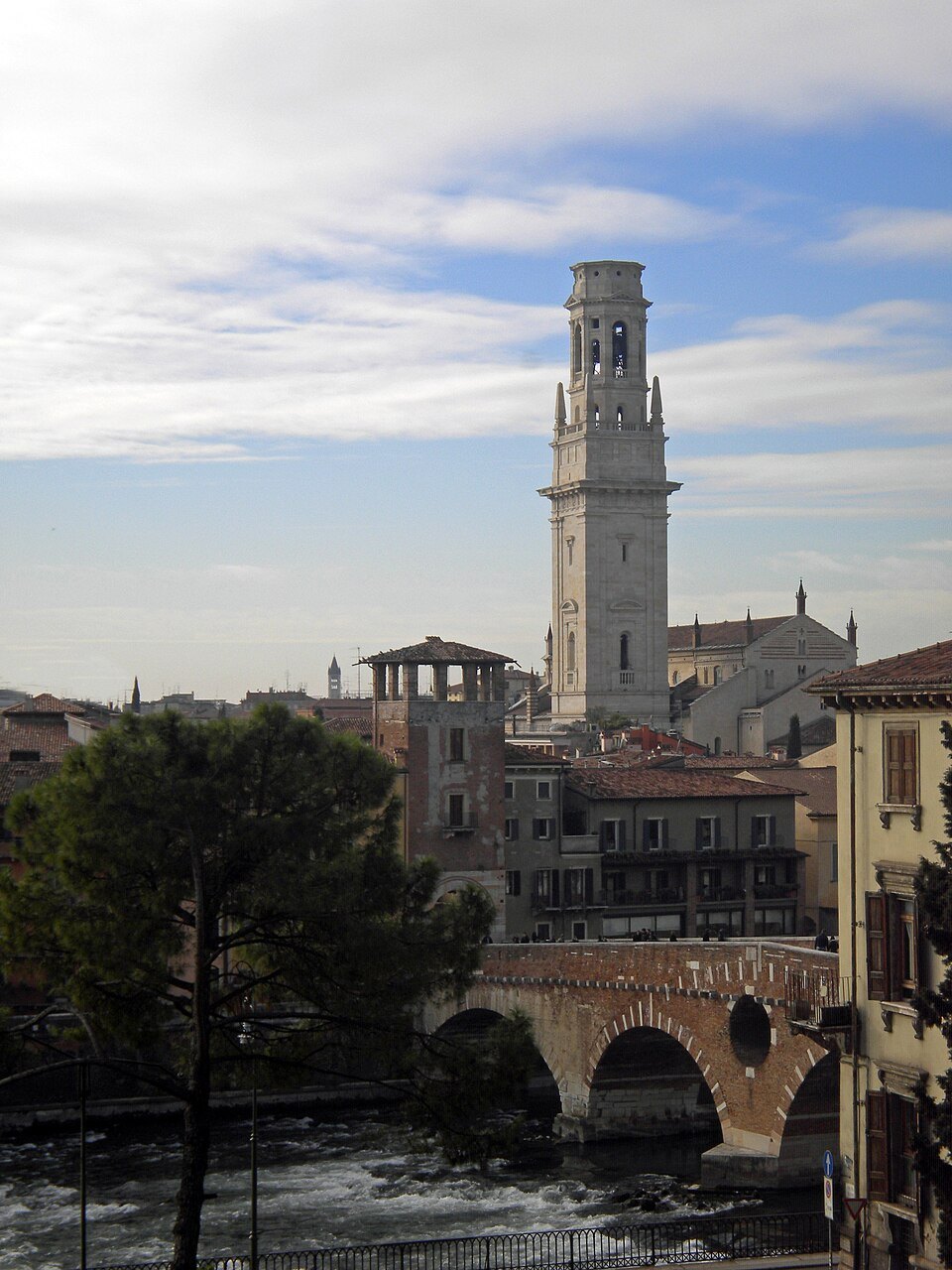
Whichever way a visitor arrives, the terrace in front of the barracks is the point of the climb. The Adige wraps tightly around the old city below, and from this height the loop reads like a map: Ponte Pietra directly underfoot, the cathedral quarter nearest the water, the Torre dei Lamberti rising in the middle distance, and the curve of the Arena further off toward the edge of the center. Few other points in Verona show so plainly why the city grew exactly where it did.
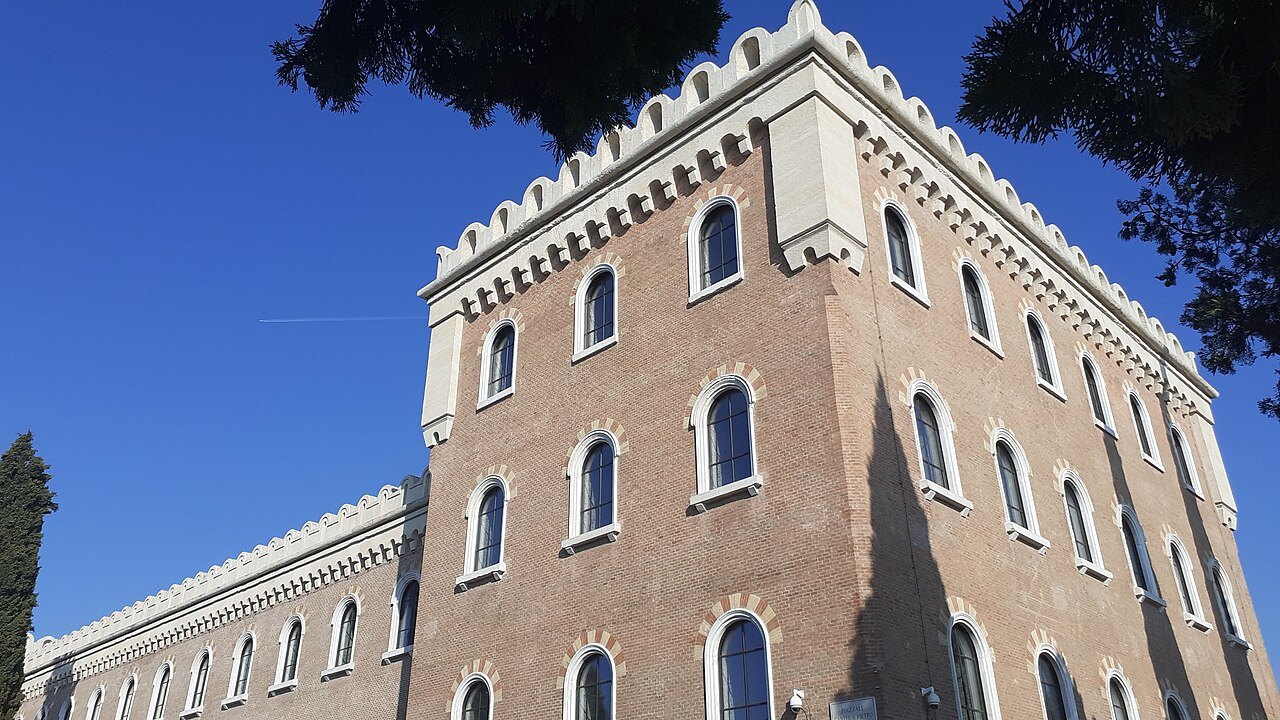
Turning away from the river, the barracks building itself is worth a look. Its long front and round-arched windows are a nineteenth-century Austrian idea of a medieval fortress, built in the 1850s after Napoleonic troops had mined the earlier castle and Austrian engineers had cleared most of what survived. The building is not open for visits; the terrace in front of it is what people come for, and the city of Verona has owned the site since 1932.
Choosing a time to climb
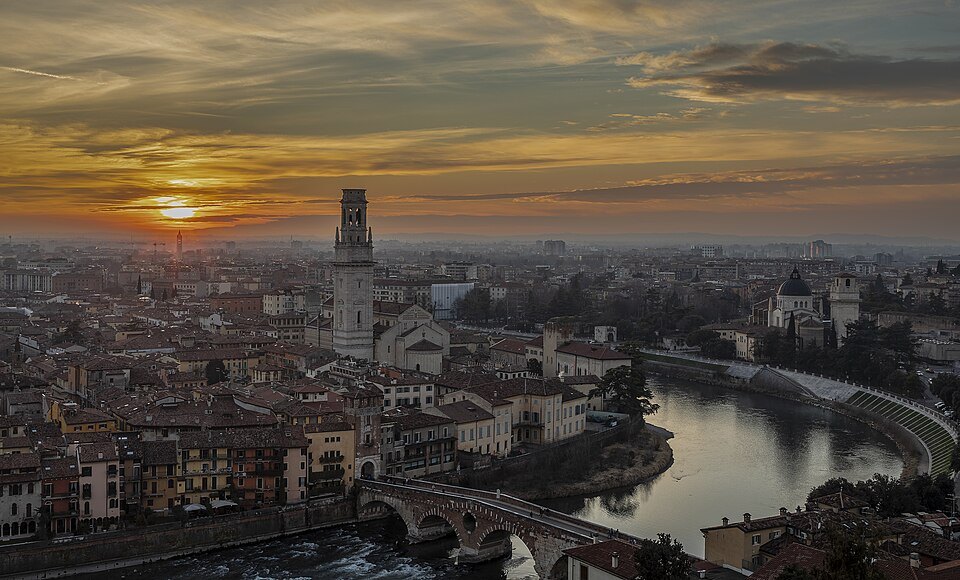
Light matters more here than at most viewpoints in the city. Because the old town lies to the south and west of the hill, the late afternoon sun crosses the roofs and the river from the far side, and the towers and domes take on a warm color before dusk. That hour before sunset is also when the terrace is busiest, with visitors lining the parapet for the same light, so arriving early secures a place at the edge rather than a view over other people's shoulders.
Anyone planning to walk down the steps after dark should bring a torch or a phone light, since the path is not consistently lit. The funicular runs to seasonal schedules rather than a fixed daily timetable, so it is worth checking current times with the operator before counting on it for the way down, particularly later in the day.
Making the climb part of a longer visit
Allow somewhere between forty-five minutes and an hour for the round trip, including time at the top, more if the Roman theater or the museum are added to the outing. The hill combines naturally with a visit to the theater at its foot and with Giardino Giusti, a short walk away on the same side of the river, making this whole quarter an easy half-day loop on foot.
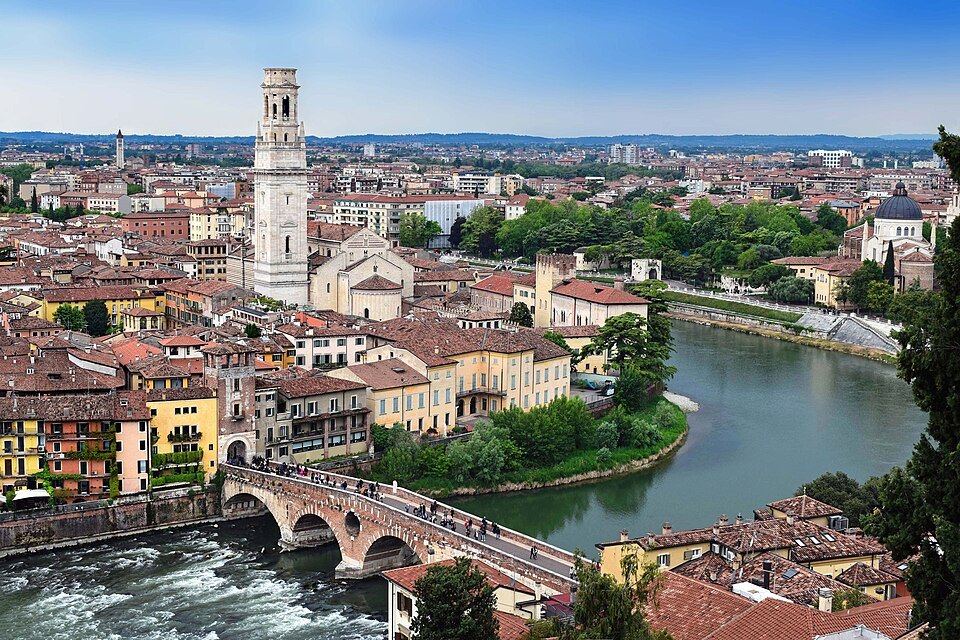
One practical sequence: cross Ponte Pietra from the old city, see the theater and museum at the base of the hill, climb the steps while the light is still good, and either ride the funicular down or retrace the path on foot. Either way, this is one of the few places in Verona where the climb itself, not just the summit, is worth doing slowly.
Read next
- Castel San PietroWhere to stand for the view of the Adige loop in the morning and at sunsetThe terrace below Castel San Pietro looks across the Adige at the whole old town. How to get up, what you see, and how the light changes morning to dusk.Read
- The Roman TheatreGoing to a summer play or concert in the Roman Theater above the riverHow to visit Verona's Roman theater by day and return for a summer play or concert on the modern stage above it.Read
- Ponte PietraHow Ponte Pietra was pulled out of the Adige stone by stone and put back togetherHow Verona's oldest bridge was blown up in 1945 and rebuilt from its own recovered stones.Read